Plug-in hybrid cars (PHEVs) are gaining traction in South Africa as of 2026, offering a mix of electric and gasoline power for efficiency and flexibility. They are ideal for daily commutes using electric power while retaining a petrol engine for long trips. With electric ranges now reaching up to 150 km (93 mi) in newer models, these vehicles cater to a variety of needs, from affordability to luxury performance.
Key Highlights:
- BYD Sealion 5 DM-i: Budget-friendly at R639,900 (~$35,500 USD) with a 70+ km (43+ mi) electric range and 1.2 L/100 km (~196 mpg) fuel economy.
- Haval H6 GT PHEV: R799,900 (~$44,400 USD) with 180 km (112 mi) electric range and 0.8 L/100 km (~294 mpg).
- OMODA C9 PHEV: R999,000 (~$55,500 USD), offering 150 km (93 mi) electric range and 440 kW (590 hp) power.
- BMW X1 xDrive30e: R1,050,000 (~$58,300 USD), with 78 km (48 mi) electric range and 1.1 L/100 km (~214 mpg).
- BMW X3 30e xDrive: R1,282,000 (~$71,200 USD), featuring 81–90 km (50–56 mi) electric range and 1.1 L/100 km (~214 mpg).
Quick Comparison:
| Model | Price (Starting) | Power Output | Electric Range | Fuel Economy | Vehicle Class |
|---|---|---|---|---|---|
| BYD Sealion 5 DM-i | R639,900 (~$35,500) | 160 kW (215 hp) | 70+ km (43+ mi) | 1.2 L/100 km (~196 mpg) | Compact SUV |
| Haval H6 GT PHEV | R799,900 (~$44,400) | 321 kW (430 hp) | 180 km (112 mi) | 0.8 L/100 km (~294 mpg) | Midsize SUV |
| OMODA C9 PHEV | R999,000 (~$55,500) | 440 kW (590 hp) | 150 km (93 mi) | 1.4 L/100 km (~168 mpg) | Midsize SUV |
| BMW X1 xDrive30e | R1,050,000 (~$58,300) | 240 kW (322 hp) | 78 km (48 mi) | 1.1 L/100 km (~214 mpg) | Compact SAV |
| BMW X3 30e xDrive | R1,282,000 (~$71,200) | 220 kW (295 hp) | 81–90 km (50–56 mi) | 1.1 L/100 km (~214 mpg) | Midsize SAV |
These vehicles address concerns like range anxiety and fuel costs while offering a variety of options for different budgets and preferences.
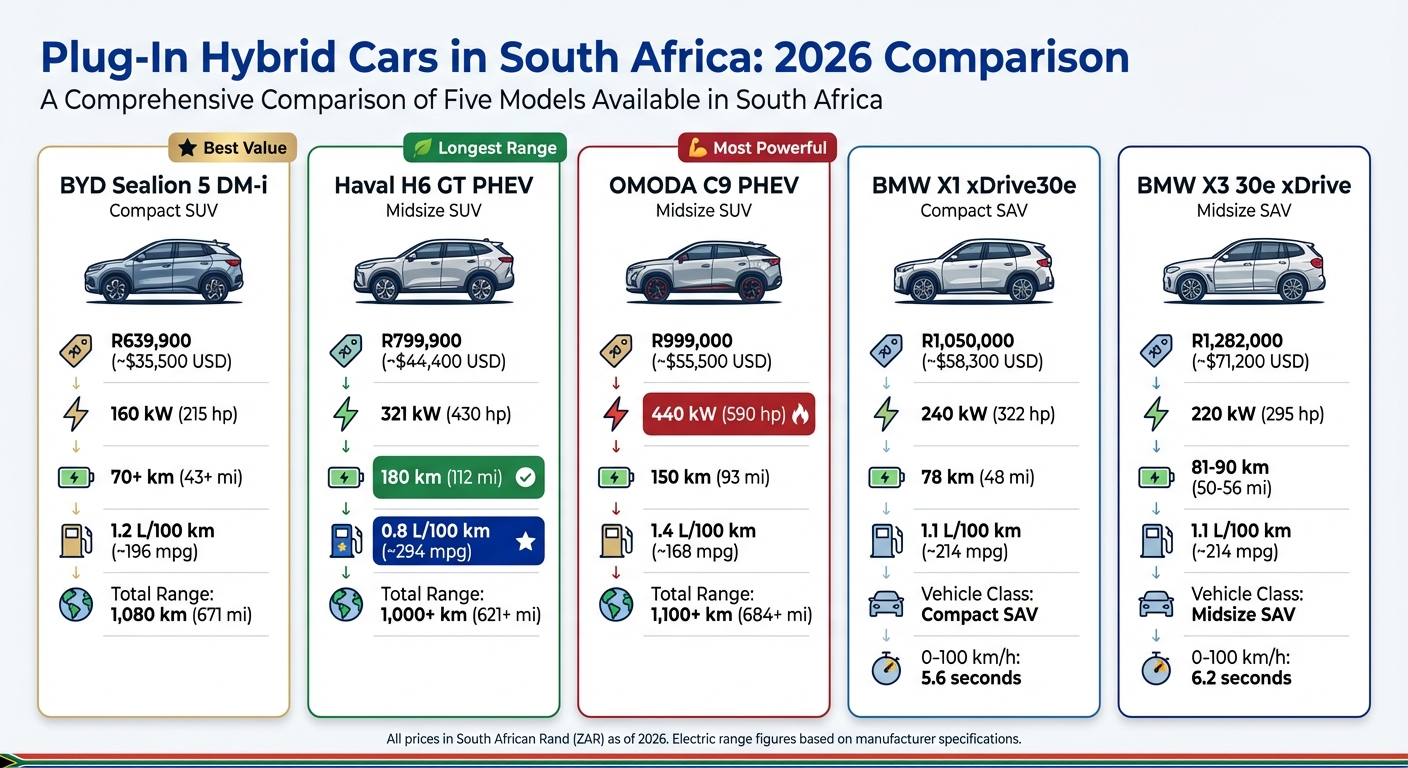
South Africa PHEV Comparison 2026: Price, Range, Power & Efficiency
BYD Sealion 5 Launch Review | The cheapest PHEV in SA with 1000km Range!
1. BYD Sealion 5 DM-i
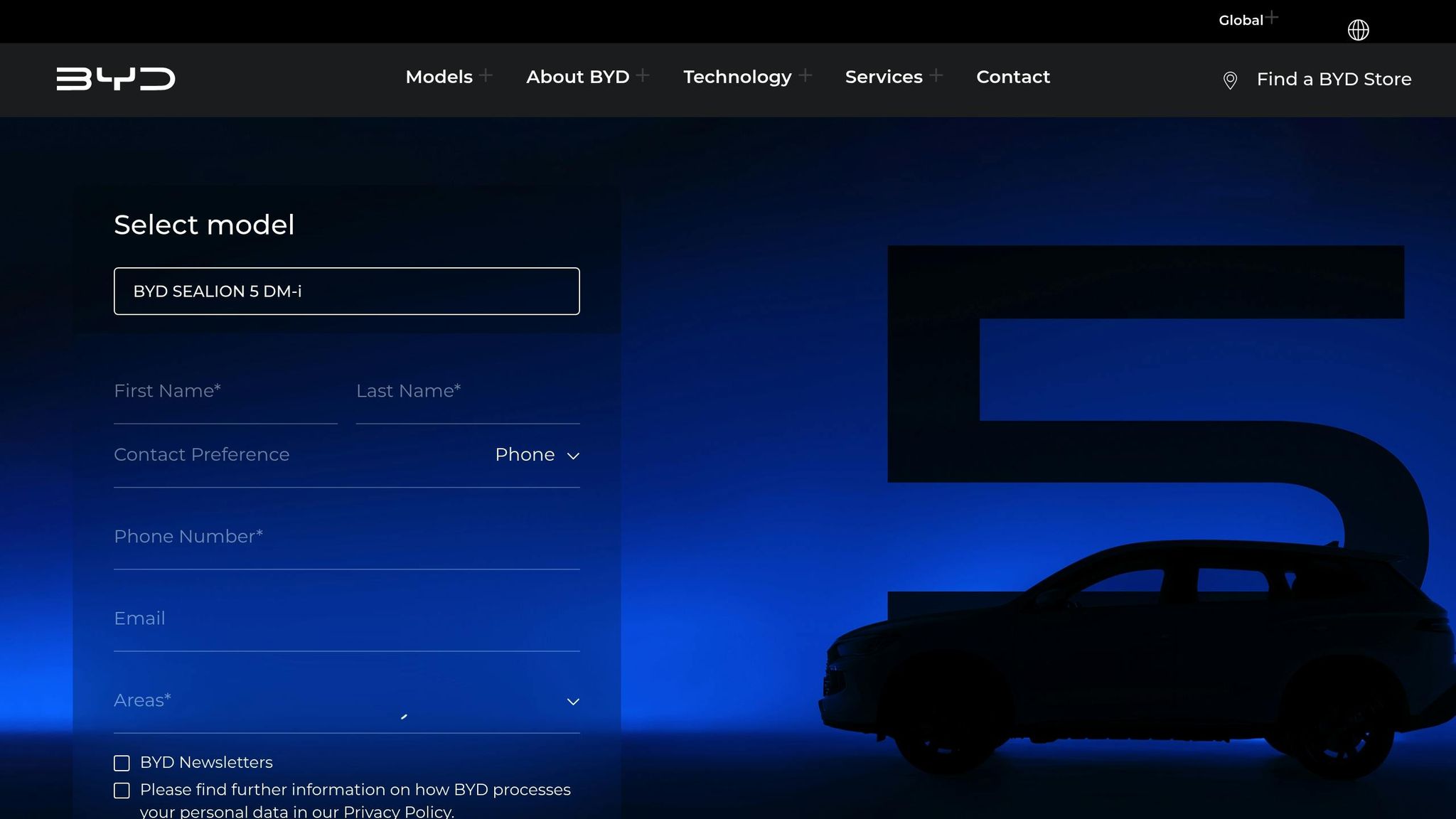
The BYD Sealion 5 DM-i, launched on December 6, 2025, holds the title of the most budget-friendly plug-in hybrid in South Africa. It measures 4,738 mm (186.5 in) in length, offering plenty of room for families and their gear. Let’s dive into its performance, electric range, and fuel efficiency.
Power Output
Powered by BYD’s Super DM technology, this hybrid combines a high-efficiency Xiaoyun hybrid engine with dual high-speed electric motors. The base model generates 160 kW and reaches a top speed of 170 km/h (106 mph). For those who crave more power, the AWD version accelerates from 0 to 62 mph (0–100 km/h) in just 5.9 seconds. The system is designed to optimize energy use – relying on electric power for city driving and switching to the hybrid engine for highways.
Electric Range
Equipped with an 18.3 kWh Blade Battery, the Sealion 5 DM-i delivers a pure electric range of over 70 km (43 mi). When paired with its gasoline engine, the total driving range extends to an impressive 1,080 km (671 mi). The battery also supports 18 kW DC rapid charging, allowing it to go from 30% to 80% in about 35 minutes.
Fuel Economy
The Sealion 5 DM-i boasts a fuel consumption rating of just 1.2 L/100 km (196 mpg). However, real-world conditions may see this rise to around 6.4 L/100 km (37 mpg). Additionally, it includes Vehicle-to-Load (V2L) technology, enabling the car to power household devices during emergencies or outdoor adventures.
2. Haval H6 GT PHEV
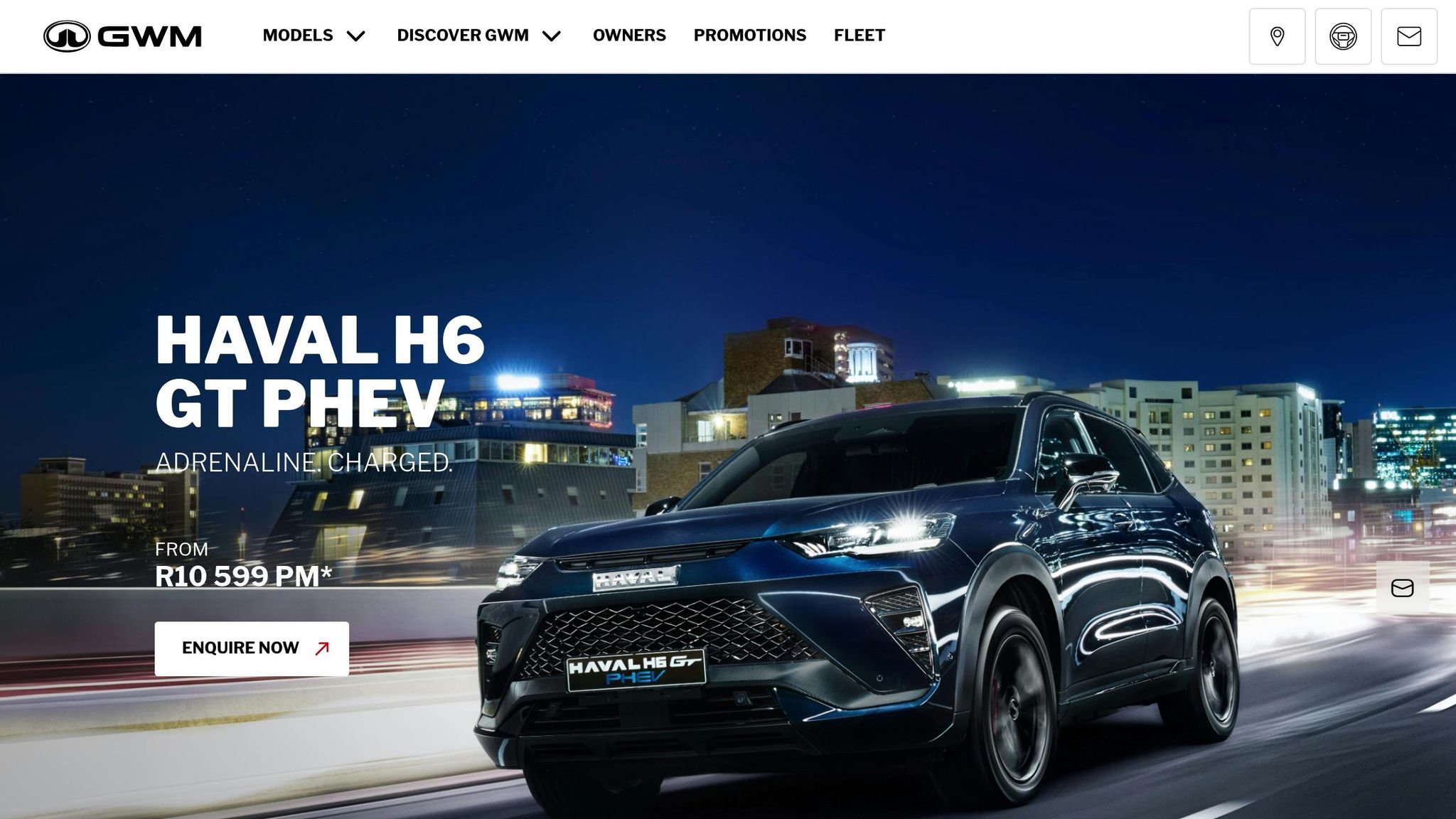
Introduced in June 2025, the Haval H6 GT PHEV combines a 1.5-liter turbocharged gasoline engine with dual electric motors and a 2-speed DHT, delivering performance comparable to hot hatches while prioritizing fuel efficiency .
Price
With a price tag of R799,900 (around $44,400 USD), the H6 GT PHEV comes in significantly lower than competitors priced closer to R1 million. The package includes a 7-year/200,000 km warranty, a 7-year/75,000 km service plan, and an 8-year/150,000 km battery warranty – a compelling offering for buyers seeking performance and peace of mind .
Power Output
The H6 GT PHEV boasts an impressive combined output of 321 kW (430 hp) and 762 Nm of torque, allowing it to sprint from 0 to 100 km/h (0 to 62 mph) in just 4.9 seconds. This gives it a clear edge over rivals like the BYD Sealion 6 (238 kW) and Jaecoo J7 PHEV (255 kW). Its all-wheel-drive system and multiple drive modes – ranging from a quiet EV mode for city driving to a Sport mode for maximum performance – add to its adaptability .
Electric Range
Equipped with a 35.4 kWh lithium-ion battery, the H6 GT PHEV offers an electric-only range of 180 km (112 mi) under NEDC standards. Combined, it can travel over 1,000 km (621 mi), making it an excellent choice for both daily commutes and longer journeys .
Fuel Economy
The vehicle achieves an impressive fuel consumption rate of 0.8 L/100 km (approximately 294 mpg). While actual mileage may vary depending on driving style and charging habits, this level of efficiency, paired with a ground clearance of 170 mm (6.7 in), ensures it can handle South Africa’s diverse road conditions with ease.
3. OMODA C9 PHEV

Introduced in August 2025, the OMODA C9 PHEV stands as the flagship luxury SUV of the brand. Combining strong acceleration, a practical electric range, and a competitive price, it aims to deliver a premium experience without breaking the bank. Here’s a closer look at its pricing, performance, electric range, and fuel efficiency.
Price
The OMODA C9 PHEV Explore AWD comes with a price tag of R999,000 (around $55,500 USD), positioning it as a more budget-friendly option compared to rivals like the BMW X3 xDrive30e (starting at R1.2 million) and the Volvo XC60 T8 (starting at R1.3 million). Despite being more affordable, the C9 PHEV offers better power and electric range. Buyers also benefit from an extensive package that includes a 7-year/200,000 km warranty, a 7-year/100,000 km service plan, and a 10-year/unlimited km battery warranty for the first owner.
Power Output
The C9 PHEV delivers an impressive combined output of 440 kW (about 590 hp) and 915 Nm of torque (approximately 675 lb-ft), leaving its European competitors behind. For comparison, the BMW X3 xDrive30e offers 215 kW, while the Volvo XC60 T8 produces 340 kW. Under the hood, it features a 1.5-liter turbocharged engine paired with four electric motors and a 3-speed dedicated hybrid transmission. This setup allows the SUV to sprint from 0 to 100 km/h (0 to 62 mph) in just 4.9 seconds.
Electric Range
The C9 PHEV boasts a standout pure electric range of 150 km (93 mi), which outclasses its competitors. When combining petrol and electric power, the range extends to over 1,100 km (684 mi). The vehicle is equipped with a 34.5 kWh lithium iron phosphate battery that supports 70 kW DC fast charging. This means you can charge the battery from 30% to 80% in just 25 minutes using a fast charger. For home charging with a Wall Box, the process takes about 5.5 hours.
Fuel Economy
When running on electric power, the C9 PHEV achieves an impressive 1.4 L/100 km (168 mpg). Under petrol-powered conditions in everyday driving, it averages 5.5 L/100 km (43 mpg).
Hans Greyling, General Manager for OMODA & JAECOO South Africa, commented, "The addition of the C9 PHEV to OMODA’s lineup signals a new era for efficient luxury motoring in South Africa. It’s the best of both worlds – electric when you want it, petrol when you need it".
sbb-itb-09752ea
4. BMW X1 xDrive30e
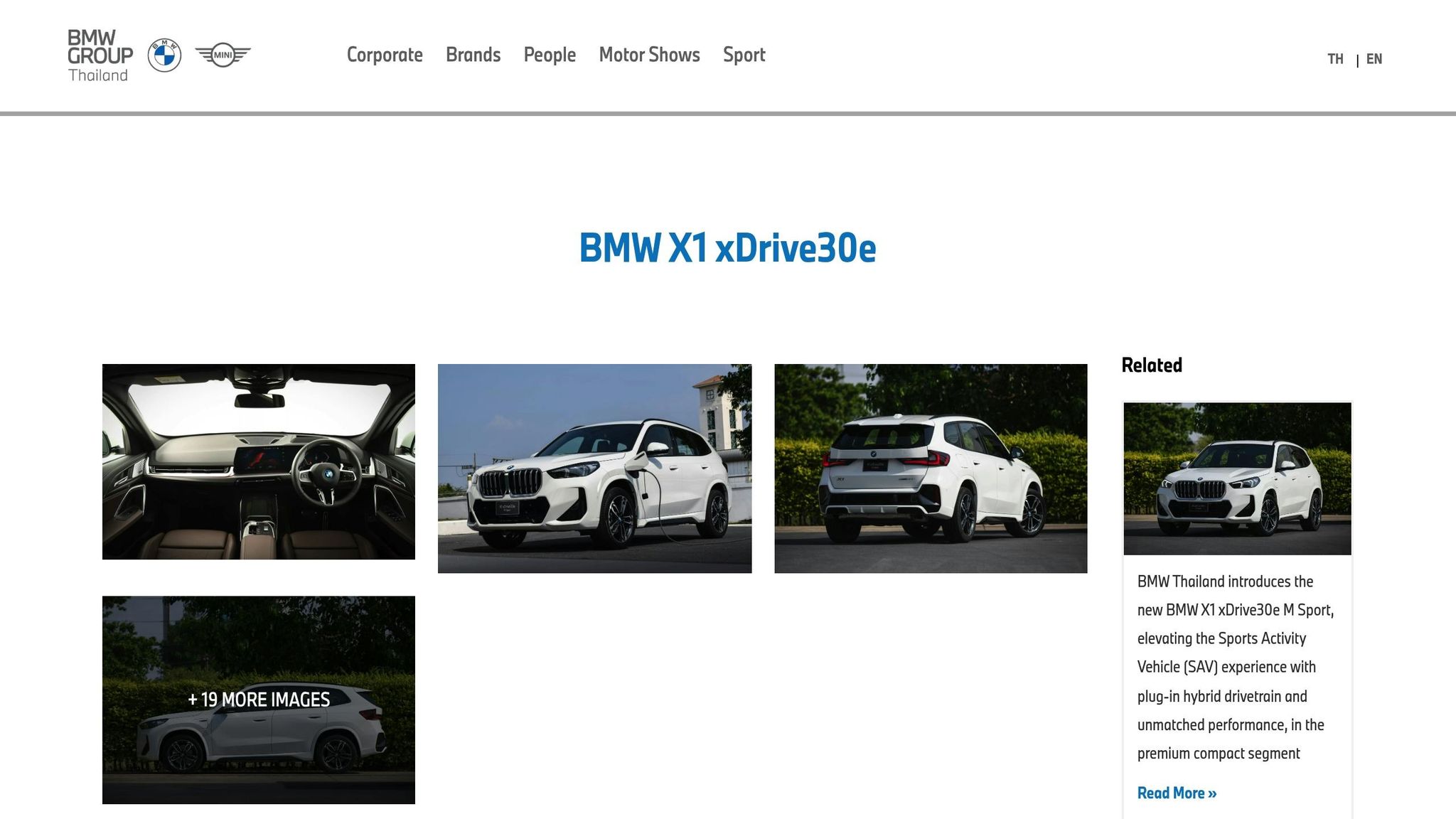
The BMW X1 xDrive30e is BMW’s entry-level plug-in hybrid SUV for the South African market. Positioned as a premium compact Sports Activity Vehicle (SAV), it combines the precision of German engineering with practicality for everyday use. Introduced around August 2023, it provides an accessible way for buyers to explore BMW’s electrified vehicle lineup.
Price
The X1 xDrive30e comes in two trims: the x-Line priced at R1,050,000 ($58,300 USD) and the M Sport at R1,090,000 ($60,500 USD). The official starting price is set at R1,055,000, which includes 15% VAT and a 5-year/100,000 km Motorplan. This pricing makes it more affordable than the larger BMW X3 PHEV, which starts at R1,282,000, and also undercuts the fully electric BMW iX1 xDrive30, priced from R1,205,000. Buyers also receive a 2-year/unlimited mileage warranty along with the 5-year/100,000 km maintenance plan.
Power Output
Under the hood, the X1 xDrive30e features a 1.5-liter three-cylinder turbocharged engine delivering 110 kW (about 147 hp) at 4,700 rpm. It works alongside an electric motor and a 7-speed dual-clutch transmission. This setup allows the SUV to accelerate from 0 to 100 km/h (0 to 62 mph) in just 5.6 seconds, offering performance on par with its fully electric counterpart, the iX1.
Electric Range
Designed for emission-free urban driving, the X1 xDrive30e can operate solely on electric power in city settings, although its exact electric range remains unspecified. For longer journeys, the 45-liter fuel tank and 205 mm ground clearance make it versatile enough for varied road conditions. Cargo space is also flexible, ranging from 490 liters to 1,495 liters, depending on how the rear seats are configured.
Fuel Economy
With an average fuel consumption of just 1.1 L/100 km (roughly 214 mpg) under ideal conditions, the X1 xDrive30e leans heavily on its electric motor for daily driving. The petrol engine is there as a backup, ensuring extra power for extended trips when needed.
5. BMW X3 PHEV

The BMW X3 30e xDrive expands BMW’s lineup of plug-in hybrids, offering a midsize Sports Activity Vehicle (SAV) tailored for both urban and adventurous lifestyles. Built at the BMW Group Plant Rosslyn in South Africa, it holds special appeal for the local market. Introduced in February 2025, this model starts at R1,282,000 (around $71,200 USD), slotting between the entry-level X1 PHEV (R1,055,000) and the larger X5 PHEV (R1,930,000).
Vehicle Class
Designed for the premium midsize SAV market, the X3 30e xDrive is versatile enough for daily commutes, leisure trips, and outdoor adventures. It features BMW’s xDrive all-wheel-drive system, ensuring reliable traction on South Africa’s diverse road conditions. With a braked towing capacity of 2,000 kg, it’s a practical choice for those who enjoy weekend getaways or outdoor activities.
Power Output
Under the hood, the X3 30e xDrive combines a 2.0-liter four-cylinder petrol engine with a next-generation electric motor. Together, they deliver 220 kW (295 hp) and 450 Nm (332 lb-ft) of torque. This powertrain propels the SUV from 0 to 100 km/h (0 to 62 mph) in just 6.2 seconds and reaches a top speed of 215 km/h (134 mph). In electric-only mode, the top speed is capped at 140 km/h (87 mph). An 8-speed automatic transmission ensures smooth transitions between the electric and petrol systems.
Electric Range
Fitted with a 19.7 kWh high-voltage battery, the X3 30e xDrive offers an electric-only range of 81–90 km (50–56 miles), making it ideal for urban commutes. The intelligent "eDrive zone" feature automatically switches to all-electric mode when entering low-emission urban areas. Charging options include a standard domestic socket, a BMW Wallbox, or public charging stations. Additionally, the My BMW app allows preconditioning, letting you adjust the cabin temperature while the vehicle charges.
Fuel Economy
With a combined fuel consumption of 1.1 L/100 km (about 214 mpg), energy usage of 22.3–24 kWh/100 km, and CO₂ emissions of 21–26 g/km, the X3 30e xDrive is engineered for efficiency. The luggage capacity ranges from 460 liters to 1,600 liters with the rear seats folded – slightly less than standard X3 models due to the battery’s placement.
Advantages and Disadvantages
Plug-in hybrids bring a mix of benefits and challenges, especially for South African buyers. On the plus side, they address range anxiety by combining electric power with a petrol backup, making them ideal for emission-free daily commuting while still being road-trip ready. The dual power setup – electric and petrol – also enhances acceleration and overall performance. Notably, Chinese brands like BYD, Chery, and OMODA captured 27% of total plug-in hybrid sales in the first half of 2025, offering feature-rich vehicles at more competitive prices compared to European models.
However, the higher purchase price remains a significant hurdle when compared to traditional internal combustion engines or mild hybrids. Another challenge is the reliance on a still-developing charging infrastructure. Despite these obstacles, the plug-in hybrid segment is gaining momentum. While they made up only 0.14% of the South African vehicle market in 2024, newer models now offer electric ranges between 90 km and 150 km (56–93 mi) – enough to cover most daily commutes.
Here’s a quick comparison of some key plug-in hybrid models:
| Model | Price (Starting) | Power Output | Electric Range | Fuel Economy | Vehicle Class |
|---|---|---|---|---|---|
| BYD Sealion 5 DM-i | R639,900 (~$35,500 USD) | 160 kW (215 hp) | 70+ km (43+ mi) | 1.2 L/100 km (~196 mpg) | Compact SUV |
| Haval H6 GT PHEV | R799,900 (~$44,400 USD) | 321 kW (430 hp) | 180 km (112 mi) | 0.8 L/100 km (~294 mpg) | Midsize SUV |
| OMODA C9 PHEV | R999,000 (~$55,500 USD) | 440 kW (590 hp) | 150 km (93 mi) | 1.4 L/100 km (~168 mpg) | Midsize SUV |
| BMW X1 xDrive30e | R1,050,000 (~$58,300 USD) | 240 kW (322 hp) | 78 km (48 mi) | 1.1 L/100 km (~214 mpg) | Compact SAV |
| BMW X3 30e xDrive | R1,282,000 (~$71,200 USD) | 220 kW (295 hp) | 81–90 km (50–56 mi) | 1.1 L/100 km (~214 mpg) | Midsize SAV |
The BYD Sealion 5 DM-i, priced at R639,900 (~$35,500 USD), is an attractive option for those new to electrified vehicles. On the other end of the spectrum, the BMW X3 30e xDrive comes in at R1,282,000 (~$71,200 USD) but offers an impressive fuel efficiency of 1.1 L/100 km (~214 mpg). For buyers focused on charging speed, the OMODA C9 PHEV delivers with 70 kW DC fast-charging capability.
Performance varies widely across models. For instance, the BMW X1 xDrive30e boasts a 0–100 km/h (0–62 mph) acceleration time of just 5.6 seconds, thanks to its 240 kW (322 hp) output. In comparison, the BYD Sealion 5 DM-i takes 8.5 seconds with 160 kW (215 hp). These differences underline the growing appeal of plug-in hybrids, as they find their niche in South Africa’s evolving automotive market.
Conclusion
South Africa’s plug-in hybrid market in 2026 offers a range of options tailored to different needs and budgets. For those watching their wallets, the BYD Sealion 5 stands out with a starting price of R499,900 (~$27,700 USD). It’s a model that balances affordability with performance. As Mark Handley, Commercial Director at BYD Auto South Africa, explains:
"South Africans want efficiency, quality and value without compromising on performance. The Sealion 5 delivers that balance".
Beyond affordability, there are models designed for specific lifestyles. For long-distance commuters, the Haval H6 GT PHEV is a compelling choice at R799,900 (~$44,400 USD). With an impressive 180 km (112 mi) electric range and a 7-year/200,000 km warranty, it’s ideal for reducing fuel costs when paired with regular home charging. On the other hand, performance enthusiasts might gravitate toward the OMODA C9 PHEV, boasting 440 kW (590 hp) and 915 Nm of torque, priced at an estimated R1,000,000 (~$55,500 USD).
For buyers seeking luxury, the Volvo XC60 T8 and XC90 T8 offer premium features but come with higher price tags – starting at R1,218,900 and R1,807,300 (~$67,700 and ~$100,400 USD) respectively. These models underline the importance of regular home charging to achieve optimal fuel efficiency.
As mentioned earlier, the efficiency of plug-in hybrids heavily depends on maintaining proper charging habits. Installing a home charger ensures full battery capacity and maximizes savings. Greg Maruszewski, Managing Director at Volvo Car South Africa, emphasizes this point:
"A plug-in hybrid is an attractive first step for South Africans who are considering making the switch to electric".
With electric ranges now reaching 150–180 km (93–112 mi) in newer models, many South African commuters can rely on electric power for daily travel while keeping the petrol engine as a backup for extended trips.
FAQs
What are the advantages of choosing a plug-in hybrid over a fully electric car in South Africa?
Plug-in hybrids (PHEVs) combine the energy efficiency of electric vehicles with the dependability of a gasoline engine, making them a smart option for drivers in South Africa. These vehicles typically cover between 28 and 60 miles on electric power alone, which is perfect for daily commutes. For longer trips, the gasoline engine kicks in, eliminating concerns about charging infrastructure – a valuable feature as the country’s network of charging stations continues to expand.
When it comes to fuel efficiency, PHEVs shine. Take the JAECOO J7 Super-Hybrid, for example. It averages around 48 mpg and offers an electric driving range of about 56 miles. Meanwhile, the OMODA C9 PHEV stands out with an electric-only range of up to 93 miles and combined fuel efficiency as low as 168 mpg. These vehicles not only help reduce fuel costs but also minimize environmental impact, all while maintaining the convenience of a traditional fuel tank. For South African drivers seeking a more sustainable yet practical choice, PHEVs tick all the right boxes.
How well does South Africa’s charging infrastructure support plug-in hybrid vehicles?
South Africa’s charging infrastructure is steadily expanding to meet the needs of plug-in hybrid vehicle (PHEV) drivers. Public charging stations, which include both AC wall boxes and DC fast chargers, are becoming more accessible, making it simpler for drivers to recharge while on the road. For example, a PHEV equipped with a 34.5 kWh battery can be fully charged in about 5.5 hours using a home-installed wall box. If you’re in a hurry, a DC fast charger can take the battery from 30% to 80% in just around 25 minutes.
Home charging is another convenient option, thanks to South Africa’s 230 V electrical grid. Installing a dedicated EV wall box is straightforward and allows for overnight charging via standard household outlets. With the combination of an expanding public charging network and easy home charging solutions, PHEV owners can comfortably rely on electric-only mode for daily commutes and use fast chargers for longer journeys.
What should I look for when choosing a plug-in hybrid for long trips in South Africa?
When choosing a plug-in hybrid (PHEV) for long trips, it’s important to look at its electric-only range and overall driving range, which combines electric power with fuel. Take the HAVAL H6 GT PHEV, for instance – it can deliver up to 112 miles of electric range and over 621 miles of total range under ideal conditions. Similarly, the OMODA C9 PHEV offers around 93 miles of electric range and surpasses 684 miles in total range. Keep in mind, though, that actual performance can vary depending on factors like your driving habits, road conditions, and weather.
You’ll also want to check out the charging options. Some PHEVs can fully charge at home in about 5.5 hours, while others support public DC fast charging, allowing you to go from 30% to 80% in roughly 25 minutes. With South Africa’s charging infrastructure growing, it’s a good idea to choose a model that works well with fast chargers along major travel routes. Finally, don’t forget to weigh other considerations like the price, warranty coverage, service plans, and comfort features to ensure the car fits your needs for long-distance travel.
Related Blog Posts
- SA EV Sales Growth 2025: Key Numbers
- Electric vs Hybrid: Fuel Costs Compared
- Electric vs Petrol: Trends in South Africa
- EVs vs Hybrids: Which is Better for South African Drivers?