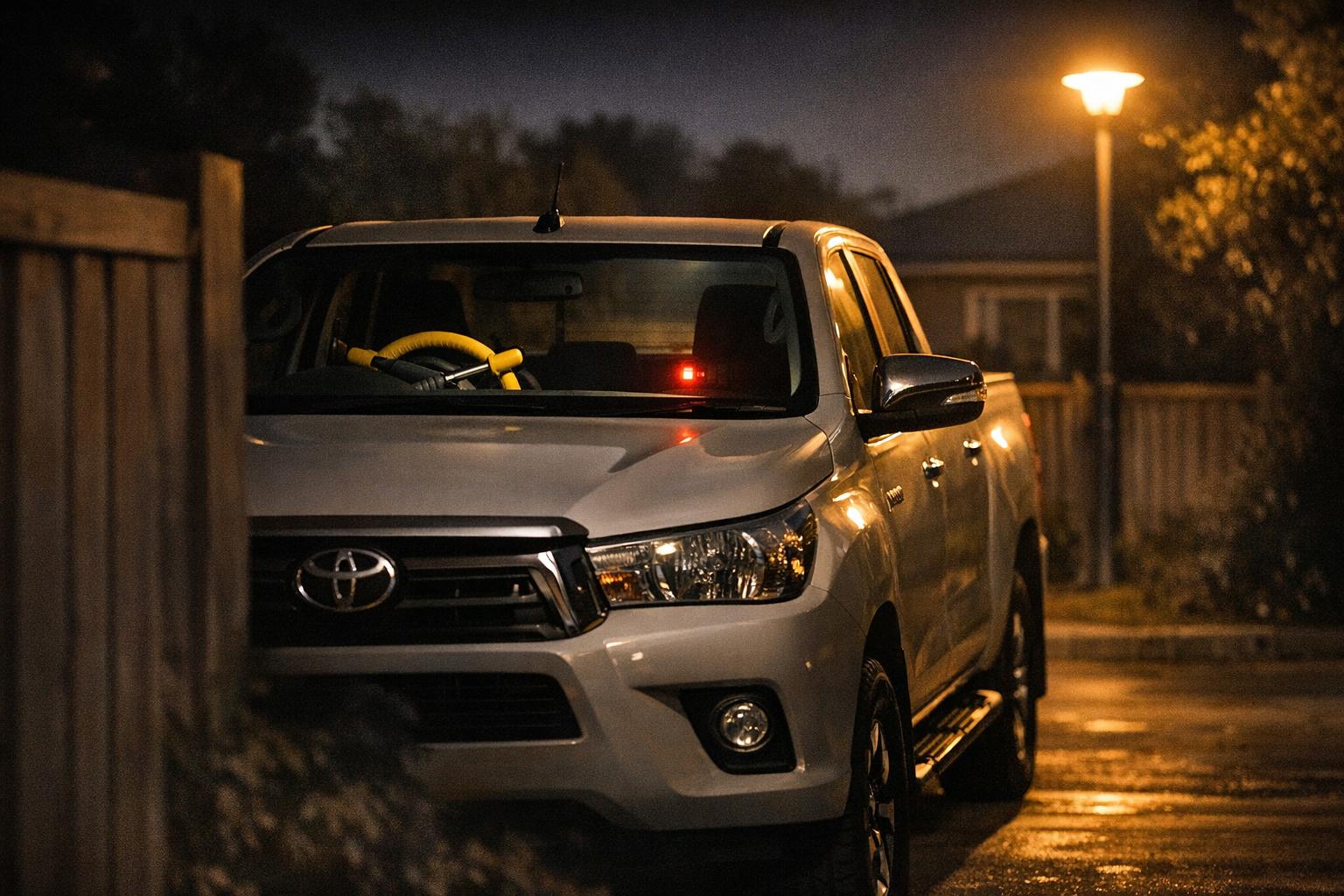
The Toyota Hilux has become a top target for vehicle theft and hijacking in South Africa due to its popularity, high resale value, and demand for parts. Criminals use advanced tactics like keyless entry relay attacks and even kidnappings to locate tracking devices. Gauteng leads in vehicle crimes, with business-owned Hilux models being at higher risk. Fridays and Saturdays are peak times for these incidents, often occurring near homes or workplaces. Protecting your Hilux requires a combination of daily security habits, physical deterrents, and advanced electronic systems like GPS trackers and immobilizers. Staying informed about crime trends and using layered security measures can help minimize risks.
Toyota Hilux Theft Statistics in South Africa: Key Facts and High-Risk Areas
How Big Is the Toyota Hilux Theft Problem?
Theft Numbers and Rankings
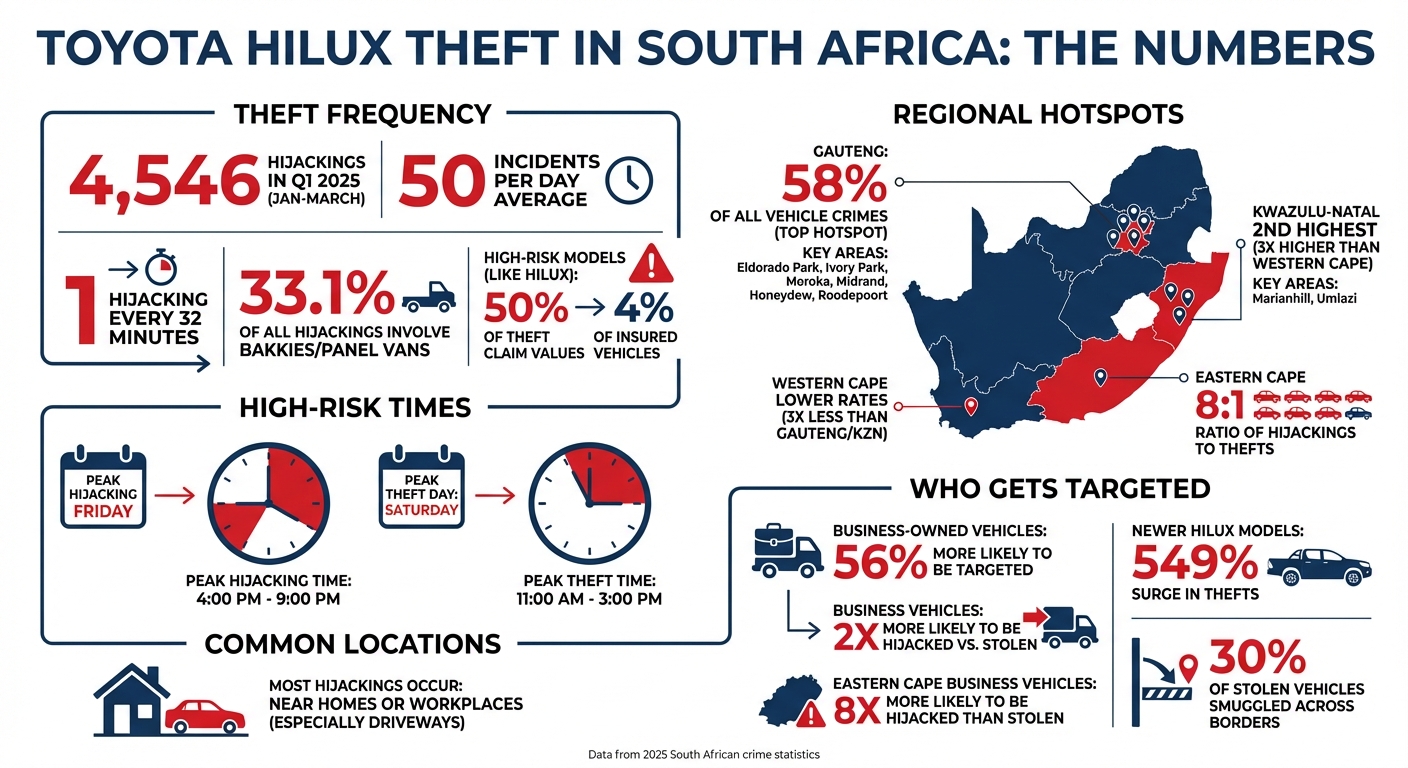
The Toyota Hilux continues to rank as one of South Africa’s most targeted vehicles for theft and hijacking. Between January and March 2025, there were 4,546 hijackings – averaging about 50 incidents daily, or one every 32 minutes. Bakkies and panel vans, which include the Hilux, made up 33.1% of all hijackings, while sedans, hatchbacks, and coupes accounted for the largest share at 44.4%.
Despite making up just 4% of Santam‘s insured vehicles, high-risk models like the Hilux are responsible for a staggering 50% of theft and hijacking claim values.
Where Thefts Happen Most
The regional breakdown of crime data highlights the areas where Hilux thefts and hijackings are most prevalent.
Gauteng tops the list, contributing to approximately 58% of all vehicle-related crimes. Within Gauteng, neighborhoods such as Eldorado Park, Ivory Park, and Moroka are notable hotspots. During early 2025, areas like Midrand, Honeydew, and Roodepoort recorded the highest hijacking incidents.
KwaZulu-Natal comes in second, with Marianhill and Umlazi identified as particularly high-risk locations. Theft rates in Gauteng and KwaZulu-Natal are three times higher than in urban areas of the Western Cape. Meanwhile, the Eastern Cape reveals a striking 8:1 ratio of hijackings to thefts, showing that hijackings overwhelmingly dominate in this region. Most hijackings occur near victims’ homes or workplaces, with driveways being a frequent site. Fridays between 4:00 PM and 9:00 PM are peak times for hijackings, while thefts are most common on Saturdays between 11:00 AM and 3:00 PM.
Who Gets Targeted
Business owners are at a much higher risk compared to private individuals. Business-owned vehicles are 56% more likely to be involved in vehicle crime and are twice as likely to be hijacked rather than stolen. Small businesses, logistics firms, and courier services are frequent targets since criminals often aim to take both the vehicle and its cargo. In the Eastern Cape, business-owned vehicles are eight times more likely to be hijacked than stolen.
The type of crime also varies by region. In Gauteng and KwaZulu-Natal, theft – often involving keyless entry relay attacks – is more prevalent, while hijacking dominates in the Western and Eastern Cape. Private owners are often targeted during predictable activities like school runs, gas station stops, or entering and exiting their driveways. Recognizing these patterns is essential for developing strategies to keep your Hilux secure.
Why Thieves Target the Toyota Hilux
Black Market Demand
The Toyota Hilux holds a high resale value on South Africa’s black market and in neighboring countries. Around 30% of stolen or hijacked vehicles in South Africa are smuggled across borders to areas where rugged, dependable utility vehicles are in constant demand. Its reputation for durability makes it especially attractive in regions with limited access to vehicle maintenance.
Cross-border smuggling operations are highly organized. A striking example occurred in May 2022, when two Nigerian nationals were arrested in Niamey, Niger, after transporting a stolen Toyota Hilux from Nigeria for resale. Their operation involved a local accomplice, who was found with three AK-47 rifles, 151 cartridges, and stolen motorbike parts. The group used fake military IDs and multiple license plates to avoid detection at border crossings. This case highlights the lengths these networks go to in order to move stolen vehicles internationally.
"The demand for Toyotas, Volkswagens, Fords and Nissans remains high on the black market, with vehicle hijackings largely a business driven by demand and supply." – Fidelity Services Group
The issue isn’t limited to South Africa. Nearly 40% of stolen cars in the UK end up in the Democratic Republic of Congo (DRC), driven by the demand for rugged vehicles and their components. This global market only adds fuel to the fire of vehicle theft operations.
Demand for Parts and Components
Criminal syndicates often dismantle stolen Hilux vehicles in illegal chop shops to sell their high-value components. Thefts of newer Hilux models have surged by 549%, reflecting the high demand for parts like engines, body panels, and electronics. Instead of reselling entire vehicles, these networks increasingly strip them for parts, which are easier to sell and transport.
As the price of legitimate replacement parts rises, more consumers turn to the black market for affordable options. Given the Hilux’s global popularity and ease of service, its parts remain highly liquid assets in international markets.
"We’re seeing a shift towards stolen vehicles being re-VINed for sale or disassembled in illegal chop shops and sold for parts. As the cost to buy and maintain vehicles rises, we can expect to see this trend grow." – Bryan Gast, National VP, Investigative Services, Équité Association
Interestingly, thieves don’t always steal the whole vehicle. Parked Hilux trucks are often stripped of external components, like wheels, mirrors, and lights, which can be quickly sold while reducing the risk of getting caught.
Organized Crime Networks
Vehicle theft and hijacking are rarely random acts. These crimes are the work of organized syndicates, involving spotters, thieves, chop-shop operators, and smugglers. These groups have refined their methods to improve success rates while avoiding detection. A disturbing trend involves kidnapping vehicle owners to force them to reveal the location of tracking devices, delaying crime reporting and giving the syndicates more time to move stolen vehicles or hide them in safe houses.
These networks also diversify their activities. Stolen Hilux vehicles are often repurposed to transport illegal goods, such as weapons or motorbikes, maximizing the value extracted from each theft. Their ability to exploit operational gaps and technological weak points makes them highly effective.
Security Weaknesses
Modern technology, while improving convenience, has also introduced new vulnerabilities. In Gauteng, theft now surpasses hijacking, largely due to keyless entry relay attacks. In these cases, criminals amplify the signal from a key fob, tricking the vehicle into unlocking without the owner’s awareness.
"At the moment, theft in Gauteng is greater than hijacking, most likely due to syndicates using keyless entry relay attacks to steal vehicles." – Tracker
Other methods include signal jammers that block key fobs from locking doors, leaving vehicles accessible despite the owner’s belief that they are secure.
How Hilux Owners Use Their Vehicles
The way Hilux vehicles are used in everyday life also makes them more vulnerable to theft.
As a workhorse for businesses, the Hilux is at greater risk than standard passenger cars. Business-owned vehicles are 56% more likely to be targeted for vehicle crime and face a 33% higher chance of being hijacked compared to privately owned cars. Small businesses, logistics firms, and courier services are frequent targets, as criminals can seize both the vehicle and its cargo.
Farmers and rural drivers face additional risks. Hilux vehicles often carry valuable tools and supplies and are parked in remote areas with minimal security. Predictable patterns, such as regular routes, scheduled stops, and consistent parking locations, make these vehicles easier to track and target by organized crime groups.
How to Protect Your Toyota Hilux from Theft
Daily Security Habits
Start with the basics: always lock your Hilux. Don’t just rely on the key fob – manually check the door handle to ensure it’s secure. Remote jamming devices can interfere with key fob signals, leaving your vehicle vulnerable.
If your Hilux has keyless entry, consider storing the key fob in a Faraday pouch. This signal-blocking case helps prevent relay attacks. Keep the pouch away from entry points in your home for added safety. If you’re okay trading convenience for security, you can disable the keyless entry feature through your vehicle’s settings.
Hijackings often happen near homes or workplaces, with Fridays between 4:00 p.m. and 8:00 p.m. being particularly risky. Stay alert to vehicles following you. If you suspect someone is tailing you, avoid heading home. Instead, drive to a police station or a busy area.
At home, parking in a garage is ideal. If that’s not an option, park outdoors with another vehicle – preferably one with a traditional key – blocking your Hilux. In public areas, choose well-lit spaces with plenty of foot traffic or CCTV coverage. Installing motion-detecting lights and cameras for your driveway can also add an extra layer of protection.
"Sometimes it is the most simple of behaviours that can make all the difference in ensuring that you remain a step ahead." – Duma Ngcobo, Chief Operations Officer, Tracker
Physical deterrents, paired with these habits, can go a long way in keeping your Hilux safe.
Physical Security Devices
Physical devices are a straightforward way to discourage theft. A steering wheel lock, for example, signals to thieves that stealing your vehicle would take more time and effort. These locks are affordable and don’t rely on electronics, making them a practical choice.
Here’s a quick look at an effective option:
| Device Type | Pros | Cons |
|---|---|---|
| Steering Wheel Lock | Inexpensive; visible deterrent | Can be bulky to store; not foolproof |
For even stronger protection, consider pairing these devices with advanced electronic systems.
Electronic Security Systems
A GPS tracker significantly increases the chances of recovering your Hilux if it’s stolen. Thatcham-approved S5 and S7 trackers, for instance, offer 24/7 monitoring and features like driver identification. These systems alert you if the vehicle moves without the correct key fob.
Radio Frequency (RF) trackers often outperform cellular-based systems because they’re less vulnerable to signal jamming and don’t depend on cell towers. If you prefer a cellular tracker, ensure it works on 4G or 5G networks, as older 2G and 3G systems are being phased out.
Proper installation is key. Hide your tracker in a discreet location, and consider adding a backup tracker for redundancy. Some systems even send alerts to your phone if your vehicle is moved without authorization.
"While technology can provide convenience by allowing you to access your car without having to search for your keys, keyless access theft also highlights how criminals are turning to tech to make car theft easier." – Duma Ngcobo, Chief Operations Officer, Tracker
Hilux-Specific Security Measures
The Toyota Hilux can benefit from additional, tailored security solutions. Ghost immobilizers, for example, integrate with the vehicle’s CAN Bus network to block unauthorized engine starts. These systems require a unique PIN to be entered via the dashboard, making them immune to relay attacks and key cloning.
Securing the OBD port is another critical step. Thieves can use this access point to program new keys or disable factory immobilizers. Protect it with an OBD port blocker or a device like the Trackport.
Many newer Hilux models include Toyota Safety Connect, which features a Stolen Vehicle Locator. Once theft is confirmed by the police, Toyota’s response team can track your vehicle and share its location with law enforcement. This service often comes with a complimentary three-year trial from the purchase date.
Insurance and Recovery Plans
Investing in security devices doesn’t just protect your Hilux – it can also save you money on insurance. Many insurers offer discounts for installing tracking devices or additional immobilizers. For example, a Thatcham S5 tracker often results in lower premiums, while S7 trackers may be required for higher-value Hilux models.
Keep detailed records of your vehicle, including photos of the VIN, license plate, and any unique features or aftermarket security upgrades. Also, save the emergency contact information for your tracking service – quick action is crucial in theft situations.
Here’s how some security measures affect insurance:
| Security Measure | Primary Function | Insurance Impact |
|---|---|---|
| Thatcham S5 Tracker | Recovery & Driver ID | Can lead to significant premium discounts |
| Thatcham S7 Tracker | Basic Theft Recovery | Often required for high-value vehicles |
| Aftermarket Immobilizer | Theft Prevention | Adds a secondary defense; may lower premiums |
| Secure Parking (Garage) | Physical Protection | Reduces risk profile and premiums |
If your Hilux is stolen, immediately notify your tracking service and the police. For Toyota Safety Connect users, call 1-888-TOYOTA-8. Keep in mind that if your vehicle is financed or leased, you’ll need to continue payments until any insurance claims are settled.
sbb-itb-09752ea
Stolen Toyota Hilux Invincible X Security
Conclusion
The surge in Toyota Hilux thefts can be attributed to high demand on the black market, cross-border smuggling, and increasingly sophisticated criminal methods . A significant number of these stolen vehicles end up in neighboring countries , with thieves constantly adapting their tactics to bypass security measures .
To counter these threats, relying on a single security measure isn’t enough. Criminals are always evolving, so implementing a layered security system is key. Combine physical locks, GPS trackers, immobilizers, and consistent security habits to safeguard your vehicle. Fleet owners, in particular, should take extra precautions – business-owned Hilux trucks are 33% more likely to be hijacked compared to personal vehicles.
Be especially cautious during high-risk times, like late Friday afternoons and mid-day on Saturdays. Hijackers often strike near homes and workplaces, so heightened awareness in these areas is crucial. If you ever suspect someone is following you, head to the nearest police station or a busy, well-lit area .
Staying informed about crime trends is just as important. Gauteng continues to be a hotspot for vehicle crime, and keeping track of these patterns can help you refine your security approach.
For more tips on Hilux security and the latest updates in South African automotive news, check out ImotoNews South Africa. Staying updated is one of the best ways to protect your vehicle against ever-changing threats.
FAQs
What are the best ways to protect your Toyota Hilux from theft?
To keep your Toyota Hilux safe, it’s smart to combine visible deterrents with high-tech security tools. Start with a sturdy steering wheel lock – it’s a simple yet effective way to make your truck less appealing to thieves. Adding a dash cam equipped with motion detection and GPS tracking can act as both a warning and a source of evidence if someone tries to steal your vehicle.
Because many Hilux models use keyless entry, a Faraday pouch is a must-have. This pouch blocks the signal from your key fob, stopping thieves from using relay attacks to gain access or start your truck. Make it a habit to store your key fob in the pouch whenever it’s not in use.
To further protect your Hilux, park in well-lit, secure locations, double-check that all doors are locked, and think about investing in a professional tracking or immobilizer system. While physical locks and a Faraday pouch are great for prevention, a tracking device can be a lifesaver for quickly recovering your truck if it’s ever stolen.
Why is the Toyota Hilux frequently targeted by thieves in South Africa?
The Toyota Hilux has become a prime target for thieves, largely because of its strong resale value and the consistent demand for its parts – especially its engine. These qualities make it a lucrative option for the black market and illegal exports.
On top of that, organized crime groups often take advantage of weaknesses in the vehicle’s security systems, making it easier to steal. Its reputation for being dependable and long-lasting only increases its appeal, as both complete vehicles and their parts are always in high demand.
What is a keyless entry relay attack, and how can I protect my car from it?
A keyless entry relay attack is a technique used by thieves to exploit vehicles with keyless entry systems. Here’s how it works: your key fob constantly sends out a signal, even when you’re not actively using it. Criminals use special devices to amplify and relay this signal to your car, tricking it into believing the key is nearby. This allows them to unlock the doors and even start the engine – no physical key required.
To safeguard your vehicle, consider these tips:
- Store your key fob in a Faraday pouch or a metal-lined container to block the signal.
- If your car allows, disable the keyless entry feature when not needed.
- Keep the fob away from doors and windows at home to limit signal exposure.
- Park in well-lit areas or secure garages whenever possible.
- Add an extra layer of protection with a steering wheel lock or an aftermarket alarm system.
Using a combination of these precautions can make it much harder for thieves to target your car.
Related Blog Posts
- How To Protect Used Cars From Theft
- 8 Ways To Prevent Used Car Theft
- Why Keyless Entry Cars Are High-Risk In SA
- Most Stolen Cars in South Africa 2025: Updated Crime List