
South Africa’s new car warranty rules, introduced on July 1, 2021, have changed how vehicle owners handle servicing and repairs during the warranty period. Here’s what you need to know:
- Independent Servicing Allowed: You can service your car at independent providers without voiding the warranty, as long as proper procedures and quality parts are used.
- Transparent Pricing: Dealerships must separate vehicle and service package pricing, making it easier to understand costs.
- Partial Warranty Voiding: Only the specific part of the warranty related to a failure caused by non-compliant servicing or parts can be voided, not the entire warranty.
These changes aim to give you more freedom and clarity while maintaining your warranty rights. Keep detailed service records, follow manufacturer guidelines, and understand what your warranty covers to avoid disputes.
Choosing the Right Car Warranty? Here’s What You Need to Know! | Keep It or CHANGECARS Podcast
What Changed in the New Car Warranty Rules
South Africa’s new warranty regulations have reshaped how car owners approach maintenance and repairs, aiming to make the process more transparent and consumer-friendly. The Competition Commission’s "Right to Repair" guidelines introduced three major updates that could directly impact your choices and expenses. Here’s what you need to know:
1. Dealerships must now break down their pricing.
Car dealerships are now required to provide a detailed breakdown of costs for the vehicle, service plans, maintenance plans, and extended warranties. This allows you to see exactly what you’re paying for and gives you the option to skip extras like service plans if you’d rather pay for maintenance as needed.
2. Warranties are now partially valid.
If you use an independent service provider (ISP) or non-original parts, only the specific part of the warranty related to the failure or damage will be voided. According to Right to Repair South Africa:
Only the section/s of the warranty that relate to the failure/damage may be voided, the remainder of the warranty must be honoured by the manufacturer.
This rule even applies to "matching-quality" parts, as long as they meet or exceed the original specifications.
3. Clear rules for independent service providers (ISPs).
ISPs are now required to document all work in your vehicle’s service book and be upfront about any risks that could lead to a partial warranty denial. They must strictly follow manufacturer guidelines, including using the correct fluids and sticking to service intervals. Before choosing an ISP, check that they have proper commercial insurance to cover any issues that might arise.
These changes are designed to give consumers more control and protection when it comes to vehicle maintenance. Whether you’re driving a Ford with a 4-year/120,000 km warranty or a Kia with 5-year/unlimited mileage coverage, these updated rules apply across the board.
What Warranties Cover and Don’t Cover
Knowing what your warranty protects can save you from unexpected repair costs. Recent regulations aim to make these coverage details clearer, outlining what’s included and what falls on the owner to handle. Warranties typically cover major mechanical issues in the engine (like the block, cylinder heads, water pump, and oil seals), transmission (gears, housings, bearings, shafts), drivetrain, braking systems, and critical electrical components such as the alternator and starter motor. Electrical and safety systems, including the steering shaft (MDPS motor), brake calipers, and essential sensors, are also covered.
Factory defects in body and interior parts, such as door locks, hinges, window seals, and interior trim, are generally included in warranty coverage. However, paint warranties tend to be shorter than the main vehicle warranty. For instance, Kia’s paint coverage lasts for 3 years or 62,137 miles (100,000 km), while their overall vehicle warranty extends to 5 years. Batteries, on the other hand, usually come with a warranty of 1 to 3 years.
Components Covered by Warranties
According to the National Automobile Dealers’ Association, "normally mechanical faults in major components, for example, the engine or gearbox, are covered". This includes internal engine parts like gaskets and cylinder heads, as well as transmission components such as the flywheel and drive shafts. Braking systems, including calipers and hand brake cables, are often protected, along with electrical components like the alternator and starter motor.
Even after the manufacturer warranty expires, the Consumer Protection Act guarantees an implied warranty of quality for 6 months on both new and used vehicles, overriding "voetstoots" (as-is) clauses. Additionally, starting in September 2024, Kia South Africa extended its parts warranty for out-of-warranty vehicles to 3 years with unlimited mileage.
Items Not Covered by Warranties
Certain items, especially those subject to wear and tear, are excluded from warranty coverage. This includes tires, wiper blades, brake pads, brake linings, clutch plates, and exhaust systems. Consumables like fuses, remote key batteries, and air conditioning refrigerant (unless replaced during a component repair) are also not covered. Minor annoyances, like rattles or general adjustments, typically fall outside warranty protection as well.
External damage caused by environmental factors is another exclusion. Examples include stone chips in glass, paint scratches from road debris, sun-damaged rubber seals, and accident-related damage. Using the wrong or contaminated fuel can void coverage for any resulting damage. Unauthorized aftermarket modifications – such as installing non-original exhaust systems or upgraded headlights – can also void the warranty for affected components. Similarly, damage caused by driver misuse, like racing, overloading, or skipping scheduled maintenance, won’t be covered.
Under the "Right to Repair" rules, manufacturers can deny claims if they prove an Independent Service Provider caused the problem by using substandard parts or incorrect procedures. However, only the specific portion of the warranty related to that failure is voided, leaving the rest of the warranty intact.
Next, we’ll look at how warranties differ between new and used vehicles.
Warranty Differences Between New and Used Cars
New car warranties are provided directly by the manufacturer and typically last between 3 to 10 years or cover 62,137 to 124,274 miles (100,000 to 200,000 km), depending on the brand. For instance, manufacturers like Toyota, Hyundai, and Volkswagen in South Africa often extend warranties up to 10 years or 124,274 miles (200,000 km). These warranties are extensive and remain valid even when routine maintenance is performed by an Independent Service Provider (ISP), as long as no damage results from their work.
When it comes to used cars, warranties differ significantly. If you’re buying a relatively new pre-owned vehicle, it might still carry the balance of the original factory warranty. These warranties transfer based on the original registration date. To find out how much warranty remains, you can contact a franchise dealership and provide the car’s VIN. Once the factory warranty expires, additional warranty options may be necessary.
For used cars, South Africa’s Consumer Protection Act (CPA) offers an implied 6-month warranty on defects for vehicles sold by dealers. This warranty covers unexpected defects, such as a gearbox issue, but excludes wear-and-tear items like brake pads, tires, and clutches. As AutoAdvice explains:
The buyer will be required to sign that he accepts that he is buying a used vehicle and that it has a level of wear and tear and that it is not expected to perform like a new vehicle.
When factory coverage ends, aftermarket warranties become an option. Providers like Motorite or Hollard offer these warranties for vehicles less than 15 years old with mileage under 155,343 to 186,411 miles (250,000 to 300,000 km), depending on the provider. Certified pre-owned programs, such as Toyota Automark or VW MasterCars, also offer warranties – either their own or through third-party providers. However, aftermarket warranties often have stricter requirements, such as mandatory servicing at RMI-approved workshops.
Before purchasing a used car, always confirm the registration date and check the VIN details to understand the exact warranty coverage. Keep detailed records of all services and repairs, especially when using independent workshops, to avoid potential claim rejections. These steps help ensure you’re fully informed about warranty protections in South Africa’s dynamic car market.
sbb-itb-09752ea
How to File Warranty Claims and Use Roadside Assistance
Steps to File a Warranty Claim
To start a warranty claim, schedule your vehicle with an authorized dealer or a recognized specialist. Gather essential documents like your full service history, a photo of your license disc, the latest policy schedule, and either a damage report or a repair quote. Before any repairs begin, the repair shop must contact the warranty provider’s authorization center for approval. Repairs done without prior authorization are typically not covered.
Claims must be submitted within 30 days of the breakdown. For minor repairs, approvals usually take 24–48 hours, while more complex issues might require 3–7 days. Once approved, the provider pays the repair shop directly, minus any deductible. Always inspect the completed work and the invoice before accepting the repair.
If your claim is denied and you believe the decision is unfair, you can escalate the issue to the Motor Industry Ombudsman of South Africa (MIOSA) for an independent review. Many warranties also come with added benefits, such as roadside assistance.
Roadside Assistance and Other Benefits
Most new car warranties include 24/7 roadside assistance for the duration of the warranty. For instance, Peugeot offers this for 3 years or 62,137 miles (100,000 km), while Mitsubishi provides up to 5 years of coverage. These services typically cover mechanical or electrical breakdowns, but accident towing is either excluded or charged separately. Coverage often extends across South Africa and neighboring countries like Swaziland, Lesotho, Botswana, and Namibia.
Roadside assistance services generally include battery jumpstarts, emergency fuel delivery, locksmith help for jammed locks or lost keys, and towing to the nearest approved facility. If you’re more than 62 miles (100 km) from home when a breakdown occurs, many warranties offer "trip interruption" benefits. These might include overnight accommodations or car hire. For example, Mitsubishi may reimburse up to $31 (R500) per person for one night’s accommodation and up to $47 (R750) for car rental or public transport. Similarly, Bidvest Insurance offers car hire for up to 5 days, with an annual roadside assistance benefit limit of $930 (R15,000).
Some manufacturers, like Peugeot, charge a $26 (R420, excl. VAT) call-out fee for minor issues such as jumpstarts or tire changes within a 25-mile (40 km) radius. This fee is usually payable in cash to the technician. Mitsubishi, on the other hand, limits certain roadside services to 2 call-outs per 12-month period. For tire changes, ensure your car has a roadworthy spare and all factory-supplied tools; otherwise, the vehicle may need to be towed at your expense. Always contact your warranty provider’s emergency number first – arranging a private tow could void your coverage.
Warranty Comparison by Brand
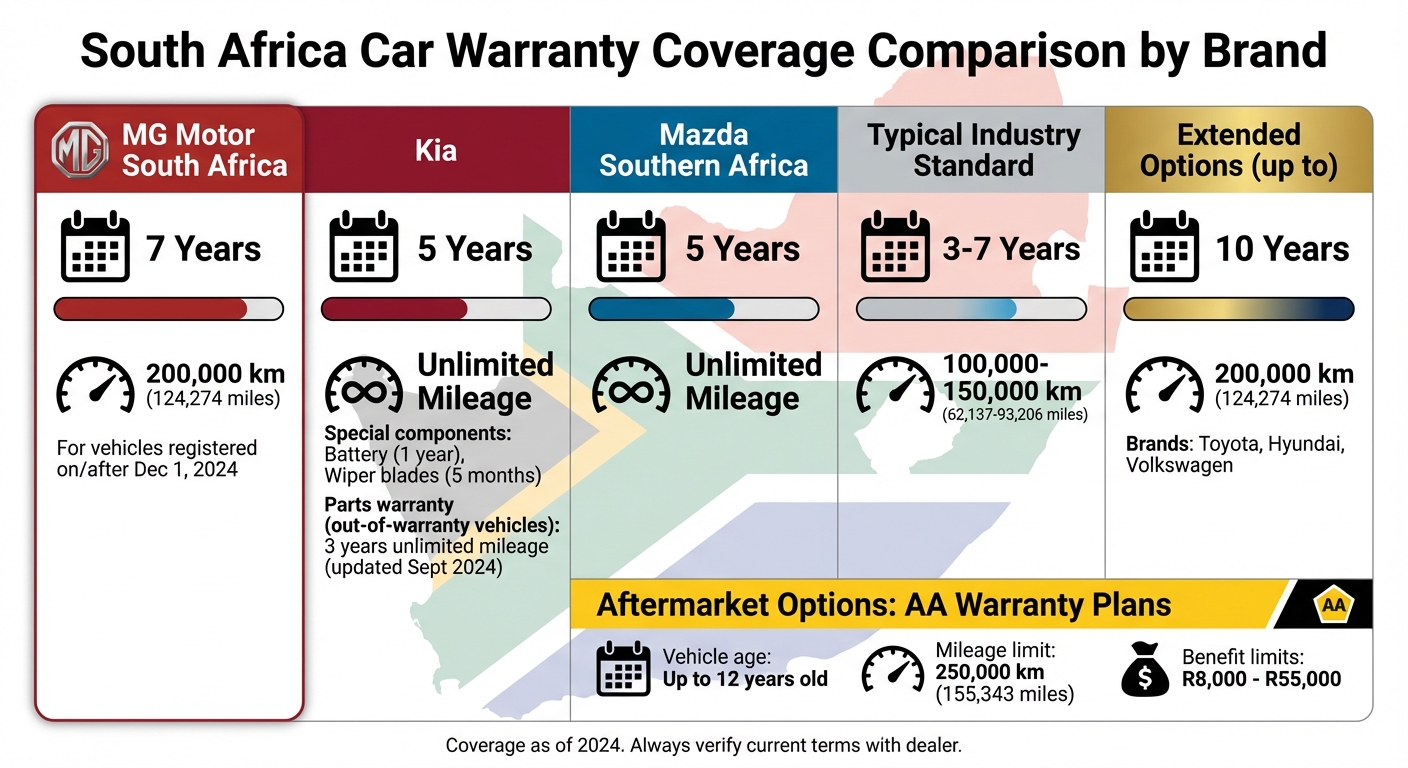
South Africa Car Warranty Coverage Comparison by Brand 2024
Let’s dive into how different brands approach their warranty offerings and what sets them apart.
Kia stands out with a 5-year unlimited mileage warranty, going beyond the typical 3–7-year terms that often include mileage limits of 62,000 to 93,000 miles. Meanwhile, MG Motor South Africa ups the game with a 7-year, 124,274-mile (200,000 km) warranty for vehicles registered on or after December 1, 2024. Similarly, Mazda Southern Africa matches Kia’s unlimited mileage approach with a 5-year warranty, providing another strong option for buyers. These differences highlight how brands tailor their warranties to appeal to specific customer needs.
For South African buyers, these variations are particularly important when weighing long-term ownership costs and service expectations. While Kia’s main warranty is impressive, it’s worth noting that specific components like the battery and wiper blades are covered for only 1 year and 5 months, respectively.
Kia also made a key update in September 2024, revising its parts warranty policy. Now, parts installed on vehicles that are out of warranty come with a 3-year unlimited mileage warranty, replacing the earlier 1-year/20,000 km coverage.
For those seeking extra peace of mind, aftermarket options like AA Warranty Plans offer extended protection. These plans cover vehicles up to 12 years old or with fewer than 250,000 km (approximately 155,343 miles), with benefit limits ranging from R8,000 to R55,000. This flexibility can be a valuable consideration for buyers looking to extend their vehicle’s lifespan without worrying about unexpected repair costs.
What South African Car Buyers Need to Know
Understanding your warranty terms is essential to protect your investment and avoid unexpected expenses. Before committing to a purchase, confirm the warranty’s coverage duration and mileage limits. Most warranties range from three to seven years (62,137–93,206 miles), but some brands extend coverage up to 10 years (124,274 miles). If you’re considering a pre-registered or demo vehicle, check when the warranty started, as this can impact how much coverage remains. These checks are vital before moving on to price negotiations or organizing documentation.
When discussing pricing, always request a clear breakdown of costs for the vehicle and any add-ons. Dealers are now required to provide this separation, including average prices for services and parts covered under maintenance plans. This transparency allows you to choose add-ons that work for your budget instead of being locked into a bundled package.
If you choose to service your car through an Independent Service Provider (ISP), keep detailed records as outlined by the "Right to Repair" guidelines. If a claim is denied by the Original Equipment Manufacturer (OEM) due to ISP work, they can only reject the part of the warranty related to that specific issue – not the entire warranty.
It’s also crucial to follow warranty conditions. Misuse, unauthorized modifications, or skipping service intervals can void your warranty. However, under the Consumer Protection Act (CPA), you have a six-month implied warranty of quality. This gives you the right to request a repair, replacement, or refund for major defects. If you can’t resolve a dispute with the dealership, you can escalate the issue to the Motor Industry Ombudsman of South Africa (MIOSA), which mediates between consumers and the automotive industry.
Industry experts stress your rights as a vehicle owner:
"You are entitled to choose where you service your vehicle both during the in-warranty (including extended warranties) period and after." – Right to Repair South Africa
FAQs
Can I take my car to an independent service provider without losing my warranty?
Under South Africa’s updated car warranty rules, you’re allowed to have your car serviced or repaired by an independent service provider (ISP) without risking your warranty. These rules protect your right to choose where to service your vehicle, as long as the work meets the required standards and specifications.
To ensure your warranty remains valid, the service provider must use approved parts and strictly follow the manufacturer’s guidelines. This change gives you greater freedom in maintaining your car while keeping your warranty secure.
Which parts of a car warranty can be voided if servicing isn’t done correctly?
If maintenance isn’t done according to the manufacturer’s guidelines or by an authorized service provider, you risk voiding parts of your warranty. This often applies to key components like the engine, transmission, or electrical systems, which can fail if not properly maintained.
To keep your warranty intact, stick to the recommended service schedule and make sure all work is performed by approved professionals using manufacturer-approved parts and fluids.
How can I make sure my car warranty stays valid if I use an independent service provider?
To keep your car warranty intact when opting for an independent service provider (ISP), there are a few steps you should follow.
First, make sure the ISP records all maintenance and repairs in your vehicle’s service book. This record is crucial if you ever need to make a warranty claim, as it proves the work was done and helps avoid disputes.
Second, insist on using original or high-quality equivalent parts for any repairs or replacements. This minimizes the chance of your claim being rejected due to poor-quality materials. It’s also a good idea to select a reliable ISP with skilled technicians and proper insurance coverage to safeguard yourself in case something goes wrong.
Lastly, while South African law allows you to use an ISP, keep in mind that your warranty claim might be denied if the problem stems from the service provider’s work or parts. Knowing your rights and keeping thorough records can go a long way in ensuring your warranty stays valid.
Related Blog Posts
- Service Plan vs Warranty: Key Differences Explained
- Where to buy safe used cars in South Africa
- Car maintenance costs in South Africa
- Car Buying Traps to Avoid in South Africa