
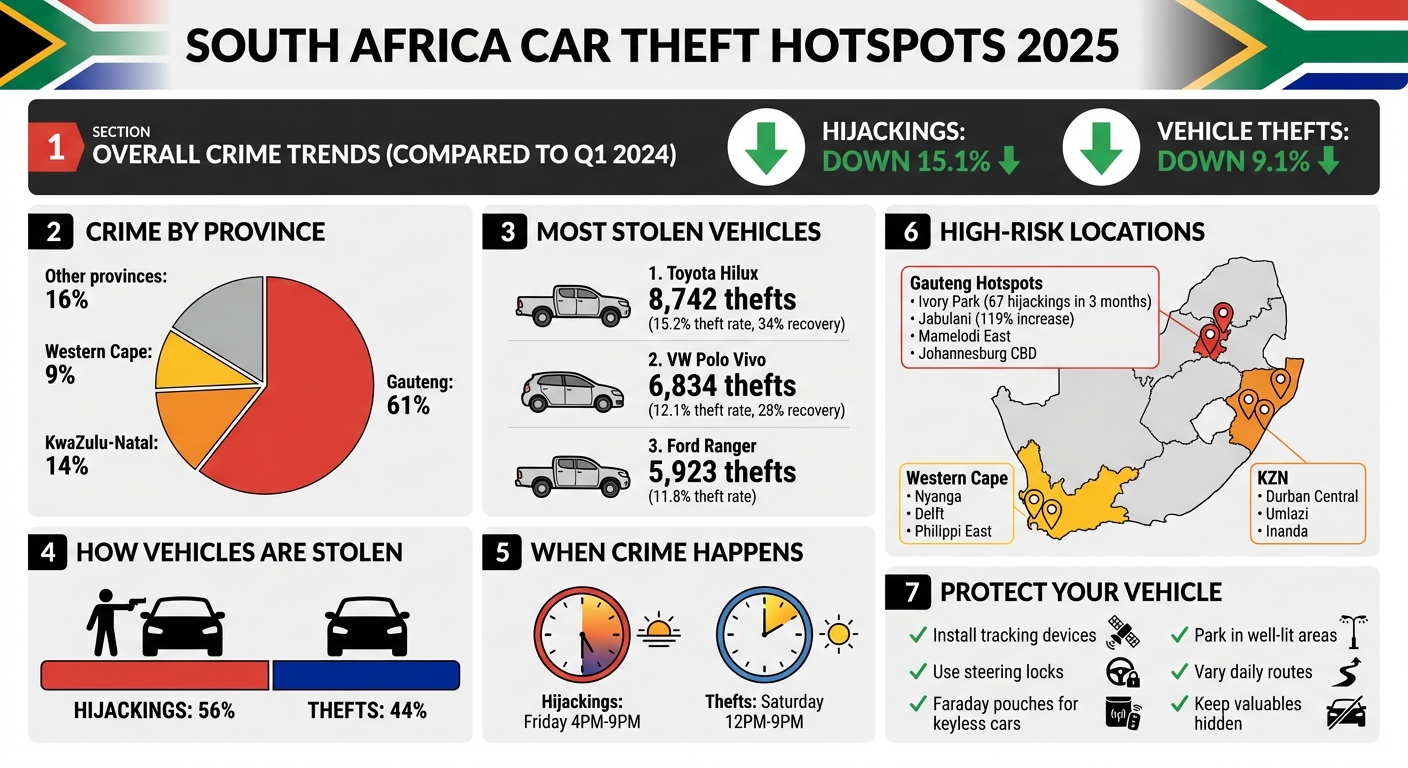
Car theft in South Africa remains a major concern, but recent SAPS data shows some positive trends. Hijackings dropped by 15.1% and vehicle thefts by 9.1% in early 2025 compared to the previous year. However, risks vary by region, with Gauteng leading in vehicle crime, accounting for 61% of incidents, followed by KwaZulu-Natal (14%) and the Western Cape (9%). High-risk areas include Ivory Park, Mamelodi East, and Johannesburg CBD in Gauteng, while hotspots in KwaZulu-Natal and the Western Cape center around cities like Durban and Cape Town.
Key findings:
- Most targeted vehicles: Toyota Hilux, VW Polo Vivo, and Ford Ranger.
- Common methods: Hijackings (56% of cases) and keyless entry hacks.
- Peak times: Friday evenings for hijackings and Saturday midday for thefts.
- High-risk locations: Residential areas, shopping centers, and busy highways like the N1/M1 corridors.
To reduce your risk:
- Use tracking devices, steering locks, and Faraday pouches.
- Avoid predictable routines and stay alert in high-risk areas.
- Park in well-lit, secure locations and keep valuables out of sight.
Stay vigilant, especially in areas with rising crime rates like Mpumalanga and the Eastern Cape, and consider layered security measures to protect your vehicle.
South Africa Car Theft Statistics 2025: Hotspots, Targeted Vehicles & Prevention
The Shocking Truth About Car Theft in South Africa 2024!
sbb-itb-09752ea
Provinces with the Highest Car Theft Rates
Gauteng accounts for 61% of vehicle crime incidents in South Africa, making it the clear leader in this category. KwaZulu-Natal follows with 14%, and the Western Cape comes in at 9%. These numbers highlight how population density and economic activity influence crime rates across regions. By examining these variations, authorities can focus on region-specific prevention strategies.
Gauteng: The Epicenter of Car Theft
Gauteng’s position as the province with the highest vehicle crime is no surprise, given the dense population of vehicles and bustling commercial hubs like Johannesburg and Pretoria. In the third quarter of 2023/24 alone, the province reported 3,010 hijackings. Key hotspots include Ivory Park, Mamelodi East, Akasia, Pretoria West, Tembisa, and the Johannesburg CBD.
Interestingly, Gauteng’s vehicle crime shows a 48:52 split between hijackings and thefts, meaning theft slightly outweighs hijacking. Duma Ngcobo, COO at Tracker, explains:
Gauteng is the province with one of the lowest proportions of hijacking, at 48% in comparison to theft at 52%
. This insight is crucial for vehicle owners looking to adopt the most effective security measures in the province.
KwaZulu-Natal and Western Cape
In KwaZulu-Natal, vehicle crime is concentrated in areas like Durban Central, Umlazi, Bhekithemba, and Inanda. Unlike Gauteng, hijacking is more common here, with business vehicles showing a 64:36 hijacking-to-theft ratio.
The Western Cape tells an even sharper story. In this province, 82% of business vehicle crimes involve hijacking, making theft a much smaller concern. High-risk zones include Nyanga, Delft, Lingelethu West, Mfuleni, Harare, and Philippi East.
Both provinces saw a decline in hijackings in early 2025, with KwaZulu-Natal experiencing a 25.7% drop and the Western Cape reporting a 23.5% reduction compared to the first quarter of 2024. These positive shifts highlight the impact of targeted crime prevention efforts.
Rising High-Risk Areas
While Gauteng, KwaZulu-Natal, and the Western Cape dominate in vehicle crime statistics, other provinces like the Eastern Cape and Mpumalanga are emerging as high-risk zones. Areas such as eMalahleni (Witbank) and Nelspruit in Mpumalanga, along with several locations in the Eastern Cape, are seeing a noticeable rise in incidents. Economic challenges and rising unemployment in these regions are contributing factors. Staying informed about these trends allows drivers to take proactive steps to protect their vehicles.
Specific High-Risk Areas and Locations
Neighborhoods and Police Precincts with High Theft Rates
Looking closer at specific areas, data from SAPS highlights neighborhoods and precincts that stand out for their high car theft rates. These zones are not just numbers on a map – they represent real risks for residents and commuters.
Take Ivory Park in Midrand, for instance. Nestled between Johannesburg and Ekurhuleni, this suburb recorded 67 hijackings in just three months (January to March 2025). That’s almost one hijacking every single day, making it the highest-risk area in the country for such crimes.
Jabulani in Gauteng also saw a sharp increase, with hijackings jumping by 119% – from 26 incidents last year to 57 this year. Other Gauteng precincts, like Moroka and Eldorado Park, are also seeing concerning spikes. Meanwhile, in KwaZulu-Natal, Mariannhill has emerged as a growing hotspot. Over in the Western Cape, areas such as Delft, Lingelethu West, Nyanga, Mfuleni, and Harare remain some of the most dangerous zones for vehicle theft.
These aren’t just statistics – they reflect areas where vigilance is absolutely critical.
Public Spaces Where Thefts Occur
Car theft isn’t confined to residential streets or commercial districts. Everyday public spaces are also prime targets. Shopping centers and malls are particularly risky, especially for follow-home hijackings. Here, criminals scout for potential victims, tailing them all the way to their homes .
Schools are another concern. Drop-off and pick-up times – around 6:00 a.m. and the busy afternoon hours – create a window of opportunity for thieves. Parents, often preoccupied with their kids, may not notice suspicious activity until it’s too late .
Petrol stations and fast-food drive-throughs are also common sites for thefts. Criminals often use a "blockage method" here – trapping vehicles by positioning one car in front and another behind, leaving the victim with no way to escape .
How Road Networks Affect Theft Patterns
Road layouts and transit routes play a big role in enabling thefts. In Gauteng, major highways like the N1/M1 corridors, especially at the Rivonia and Beyers Naudé off-ramps, are hotspots. Other risky areas include the N3 Linksfield Road off-ramp and intersections along CR Swart Road in Pretoria and Kempton Park.
Traffic lights and urban on-ramps are particularly dangerous, as stationary vehicles become easy targets. For business vehicles, the risks are even higher – commercial corridors see a 56% greater likelihood of theft, making courier vans and cargo trucks frequent victims.
The combination of high-traffic areas and strategic getaway routes makes these locations especially vulnerable. Staying alert and aware in these zones is key to avoiding becoming a statistic.
Which Vehicles Are Targeted and How
Vehicle Types Stolen Most Often
Knowing which vehicles are most commonly stolen helps highlight patterns in car theft. Statistics reveal that thieves tend to go after sedans, hatchbacks, and bakkies, largely because these vehicles are easy to resell or strip for parts.
Sedans and hatchbacks are at the top of the list, with 2,016 hijackings reported in the first quarter of 2025 – nearly 50% of all incidents. Their ability to blend into traffic makes them less noticeable after being stolen.
Bakkies and panel vans come next, with 1,503 hijackings during the same period. These vehicles are in high demand, especially for their parts, which fetch good prices on the black market. Business-owned vehicles in this category face even greater risks, as they are 33% more likely to be hijacked compared to personal-use vehicles.
SUVs and station wagons accounted for 341 hijackings. Although the numbers are smaller, these vehicles are often targeted for their off-road capabilities, making them ideal for smuggling operations. In fact, about 30% of stolen or hijacked vehicles in South Africa are smuggled into neighboring countries.
Car Models Thieves Target
Certain car models are clear favorites among thieves. The Toyota Hilux leads the pack with 8,742 thefts and a theft rate of 15.2%. It also has a relatively high recovery rate of 34%. The Volkswagen Polo Vivo follows closely with 6,834 thefts and a 12.1% theft rate (28% recovery rate). The Ford Ranger rounds out the top three with 5,923 thefts and an 11.8% theft rate. Vehicles like the Hilux are often stolen for their engines or smuggled across borders, where they fetch premium prices.
"Models like the Toyota Hilux and Fortuner are often taken for components such as their engines, whereas others like the Toyota Corolla Cross and RAV4 are frequently stolen to be smuggled across the border." – TopAuto
Other popular targets include the Hyundai Grand i10, Isuzu D-Max, Nissan NP200, BMW 3 Series, Renault Kwid, and Kia Picanto. These trends underline the demand for specific models, whether for parts or resale value.
Methods Criminals Use to Steal Vehicles
Advancements in vehicle security have shifted criminal tactics, with hijackings now making up 56% of vehicle crime, compared to 44% for theft.
"Hijacking gives criminals immediate access to the vehicle and its contents without having to bypass sophisticated ignition and security systems." – Atang Matebesi, CEO, Santam Client Solutions
Keyless entry systems are a growing target, particularly in Gauteng. Criminals use relay and canvas attacks to intercept and exploit the signal from key fobs.
Follow-home hijackings are another common method. These often happen near victims’ homes or workplaces, with criminals employing tactics like staged minor accidents, posing as law enforcement, or blocking vehicles at intersections. Hijackings are most frequent on Fridays between 4:00 p.m. and 9:00 p.m., while vehicle theft peaks on Saturdays during the same hours.
E-hailing and delivery drivers have also become frequent targets, primarily for the valuable goods they transport rather than the vehicles themselves. Business vehicles face even greater risks – in the Western Cape, they are four times more likely to be hijacked than stolen, and in the Eastern Cape, this risk increases to eight times.
How to Protect Your Vehicle from Theft
Security Technology for Vehicles
Using a combination of security measures – like immobilizers, tracking devices, dashcams, and physical locks – can make your vehicle less appealing to thieves and improve the chances of recovery if it’s stolen.
Tracking systems are especially important for recovering stolen vehicles. Today’s advanced trackers use a mix of GPS, GSM, and RF technologies to provide real-time location updates, remote monitoring, and even counteract signal jamming. For example, Cartrack reports recovering over 100,000 vehicles in the past decade, while Tracker has recovered 127,884 vehicles and played a role in 20,958 arrests. Some trackers even include early-alert features that notify recovery teams the moment your car is moved without permission.
"Vehicle tracking devices play a pivotal role in vehicle recovery and with the innovation in technology in this space, they are also essential for driver and passenger safety."
- Duma Ngcobo, Chief Operating Officer, Tracker
For cars with keyless entry, Faraday pouches are a must. These signal-blocking bags stop thieves from using relay attacks to amplify your key fob’s signal, which could otherwise allow them to unlock and start your car. Physical deterrents like steering wheel locks and wheel clamps are also effective. Besides creating a visible obstacle for thieves, they might even help reduce your insurance premiums. Pair these tools with smart daily habits to further protect your vehicle.
Daily Habits to Reduce Theft Risk
Everyday actions can go a long way in keeping your car safe. Always double-check that your car is locked after using your remote; thieves sometimes use signal-jamming devices to block the locking signal. For keyless entry vehicles, storing your fob in a Faraday pouch is essential to prevent relay attacks.
Parking in well-lit areas with security cameras is another smart move. Keep valuables like laptops, phones, or bags out of sight – store them in the trunk or hidden spaces only when you arrive at your destination. Avoid sitting in your parked car while distracted by your phone, as this can make you an easy target for hijackers. Another tip: vary your daily routes to make it harder for potential criminals to predict your movements.
Insurance and Vehicle Recovery
While physical and behavioral measures are crucial, having the right insurance adds a layer of financial security. Comprehensive insurance not only covers the loss of your vehicle but also helps with costs like car rentals, excess payments, and legal fees.
"It’s not just about replacing the car… It’s about protecting yourself financially against the ripple effects of a loss. It all adds up, from car hire costs and excess payments to potential debt obligations if the vehicle is financed."
- Atang Matebesi, CEO, Santam Client Solutions
If comprehensive coverage is out of reach, Third Party, Fire and Theft insurance is a more affordable alternative that still provides protection against theft or hijacking. As mentioned earlier, dual tracking systems can enhance recovery efforts. In case of theft, your first step should be to contact your tracking provider – they can start the recovery process immediately while you report the incident to the police.
Conclusion
Main Findings Summary
According to SAPS data, Gauteng dominates as the hub of vehicle crime, accounting for 61% of incidents. Business-owned vehicles are especially at risk, with a 56% higher chance of being targeted compared to personal vehicles, making fleet security a pressing concern. On a positive note, both hijackings and thefts have been decreasing – hijackings dropped by 15.1%, and thefts fell by 9.1% in the first quarter of 2025 compared to the same period last year.
However, criminals are adapting, using advanced techniques like relay and canvas attacks to bypass modern keyless systems. A large number of stolen vehicles are also smuggled out of the country. Certain vehicle models, including the Toyota Hilux, Fortuner, Corolla Cross, VW Polo, and Ford Ranger, remain prime targets. Hijackings are most frequent on Friday evenings, while thefts peak around mid-day on Saturdays. These patterns highlight the need for targeted security strategies.
Taking Action to Protect Your Vehicle
Given these trends, enhancing vehicle security is more important than ever. If you drive a high-risk model or live in areas like Orange Farms, Nyanga, or Kwazakele, consider layered security measures such as trackers, steering locks, and Faraday pouches to block keyless entry hacks. Tailor your precautions to local risks, and remain especially vigilant during peak crime hours. Most hijackings occur near or at home, so extra caution is essential when arriving at your residence.
"It is imperative to remain vigilant, especially during peak shopping periods. Your safety should always take precedence over material possessions."
- Duma Ngcobo, COO, Tracker
While the data shows progress in reducing vehicle crime, individual awareness and preparation remain vital. By implementing the security tips discussed here, you can greatly lower your risk of falling victim to vehicle crime. Stay alert, stay prepared, and prioritize your safety.
FAQs
How do I check if my neighborhood is a SAPS car theft hotspot?
To determine if your neighborhood is a hotspot for car theft according to SAPS data, start by reviewing recent crime statistics and reports highlighting high-risk areas in South Africa. Some well-known hotspots include urban hubs like Pretoria Central, Johannesburg Central, and areas such as Ivory Park and Tembisa.
You can stay informed by checking local SAPS crime reports or reaching out to reputable vehicle security providers. These sources often update information on theft-prone areas to help you assess the risks in your community.
What’s the best way to protect a keyless car from relay theft?
To keep your keyless car safe from relay theft, consider using signal-blocking pouches or containers, such as Faraday bags. These specially designed items block the signal from your car key, making it impossible for thieves to amplify and use it to access your vehicle. It’s a straightforward yet effective way to reduce the chances of someone gaining access without permission.
If my car is stolen, what should I do first – tracker or SAPS?
If your car is stolen, the first thing you should do is report the theft to the South African Police Service (SAPS) to have it officially documented. Once that’s done, activate your vehicle tracker (if your car is equipped with one) to help with recovery efforts. Acting promptly on these steps can significantly improve the chances of finding your vehicle.
Related Blog Posts
- Why Keyless Entry Cars Are High-Risk In SA
- Car Theft Insurance in South Africa: Key Requirements
- Most Stolen Cars in South Africa 2025: Updated Crime List
- Toyota Hilux Theft Surge: What’s Driving It?