South African fuel prices are at a turning point in February 2026. Inland petrol 95 is priced at R20.10 per liter – a four-year low – but this relief is temporary. A 21-cent-per-liter tax hike on April 1, 2026, paired with rising Brent crude oil prices ($71.30 per barrel), signals higher costs ahead. For drivers, this means tighter budgets, rising transport costs, and increased grocery prices. Key factors shaping fuel prices include global oil market trends, the Rand-Dollar exchange rate, and government levies.
Key Takeaways:
- Current Prices: Inland petrol 95 is R20.10/liter, diesel 0.005% is R17.95/liter.
- Upcoming Tax Hike: 21 cents/liter increase effective April 1, 2026.
- Global Impact: Brent crude prices rose from $61.47 to $71.30 per barrel in early 2026.
- Exchange Rate Relief: A stronger Rand (R15.88/$) has reduced some pressure.
- Forecast: Petrol may rise to R20.52/liter by April 2026, while diesel could reach R18.60/liter.
Drivers are advised to plan ahead, explore fuel-saving tips, and consider more efficient vehicle options to manage rising costs.
South Africa Fuel Price Breakdown and 2026 Forecast
Current Fuel Prices in South Africa
Recent Price Changes and Comparisons
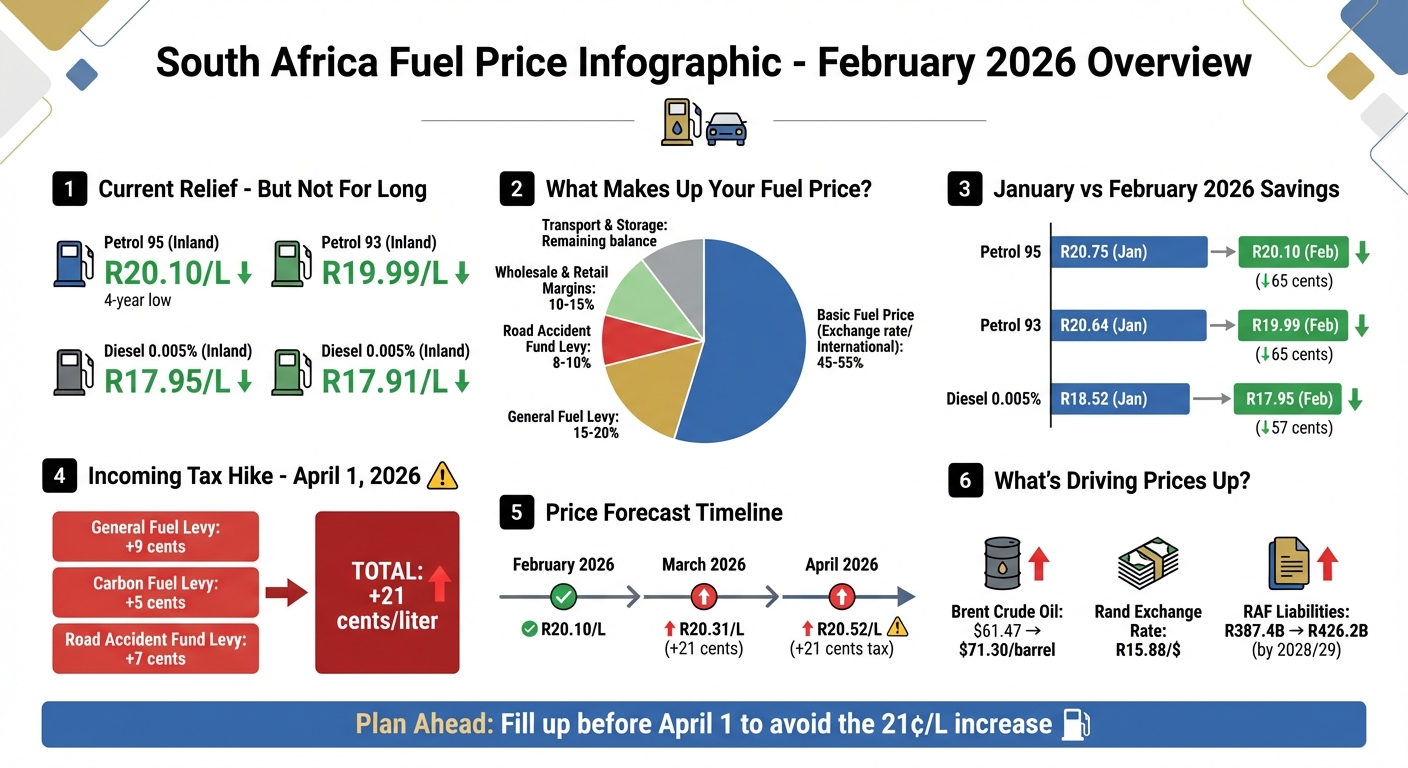
For the second consecutive month, fuel prices in South Africa have seen a decline. Inland prices for 95 unleaded petrol now stand at R20.10 per liter, while 93 unleaded is priced at R19.99 – the lowest levels recorded since February 2022. Diesel prices have also dropped, with 0.05% sulfur diesel at R17.91 per liter and 0.005% sulfur diesel at R17.95 per liter.
Between January and February 2026, inland petrol prices fell by 65 cents per liter, while diesel prices decreased by 57 cents. Coastal regions benefited even more, with 95 unleaded petrol priced at R19.27 per liter and diesel at R17.08 per liter. A stronger Rand played a key role in these reductions, averaging R16.31 to the US dollar compared to R16.85 the previous month. This marked the first time in nearly four years that the Rand dropped below the R16/$ threshold.
| Fuel Type | January 2026 (Inland) | February 2026 (Inland) | Savings |
|---|---|---|---|
| Petrol 95 ULP | R20.75 | R20.10 | 65 cents |
| Petrol 93 ULP | R20.64 | R19.99 | 65 cents |
| Diesel 0.005% | R18.52 | R17.95 | 57 cents |
While the stronger Rand has provided temporary relief, rising Brent crude oil prices – climbing from $61.47 to $71.30 per barrel – signal potential challenges ahead. Despite these reductions, long-term structural issues continue to impact motorists.
Main Challenges for Drivers
South African drivers face challenges that extend beyond short-term price drops. The country’s reliance on fuel imports makes it highly vulnerable to global oil market fluctuations and exchange rate shifts. Events like geopolitical tensions – such as the recent instability between the US and Iran – can lead to sudden spikes in oil prices.
Adding to these challenges, a 21-cent-per-liter tax hike is set to take effect on April 1, 2026. This increase includes a 9-cent rise in the General Fuel Levy, 5 cents for the carbon fuel levy, and 7 cents for the Road Accident Fund levy. Early projections for March 2026 suggest petrol prices could rise by 18–21 cents per liter, while diesel may increase by 62–65 cents due to higher international product prices.
These price changes ripple through the economy, affecting transportation costs and, by extension, the prices of goods and services. For many households, frequent fuel price fluctuations create financial strain, forcing tough decisions about allocating budgets between fuel, groceries, and other necessities. This uncertainty continues to weigh heavily on South African motorists as they navigate their financial planning in the face of fluctuating fuel costs.
sbb-itb-09752ea
What Drives Fuel Price Changes
Global Oil Market Trends
South Africa, as a country that imports both crude oil and refined products, is heavily influenced by international oil prices. This means that shifts in global markets directly impact local fuel costs. The price of Brent crude oil, which serves as the global benchmark, plays a significant role in determining these costs.
Geopolitical tensions in key oil-producing regions can cause immediate price spikes. For instance, the Strait of Hormuz, a vital passage for nearly 20% of the world’s oil supply, remains a critical factor. When tensions escalated between the US and Iran in early 2026, the price of Brent crude jumped from an average of $61.47 to over $67.20 per barrel by mid-February. Similarly, disruptions in countries like Iran, Venezuela, or areas around the Black Sea can quickly drive up local fuel prices.
Another factor pushing prices higher in 2026 is the growing demand for oil in industrial and transportation sectors across Asia. Additionally, refining and trading activities in the Gulf region further influence the availability and cost of refined products.
Rand-Dollar Exchange Rate and Local Taxes
The strength of the South African rand against the US dollar has a direct impact on fuel prices. A stronger rand reduces the cost of importing oil, as seen in January 2026. During that month, the rand appreciated from R16.55/$ to R15.70/$, which helped soften a potential fuel price hike. Without this currency gain, petrol prices would have increased by approximately 35 cents per liter instead of 18 cents.
"Because South Africa imports both crude oil and refined products, a stronger local currency directly reduces the rand cost of those dollar-priced commodities." – Henry van der Merwe, Chairman, South African Petroleum Retailers Association
The Basic Fuel Price (BFP), which makes up 45–55% of the total retail petrol price, is particularly sensitive to the exchange rate. However, local taxes also play a significant role in overall fuel costs. Starting April 1, 2026, the General Fuel Levy (GFL) will rise to R4.10 per liter for petrol, and the Road Accident Fund (RAF) levy will increase to R2.25 per liter.
| Component | Estimated Share of Price |
|---|---|
| Basic Fuel Price (Exchange rate/International markets) | 45–55% |
| General Fuel Levy | 15–20% |
| Road Accident Fund (RAF) Levy | 8–10% |
| Wholesale & Retail Margins | 10–15% |
| Transport & Storage | Remaining balance |
These factors highlight how both global market trends and local dynamics combine to shape fuel prices.
Government Policies and Energy Shifts
Government tax policies add fixed costs to fuel prices, regardless of fluctuations in global markets. In the 2026 National Budget, a combined 21-cent per liter increase across various levies was announced, effective April 1, 2026. This includes a 9-cent hike in the General Fuel Levy, a 5-cent increase for the carbon fuel levy, and a 7-cent rise in the Road Accident Fund levy.
The RAF levy alone generates over R45 billion annually for the government. However, the fund faces significant long-term liabilities, which are expected to grow from R387.4 billion to R426.2 billion by 2028/29. Critics argue that these increases, often referred to as "stealth taxes", place an undue burden on motorists without addressing the deeper structural issues within the RAF.
"Adding an extra R1.5 bn in levies annually, without addressing RAF’s structural issues, simply shifts the burden to motorists while liabilities continue to grow." – Wayne Duvenage, CEO, OUTA
Fuel Price Forecasts: 2026 and Beyond
2026 Price Outlook
By March 3, 2026, inland petrol 95 is expected to climb by 21 cents, reaching about R20.31 per liter, while diesel 0.005% could jump 65 cents to roughly R18.60 per liter. These increases are tied to Brent crude oil prices rising to $71.30 per barrel, fueled by escalating tensions between the United States and Iran.
On April 1, 2026, Finance Minister Godongwana’s tax adjustments are set to further impact fuel costs. With increases of 9 cents from the General Fuel Levy, 5 cents from the Carbon Fuel Levy, and 7 cents from the Road Accident Fund levy, petrol 95 could rise to around R20.52 per liter, assuming no additional shocks.
Interestingly, a stronger rand, trading at approximately R15.88 per dollar in late February 2026, has helped offset some of these price hikes. However, despite these short-term fluctuations, long-term factors such as fiscal obligations and steady global demand suggest that fuel prices will continue to rise.
Price Projections Through 2028
Looking beyond 2026, the same forces driving current price increases are likely to persist. Fiscal pressures and tightening global oil supplies are expected to keep fuel costs on an upward trend. For instance, the Road Accident Fund’s liabilities are projected to grow significantly, from R387.4 billion to R426.2 billion by 2028/29. This mounting fiscal burden will likely lead to further levy hikes. On the global front, steady industrial and transportation demand from Asia is expected to support higher oil price floors.
"Increasing the levy by a further R1.5 bn per annum, without fixing the structural failures of the RAF, simply shifts the burden to motorists while liabilities continue to grow. South Africans are paying more into a system that remains fundamentally broken." – Wayne Duvenage, CEO, OUTA
Geopolitical uncertainties add another layer of unpredictability. The Strait of Hormuz, a critical channel for nearly 20% of the world’s oil supply, remains a potential flashpoint. Any significant disruption there could cause prices to soar beyond current forecasts.
Domestically, South Africa’s economic growth is forecasted to reach 1.6% in 2026 and 2% by 2028. However, the affordability of fuel will play a crucial role in determining whether these growth targets can be met.
How Fuel Prices Affect South African Drivers
Household Budgets and Inflation
Fuel price increases have a direct and often painful effect on household finances in South Africa. For many families, rising fuel costs mean stretching already tight monthly budgets even further. These increases are especially tough on lower-income households, as they spend a larger portion of their income on transportation and often lack the financial cushion to handle unexpected expenses.
For example, when diesel prices are set to rise by 65 cents per liter in March 2026, the ripple effects will be felt almost immediately. Logistics companies typically pass these higher costs on to retailers, which then leads to an increase in grocery prices within weeks. On top of that, motorists face additional "stealth taxes", further intensifying the financial strain.
These rising costs force families to make tough choices, cutting back on non-essential spending and even scaling down essential purchases. Tando Ngibe, Senior Manager at Budget Insurance, highlights the critical need for financial planning in these situations:
"Fuel increases are financially regressive. They hit lower-income households hardest. This is where emergency funds and careful cash-flow planning become essential".
Vehicle Affordability and Ownership Patterns
Higher fuel costs don’t just affect daily expenses – they also reshape how South Africans approach vehicle ownership. With household budgets under pressure, consumers are rethinking their priorities when it comes to buying cars. Many are gravitating toward more economical options, focusing on value and efficiency.
The used car market, particularly for popular SUVs, has seen a surge in interest. Buyers are looking for ways to avoid the upfront costs of new vehicles while managing ongoing fuel expenses more effectively. At the same time, alternative energy vehicles are gaining traction. Models like the 2026 Prius Plug-In Hybrid and the 2026 bZ XLE electric vehicle reflect a growing shift toward options that reduce reliance on traditional fuel sources. Budget-friendly cars, such as the Changan Alsvin, are also becoming increasingly popular as families prioritize affordability over luxury features.
Adding to the burden, taxes like the Road Accident Fund levy contribute significantly to the overall cost of vehicle ownership. This levy alone generates over $11.7 billion annually, and with the fund’s liabilities expected to reach $111.2 billion by 2028/29, the financial challenges for vehicle owners are only set to grow. These pressures are pushing consumers to make more cautious and strategic decisions about their spending and vehicle choices, further highlighting the economic strain caused by rising fuel prices.
How to Reduce Your Fuel Costs
Driving Tips to Save Fuel
Simple changes in driving habits can make a big difference in fuel savings. First, keep your tires properly inflated – under-inflated tires increase fuel consumption unnecessarily. Additionally, avoid sudden acceleration and hard braking. These habits not only waste fuel but can also lead to higher maintenance costs. Aim for steady speeds and anticipate traffic patterns to minimize the need for frequent stops and starts.
Planning Routes to Cut Travel Costs
Smart route planning is another way to keep fuel costs in check. For instance, timing your gas station visits can help – prices often drop on the first Wednesday of the month. If possible, fill up before April 1, 2026, to avoid a 21¢/L levy increase. Using navigation tools to find shorter or less congested routes also helps reduce fuel consumption. These small adjustments can add up, making it easier to manage the impact of rising fuel prices.
Buying Fuel-Efficient and Second-Hand Vehicles
Your choice of vehicle plays a big role in long-term fuel expenses. Fuel-efficient models, such as the Toyota Yaris (4.9–5.1 L/100km), Kia Picanto (5.0–5.4 L/100km), or VW Polo Vivo (5.5–6.0 L/100km), can significantly lower running costs. If a new vehicle feels out of reach, consider a reliable second-hand option. Platforms like AUTO24.co.za offer listings with verified mileage, making it easier to find an efficient car within your budget. For example, a 2019 Peugeot 308 1.2T Manual is priced around $9,700 (R165,000), while a 2014 Audi A1 S-Line 1.4 Automatic costs approximately $12,000 (R205,000). These vehicles not only save on fuel but also retain their value better than many new cars.
Fuel prices set to decrease in January
Conclusion
In February 2026, South African drivers enjoyed a brief reprieve with petrol 95 priced at R20.10 per liter inland – a four-year low. However, this relief was short-lived. March brought market-driven price hikes, and starting April 1, 2026, a 21-cent per liter tax increase is set to add even more strain to fuel costs.
To navigate these rising costs, it’s crucial to stay informed. Keep an eye on the Central Energy Fund‘s mid-month data updates to plan your refueling strategically. As Tando Ngibe, Senior Manager at Budget Insurance, points out:
"Fuel increases are financially regressive. They hit lower-income households hardest. This is where emergency funds and careful cash-flow planning become essential".
These strategies can help you soften the impact of rising fuel prices on your overall financial well-being.
The ripple effects of higher fuel costs extend beyond the pump, influencing grocery prices, logistics, and the entire retail supply chain. Building an emergency fund specifically for transportation expenses and revisiting your budget can provide some financial cushioning. With geopolitical tensions driving Brent crude prices higher and a weaker rand compounding the issue, proactive planning is key to weathering future price volatility. Taking steps now can make a big difference in managing the challenges ahead.
FAQs
Why do fuel prices rise even when the rand strengthens?
Even with a stronger rand, fuel prices can still climb due to the influence of rising global oil prices. In many cases, the impact of higher oil prices outweighs the advantages of a favorable exchange rate, resulting in increased local fuel costs.
How much could the April 1, 2026 fuel levy increase add to my monthly budget?
The fuel levy increase set for April 1, 2026, is expected to add about R0.29 to R0.30 per liter to fuel prices. For the average consumer, this could mean an extra R20 to R30 per month in fuel expenses, depending on how much you drive. It’s a good idea to plan ahead and adjust your budget to accommodate this additional cost.
When should I fill up to minimize the impact of upcoming price hikes?
Fuel prices are predicted to drop in February, with petrol expected to decrease by about 66–69 cents per liter and diesel by roughly 63 cents per liter. Filling up now could help you save money and avoid paying more down the line.
Related Blog Posts
- Fuel-Saving Tips for Long South African Road Trips
- Diesel or Petrol: What’s best in SA
- Electric vs Petrol: Trends in South Africa
- South Africa fuel prices drop this November – official government update