
In 2026, South Africa introduced stricter roadworthy regulations to improve vehicle safety and reduce fraud. Here’s what you need to know:
- Starting July 1, 2026, the AARTO Act brings a demerit-point system for violations like driving without a valid roadworthy certificate.
- Vehicles older than 5 years must pass annual roadworthy tests for license renewals in most provinces.
- Inspections now include electronic safety features, emissions testing, and structural integrity checks.
- A valid roadworthy certificate is required for ownership transfers, license renewals, and vehicles returning to the road after repairs.
- Non-compliance can lead to fines, demerit points, license suspension, or voided insurance claims.
To prepare, ensure your vehicle meets updated safety standards, gather required documents, and schedule your test early. Compliance isn’t optional – stay safe and avoid penalties.
DEKRA Automotive South Africa Roadworthy Test
sbb-itb-09752ea
What Changed in the 2026 Roadworthy Regulations
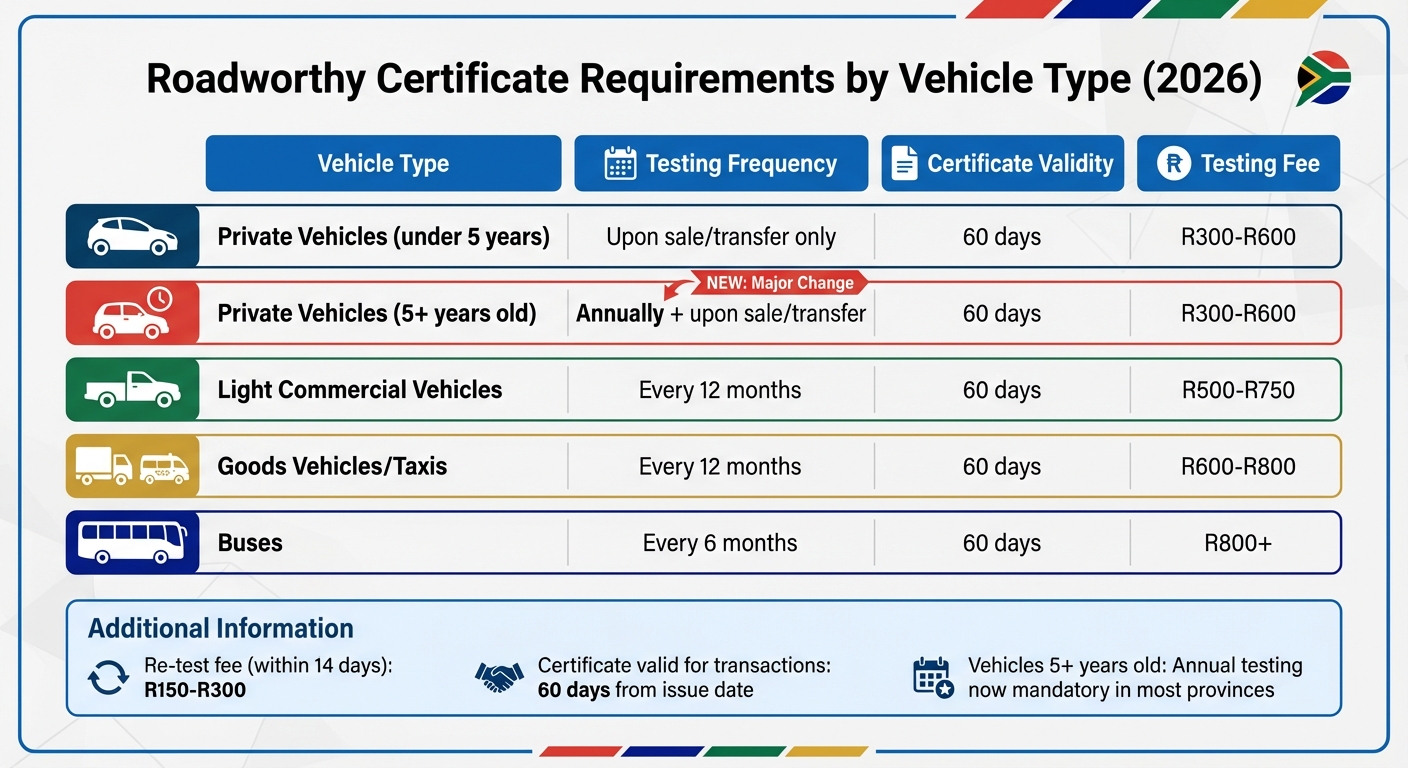
South Africa Roadworthy Certificate Requirements by Vehicle Type 2026
The 2026 roadworthy regulations bring notable updates to vehicle safety testing, certificate durations, and documentation. These adjustments aim to improve road safety by redefining when and how vehicles are inspected, as well as the validity of roadworthy certificates.
New Testing Standards
Testing now goes beyond mechanical components and includes electronic safety features and structural integrity. In the past, inspections focused mainly on brakes, lights, and tires. Under the new standards, testing stations also evaluate advanced safety features like Electronic Stability Control (ESC) and airbag functionality. Bobby Ramagwede, CEO of the Automobile Association of South Africa, highlighted the importance of these updates:
"At a minimum, every car that is sold in this country should have electronic stability control and the full suite of airbags. You shouldn’t have to buy up the safety. Safety should be standard in a vehicle."
Additionally, inspections now include emissions testing and engine condition checks, requiring vehicles to meet specific limits for smoke levels, exhaust leaks, and noise. This shift addresses areas previously overlooked in roadworthiness evaluations. Structural inspections have also intensified, with a focus on chassis integrity, rust, and damage that could impact safety during collisions.
For newer vehicles, inspectors are beginning to assess Advanced Driver Assistance Systems (ADAS). Features like emergency stop signals, reversing detection, and event data recorders are now checked against UN ECE and EU standards. These expanded criteria align with changes to certificate validity, detailed below.
Changes to Certificate Validity Periods
The validity of roadworthy certificates for private vehicles remains at 60 days from the date of issue. However, a major change is the introduction of annual roadworthy tests for vehicles older than five years in most provinces. Previously, testing was only required during ownership transfers.
| Vehicle Type | Testing Frequency | Certificate Validity |
|---|---|---|
| Private Vehicles | Upon sale/transfer or annually (if 5+ years old) | 60 days |
| Goods Vehicles/Taxis | Every 12 months | 60 days (for transactions) |
| Buses | Every 6 months | 60 days (for transactions) |
If a vehicle fails the inspection, owners have 14 days to make repairs and return for a re-test. The re-test fee ranges between R150–R250, significantly lower than the standard fee of R300–R500. These changes, combined with stricter documentation requirements, aim to ensure vehicles meet safety standards consistently.
New Documentation Requirements
The updated regulations also tighten documentation protocols. Vehicle owners must now provide several documents during inspections, including their identity document (ID), the vehicle’s registration certificate, and a completed Application for Certification of Roadworthiness (ACR) form.
For vehicles with modified engines, all changes must be registered on the National Traffic Information System (eNaTiS) before a roadworthy certificate can be issued. Inspectors verify that the engine number and Vehicle Identification Number (VIN) match the registration documents exactly. Any discrepancies or signs of tampering lead to an automatic failure.
These updates collectively aim to improve road safety and ensure that all vehicles on South African roads meet stricter compliance standards.
When You Need a Roadworthy Certificate
Understanding when a roadworthy certificate is required can save you from unnecessary penalties and delays. Here are the key situations where this certificate becomes essential.
Selling or Transferring Your Vehicle
In South Africa, a valid roadworthy certificate is a must when selling or transferring vehicle ownership. Without it, the buyer cannot register the vehicle in their name, making it an indispensable part of the sales process. For specifics on how long the certificate remains valid, refer back to the "Changes to Certificate Validity Periods" section.
For sellers, having the certificate ready before listing the vehicle can boost buyer confidence and help avoid hiccups during the transfer process. It’s also important to complete the registration within 21 days to steer clear of fines. If the certificate expires before the transfer is finalized, you’ll need to go through another inspection – and pay for it.
Next, let’s look at how these rules tie into renewing your vehicle registration.
Renewing Your Vehicle Registration
The updated renewal guidelines aim to ensure vehicles remain safe and compliant with the latest standards. If your private vehicle is older than five years, you now need a valid roadworthy certificate for its annual license renewal in most provinces. This marks a major change from past regulations. However, private vehicles less than five years old are still exempt from this requirement during standard renewals.
For commercial vehicles, testing is non-negotiable. Heavy-load and public transport vehicles (excluding buses) must pass roadworthy testing every 12 months before their license can be renewed. Buses, given their frequent use, face stricter rules and require testing every six months to maintain their operating licenses.
Returning to Public Roads After Major Repairs
If your vehicle has undergone major repairs or modifications, it must pass a roadworthy test before hitting the road again. This ensures the vehicle aligns with current safety standards. The same applies to vehicles that have been rebuilt, imported, or deregistered and are being reintroduced to active use.
For vehicles with lapsed registration exceeding four years, a new roadworthy certificate is mandatory for re-registration. When testing after repairs, you’ll need to present the original registration, a valid ID or driver’s license, and proof of address. These steps are crucial to confirm your vehicle meets the required safety benchmarks.
What Gets Inspected During a Roadworthy Test
A roadworthy inspection ensures your vehicle is safe for South African roads by examining key systems like brakes, steering, and exhaust. Inspectors look for potential hazards that could compromise safety. As Scott Vanderzalm, Owner and Inspector at V-Mech Automotive, puts it:
"A roadworthy inspection is designed to confirm a vehicle is safe to be on the road at that moment. It doesn’t mean everything on the car is perfect".
The inspection is divided into three main categories: braking and steering systems, body and lighting components, and emissions and engine health. Knowing what inspectors check can help you prepare your vehicle before scheduling the test.
Brakes, Tires, and Steering
The braking system undergoes a detailed review. Brake pads must have at least 0.12 inches (3mm) of friction material, though vehicles with wear sensors can pass with as little as 0.04 inches (1mm). Inspectors also check brake lines and hoses for leaks or cracks, evaluate rotors and drums for scoring or rust, and test the parking brake to ensure it holds on a 12% grade.
To prepare, check that your brake fluid is between "MIN" and "MAX" levels. Squealing or grinding noises often indicate worn pads or warped rotors. Test your parking brake on a steep incline to confirm it holds firmly without excessive slack. For tires, the legal minimum tread depth is 0.06 inches (1.6mm) across the center.
Body, Lights, and Visibility
The vehicle’s structural condition is inspected for rust, corrosion, or loose parts. Doors must open and close smoothly from both inside and outside, with all hinges secure and inner panels intact. Bumpers, mirrors, and reflectors must be firmly in place, with no sharp edges that could pose a danger to pedestrians.
The lighting system is thoroughly tested. This includes headlights (both high and low beams), taillights, brake lights, turn signals, hazard lights, reverse lights, and license plate lights. All bulbs must function correctly. Headlight alignment is also checked to ensure the beams are level and properly aimed. Additionally, the windshield should be free of cracks in the driver’s line of sight, and at least one windshield wiper must work along with the washer fluid system. Before the inspection, test all lights and wipers to ensure they function properly.
Emissions and Engine Condition
Inspectors verify that your vehicle complies with emissions standards. They look for exhaust smoke, leaks, and required components like catalytic converters. For newer vehicles, an On-Board Diagnostics (OBD) scan is performed to detect any emission-related issues. Diesel vehicles are subjected to an opacity test to measure the density of black smoke during acceleration.
Fluid leaks, whether oil, fuel, or coolant, will lead to an immediate failure. Inspectors also confirm that the engine number matches the registration documents. To prepare, ensure your "Check Engine" light is off, fix any visible leaks, and inspect your exhaust pipe for rust or holes. If rust crumbles when touched, replacement may be necessary. A basic tune-up, including fresh spark plugs and a clean air filter, can improve engine performance and emissions. Addressing these points ahead of time can save you from re-tests and additional costs.
How to Prepare Your Vehicle for Testing
Getting your vehicle ready for testing can save you both time and money. Focus on areas that commonly cause failures: lights, brakes, tires, and fluid leaks.
Pre-Test Maintenance Checklist
Start by cleaning the engine compartment and undercarriage. This helps you spot any leaks or structural issues that could lead to a failed test. Double-check that the engine number and VIN match the registration details – discrepancies will result in immediate rejection.
Inspect your brake pads for wear and ensure the brake fluid is between the "MIN" and "MAX" marks. Check all tires, including the spare, for a minimum tread depth of 1.6 mm, and make sure they’re free of cuts or bulges. Ensure all exterior lights are functioning correctly.
Look over the windshield for cracks that could obstruct your view and confirm that at least one wiper works properly. Test all seatbelts to make sure they fasten and release without issue. Verify that the horn, speedometer, and odometer are operational. Lastly, check underneath the vehicle for any oil, fuel, or coolant leaks – visible drips will lead to a failed inspection.
Before heading to the testing station, gather all necessary documents and fees to avoid unnecessary delays.
Documents and Fees You’ll Need
You’ll need the following:
- Vehicle registration
- A valid ID or driver’s license
- Proof of address dated within the last three months
- Completed ACR form (available at the testing station)
Here’s a breakdown of estimated testing fees:
| Vehicle Category | Estimated Testing Fee |
|---|---|
| Private Passenger Cars | $300 – $600 |
| Light Commercial Vehicles | $500 – $750 |
| Minibuses and Taxis | $600 – $800 |
| Heavy Trucks and Buses | $800+ |
| Re-inspection Fee (within window) | $150 – $300 |
If your vehicle doesn’t pass, you’ll have 14 days to fix the issues and return for a retest without paying the full fee again.
Finding and Booking a Testing Station
Roadworthy tests can be done at government-run municipal centers or accredited private facilities like DEKRA or AVTS. To find the nearest authorized station, visit the National Traffic Information System (NaTIS) website or contact your provincial transport department. Always confirm the testing station’s accreditation before booking.
In busy areas, it’s a good idea to schedule your appointment at least a week in advance. Many testing centers now offer online booking through the NaTIS portal, while others accept phone appointments or walk-ins. The inspection itself typically takes 30 to 60 minutes. Once issued, the roadworthy certificate is valid for 60 days, which is particularly important for private vehicle sales or ownership transfers.
Penalties for Non-Compliance
The updated roadworthy regulations come with strict consequences, emphasizing safety and ensuring adherence. Ignoring these rules doesn’t just put lives at risk – it can lead to serious legal, financial, and insurance-related repercussions.
Fines and Legal Consequences
Driving without a valid roadworthy certificate or failing a required inspection can result in hefty penalties under South Africa’s AARTO system. For instance, if a traffic officer instructs you to present your vehicle for testing and you fail to comply, you’ll face a fine of $100 (R1,750). The same penalty applies if you’re unable to produce necessary vehicle documents when asked.
Businesses are held to even stricter standards. If a company neglects to properly register or license a vehicle, the fine increases to $200 (R3,512). Beyond the financial hit, non-compliance impacts your driving record. Driving without a valid certificate results in 3 demerit points, while continuing to drive when prohibited racks up 6 demerit points.
The demerit system isn’t just a slap on the wrist. Accumulating 15 points leads to an automatic suspension of your license – three months for every point over the limit. And it doesn’t stop there. After two suspensions, a third offense results in permanent license cancellation, forcing you to start over by retaking both the learner’s and driving tests. Repeat offenders are also required to attend a rehabilitation program, which includes simulator testing and psychological evaluation.
But it’s not just about fines and points – failing to comply with these rules can also void your insurance, leaving you financially exposed.
Insurance and Liability Issues
Non-compliance can severely impact your insurance coverage, creating significant financial risks. Insurance policies typically require vehicles to remain roadworthy at all times. If your vehicle is deemed unroadworthy after an accident, your insurer may reject your claim. As insurance expert Willers Baard points out:
"Your insurer clearly states that they are not obligated to meet any of your insurance claims should it be found that your vehicle was not roadworthy at the time of an accident/incident and that the un-roadworthiness status could have been a contributing factor or was the cause of the accident."
This means you could be left footing the bill for all repair costs, medical expenses, and third-party damages. Even seemingly minor issues, like tire tread below 1.6mm – one of the most common reasons for failure – can give insurers grounds to deny claims. Additionally, if your license is suspended due to accumulated demerit points, you’re considered unlicensed during that period, which also invalidates your coverage.
Conclusion
South Africa’s updated roadworthy regulations for 2026 aim to ensure safer roads by keeping unfit vehicles off the streets. As Gauteng Traffic Police Spokesperson Sello Maremane pointed out:
"Road safety is the responsibility of every road user".
The takeaway is simple: compliance is mandatory, and ignoring these rules can lead to more than just fines – it could have serious consequences for safety and legality.
Here’s what stands out: private vehicle certificates remain valid for 60 days, so timing is crucial for sales or renewals. Commercial vehicles must undergo annual testing, with inspections covering essentials like a minimum tire tread depth of 1.6 mm (around 0.06 inches) and verifying that engine and VIN numbers match the registration documents. Testing fees, including retests, are designed to remain accessible.
Authorities are actively enforcing these rules. In one Gauteng operation, 19 unroadworthy vehicles were impounded, and 83 drivers were arrested in just one day. With digitized systems now preventing registrations for non-compliant vehicles, the message is clear: skipping compliance isn’t an option.
To avoid complications, make sure your vehicle’s lights, tires, and documentation are in order before scheduling your test. Double-check that your engine and VIN numbers match your papers exactly. In busier provinces, booking your appointment at least a week in advance can save you from delays. These simple steps can help you pass inspections and sidestep costly mechanical failures.
Ultimately, roadworthiness isn’t just about meeting legal requirements. It’s about safeguarding yourself, your passengers, and everyone else on the road. Taking a proactive approach not only helps you avoid penalties but also contributes to a safer driving environment.
FAQs
Do the 2026 roadworthy rules apply in every province?
Yes, the 2026 roadworthy rules will apply across all of South Africa. These regulations aim to establish uniform vehicle safety standards throughout the country, ensuring consistency across all provinces.
What if my car fails the test but I need to renew or sell it soon?
If your car doesn’t pass the roadworthy test, you usually have 14 days to fix the issues and go for a retest. When it comes to selling, you can either trade in or sell the vehicle, but it’s crucial that it meets safety standards. Additionally, make sure the buyer is fully aware of the car’s condition. Taking care of any defects right away not only ensures the vehicle is safe but also helps you steer clear of potential legal problems.
Will a missing service item void my insurance after a crash?
Failing to complete a specific service item usually won’t void your insurance after an accident. However, neglecting regular maintenance can raise safety risks and might affect your claim if your car is deemed unroadworthy or poorly maintained. To avoid potential issues with insurance claims, always ensure your vehicle meets roadworthy standards.
Related Blog Posts
- Car import duties in South Africa: SARS taxes, VAT and clearance explained
- 6 Documents You Need to Register a Car in South Africa
- 7 Tips for Safe Driving in South Africa
- How Much Is a Roadworthy Certificate in South Africa?