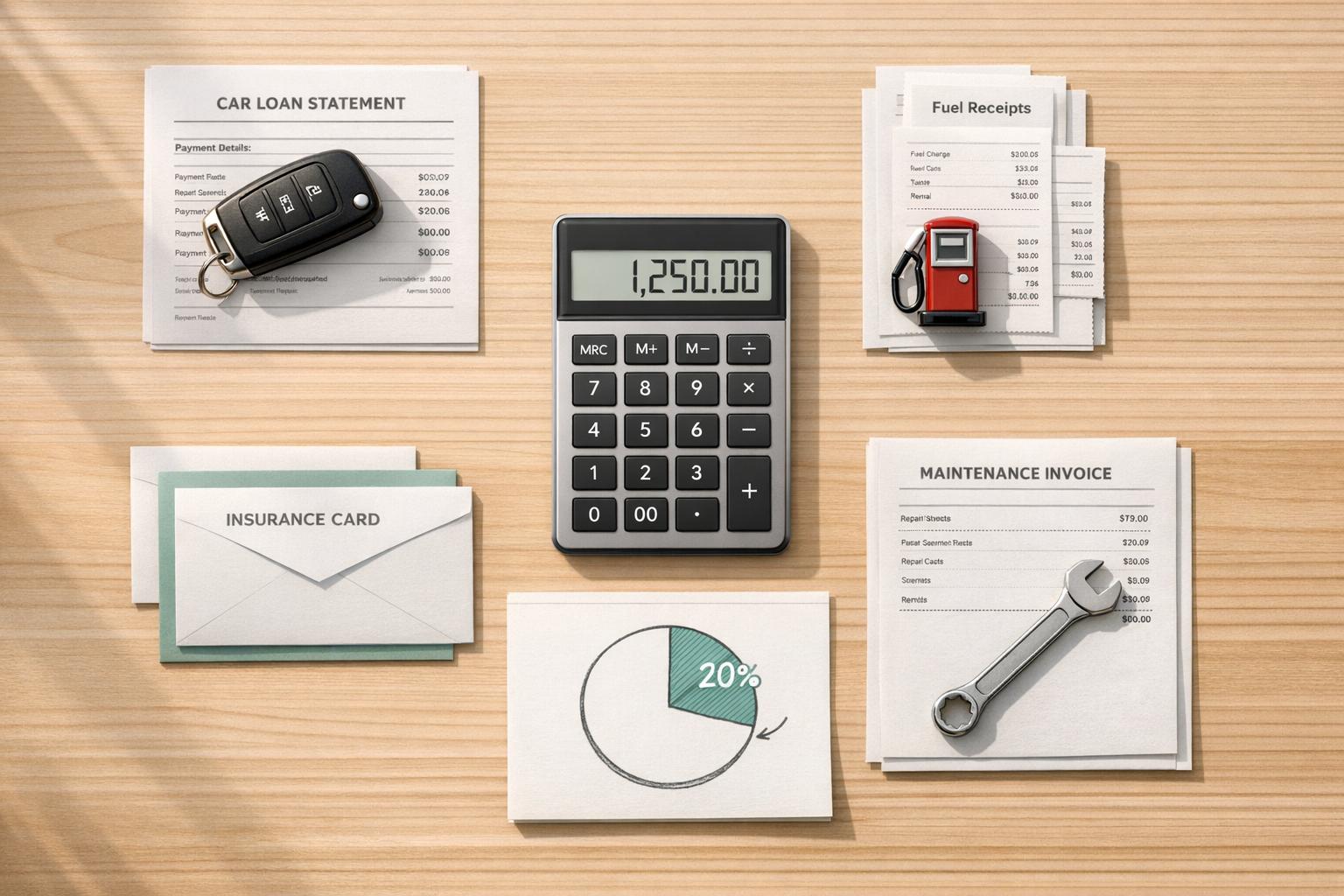
Calculating your monthly car expenses is key to managing your budget effectively. It’s not just about loan payments – owning a car also involves costs like fuel, insurance, maintenance, and registration. On average, owning a new car costs $965 per month in the U.S., with insurance alone averaging $169 monthly. Here’s a quick breakdown of what to consider:
- Loan Payments: Average $767/month for new cars, $613/month for leased vehicles, or $537/month for used cars.
- Fuel: Costs depend on mileage, fuel efficiency, and gas prices. For example, driving 1,000 miles in a car that gets 20 MPG with gas at $3.00/gallon costs $150/month.
- Insurance: Full coverage averages $1,694 annually.
- Maintenance/Repairs: Expect to spend 11.04 cents per mile, or around $1,000–$1,700 annually.
To budget effectively, aim to keep total car expenses under 20% of your take-home pay. Use online calculators for accurate estimates and plan for irregular costs like major repairs or registration renewals. By tracking and managing these expenses, you can avoid unexpected financial stress.
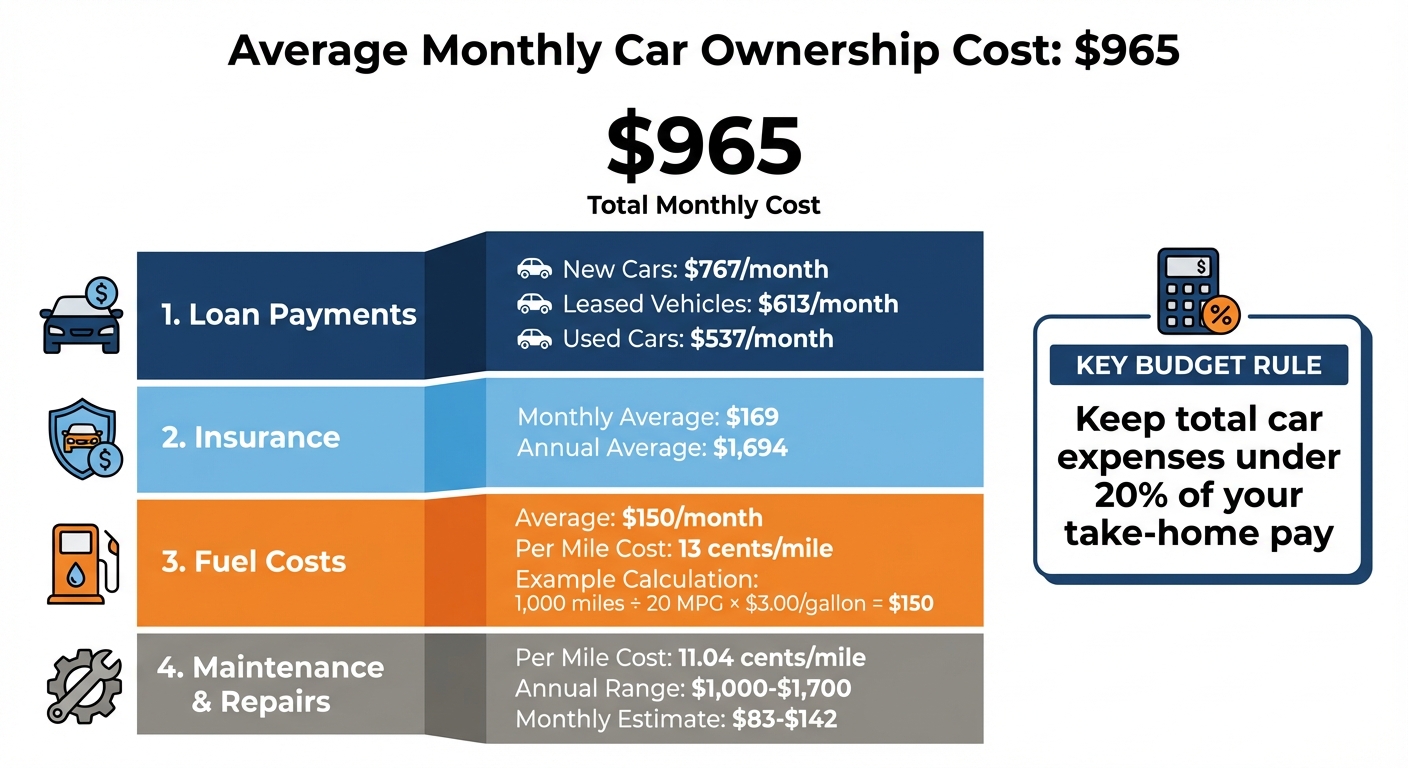
Average Monthly Car Expenses Breakdown in the U.S.
ACCOUNTANT EXPLAINS How Much Car Can You Afford | Avoid becoming CAR POOR
sbb-itb-09752ea
Main Components of Monthly Car Expenses
Breaking down your car expenses can give you a clearer picture of what you’re spending and help you spot ways to save. Shannon Bradley, Lead Writer & Content Strategist at NerdWallet, explains:
"Calculating the total cost of owning your car – or one you might buy soon – is the best way to make sure your auto budget is in line".
Car-related costs generally fall into four categories: loan payments, fuel, insurance, and maintenance. Some of these are fixed, while others depend on how much you drive or other factors. Keeping track of these separately can help you stay within the recommended range of 15% to 20% of your take-home pay for transportation expenses. Here’s how each category breaks down.
Monthly Loan Payments
Your monthly car loan payment depends on several factors: the car’s price, your down payment, the interest rate, the loan term (typically 48 to 72 months), and any balloon payment due at the end. As of Q4 2025, the average monthly payments are $767 for new cars, $613 for leased vehicles, and $537 for used cars.
If you can afford a larger down payment, you’ll finance less, which lowers both your monthly payment and the total interest you’ll pay over the life of the loan. Shorter loan terms might mean higher monthly payments, but they reduce the overall interest cost. If your loan includes a balloon payment, plan ahead to either pay the lump sum, refinance, or trade in the car when the term ends.
Fuel Costs
Fuel costs can vary widely depending on how much you drive, your car’s fuel efficiency, and local gas prices. On average, drivers cover about 1,000 miles per month, and in 2025/2026, fuel costs hover around 13 cents per mile.
To calculate your monthly fuel expense, use this formula: (Monthly Mileage ÷ MPG) × Price per Gallon. For instance, if you drive 1,000 miles in a car that gets 20 MPG and gas costs $3.00 per gallon, your monthly fuel cost would be $150 (1,000 ÷ 20 × $3.00 = $150). For electric vehicles, divide your monthly mileage by 100, multiply by the car’s kWh per 100 miles rating, and then multiply by your electricity cost per kWh.
Insurance Premiums
Car insurance is a non-negotiable expense that protects you from accidents, theft, or damage. Full-coverage insurance averages $1,694 annually, but rates depend on factors like your age, location, and driving history.
The type of coverage, your vehicle’s value, and your driving record all influence your premium. Comprehensive coverage, which includes protection against theft, fire, and damage to your car, costs more than basic liability insurance. Younger drivers, especially those under 25, often pay higher premiums because insurers see them as higher-risk drivers. If you’re financing your car, comprehensive insurance is usually required, so be sure to factor this into your budget before committing to a loan.
Maintenance and Repairs
Maintenance and repair costs can sneak up on you if you’re not prepared. On average, drivers spend 11.04 cents per mile on maintenance and repairs, which works out to about $1,000 to $1,700 annually, depending on the type of vehicle.
Routine services like oil changes, tire rotations, and brake checks follow a predictable schedule set by your car’s manufacturer. However, parts like tires, batteries, and brake pads wear out over time and will need replacing every few years. Setting aside a small amount each month for these expenses can help you avoid financial strain when it’s time for a major repair or service. As Charles Singh from USA TODAY points out:
"The true costs of car ownership are astonishingly high when you calculate fuel, insurance, maintenance costs and other car-related expenses".
Online Calculators for Car Expense Planning
While manual estimation methods can be useful, online calculators offer a much quicker and more precise way to plan car-related expenses. These tools eliminate the hassle of juggling variables like interest rates, loan terms, and fuel prices, giving you clear insights into your monthly costs. This helps you make informed decisions before committing to a purchase or loan.
Loan and Affordability Calculators
Loan calculators are designed to estimate your monthly car payment based on key inputs like the vehicle’s price, your down payment, loan term, and interest rate. For example, if you’re eyeing a $20,000 car with a $3,000 down payment, a 3.5% interest rate, and a 60-month loan term, the calculator will show your exact monthly payment. Many calculators also provide an amortization schedule, breaking down how much of each payment goes toward the loan’s principal versus interest.
Affordability calculators, on the other hand, reverse the process. As Kelley Blue Book explains:
"A car affordability calculator turns a car loan calculator on its head".
Instead of starting with the car price, you input your desired monthly payment – say $400 – and the tool calculates the maximum car price you can afford, factoring in taxes, fees, and interest. This is a practical way to stay within the recommended range of 10% to 15% of your net monthly income for car payments.
When using these calculators, remember to account for additional costs like sales tax, title, and registration fees if they’re not automatically included. These extra fees can add thousands to your financed amount. Also, if you’re trading in a car with negative equity (owing more than its current value), the calculator should include this amount, as it increases the total loan balance.
Fuel Cost Calculators
Fuel cost calculators help you estimate how much you’ll spend on gas each month or year. They typically require three inputs: your annual mileage, your car’s fuel efficiency (MPG), and the current price of gas in your area. For example, if you drive 12,000 miles a year in a car that gets 25 MPG and gas costs $3.00 per gallon, the calculator divides 12,000 by 25 to find you’ll need 480 gallons. Multiply that by $3.00, and your annual fuel cost comes out to $1,440 – or $120 per month.
These calculators also work for electric vehicles. Instead of "fuel price", you input your electricity cost per kilowatt-hour (kWh), and instead of MPG, you use miles per kWh. By providing precise estimates, these tools lay the groundwork for finding ways to reduce your monthly car expenses.
How to Lower Your Monthly Car Expenses
Once you’ve figured out your monthly car costs, the next step is finding ways to cut them down. By identifying both fixed and variable expenses, you can take smarter steps to reduce what you spend. Here are a few strategies to help you save more each month.
Choose Fuel-Efficient Vehicles
Fuel economy plays a big role in how much you spend at the gas pump. For instance, if you drive about 12,000 miles a year and gas costs $3.00 per gallon, upgrading from a car that gets 20 MPG to one that gets 30 MPG could save you around $50 a month. You can also save by consolidating errands and planning more efficient routes to reduce mileage. Renier van Schalkwyk, Head of Digital at Drive South Africa, highlights:
"People think differently about the way they use fuel. Some people think about how many kilometres they’ve driven, how much money they’ve spent, how many times they’ve filled up their tank this month, or how many litres they’ve used".
Setting a fixed fuel budget and keeping an eye on price drops can also help you redirect those savings toward other priorities.
Compare Insurance Quotes
Insurance premiums can vary significantly because companies use different methods to assess risk. For example, the average cost of full coverage insurance is about $2,101 annually (roughly $175 per month). However, shopping around and switching providers could save you up to $500 a year. To find the best deal, request quotes from at least three to five companies, ensuring you compare identical coverage limits and deductibles. Start your search 30 to 45 days before your current policy ends to avoid making rushed choices. Joey Haddad, an Independent Insurance Adjuster at Mid-America Catastrophe Services, cautions:
"Drivers who don’t proactively manage their policies could be paying 25–30% more than they did just two or three years ago".
Keep Up with Regular Maintenance
Staying on top of routine maintenance can help you avoid expensive repairs down the road. Follow your car manufacturer’s schedule for oil changes, brake checks, and tire care to keep things running smoothly. Properly inflated and aligned tires not only last longer but also improve fuel efficiency. Replacing clogged air filters is another simple way to maintain good gas mileage. Paying attention to dashboard warning lights can also help you address small issues before they become major problems.
Conclusion
Pulling everything together, creating a complete monthly car budget boils down to identifying and calculating all major expense categories – like loan payments, fuel, insurance, and maintenance – and then adding smaller recurring costs such as tolls, parking, and registration fees. For annual costs, divide them by 12 to get a monthly estimate. To get a reliable fuel cost average, track your usage over several fill-ups.
When you account for every expense – loan payments, fuel, insurance, and maintenance – you uncover your actual monthly car costs. On average, new car owners spend about $965 per month on their vehicles, with insurance alone averaging $169 monthly. These figures are essential for assessing whether a specific car aligns with your budget. As Shannon Bradley, Lead Writer & Content Strategist at NerdWallet, advises:
"Calculating the total cost of owning your car – or one you might buy soon – is the best way to make sure your auto budget is in line".
To maintain financial stability, experts suggest keeping your total monthly car expenses under 20% of your income. By applying the budgeting methods and strategies discussed in this guide, you can track every dollar spent on your vehicle, make informed decisions, and steer clear of unexpected financial hurdles.
FAQs
What car costs do people usually forget to budget for?
When budgeting for a car, it’s easy to overlook recurring expenses like insurance, maintenance, repairs, tolls, parking, and fuel. These ongoing costs can add up quickly and significantly impact the overall expense of owning a vehicle. Make sure to include them in your calculations to avoid unexpected financial strain.
How much should I set aside each month for repairs and maintenance?
Experts suggest putting away at least $100 per month to cover car repairs and maintenance. This amount usually takes care of routine services such as oil changes, tire rotations, and brake work, along with any surprise repairs that might pop up. Depending on the age and condition of your vehicle, these monthly expenses can range from $75 to $275. On average, you’re looking at about $112.50 per month, which adds up to around $1,350 per year for maintenance.
How do I estimate monthly costs if I drive more or less than average?
To get a handle on your monthly driving costs, start by tailoring your fuel and maintenance expenses to your actual mileage. One way to track fuel usage is by figuring out your cost per mile or cost per day. If you’re driving more or less than average, adjust these estimates accordingly.
Fixed costs, like insurance, typically stay the same month to month. However, variable expenses – such as fuel and maintenance – will shift depending on how much you drive. Keeping a close eye on these numbers regularly can help you fine-tune your budget over time.
Related Blog Posts
- 5 Tips To Save On Fuel Costs In South Africa
- Best Family Cars Under R300,000 in 2025
- How to Get the Best Finance Deal When Buying a Car in SA
- Top 5 Car Finance Deals in South Africa Right Now