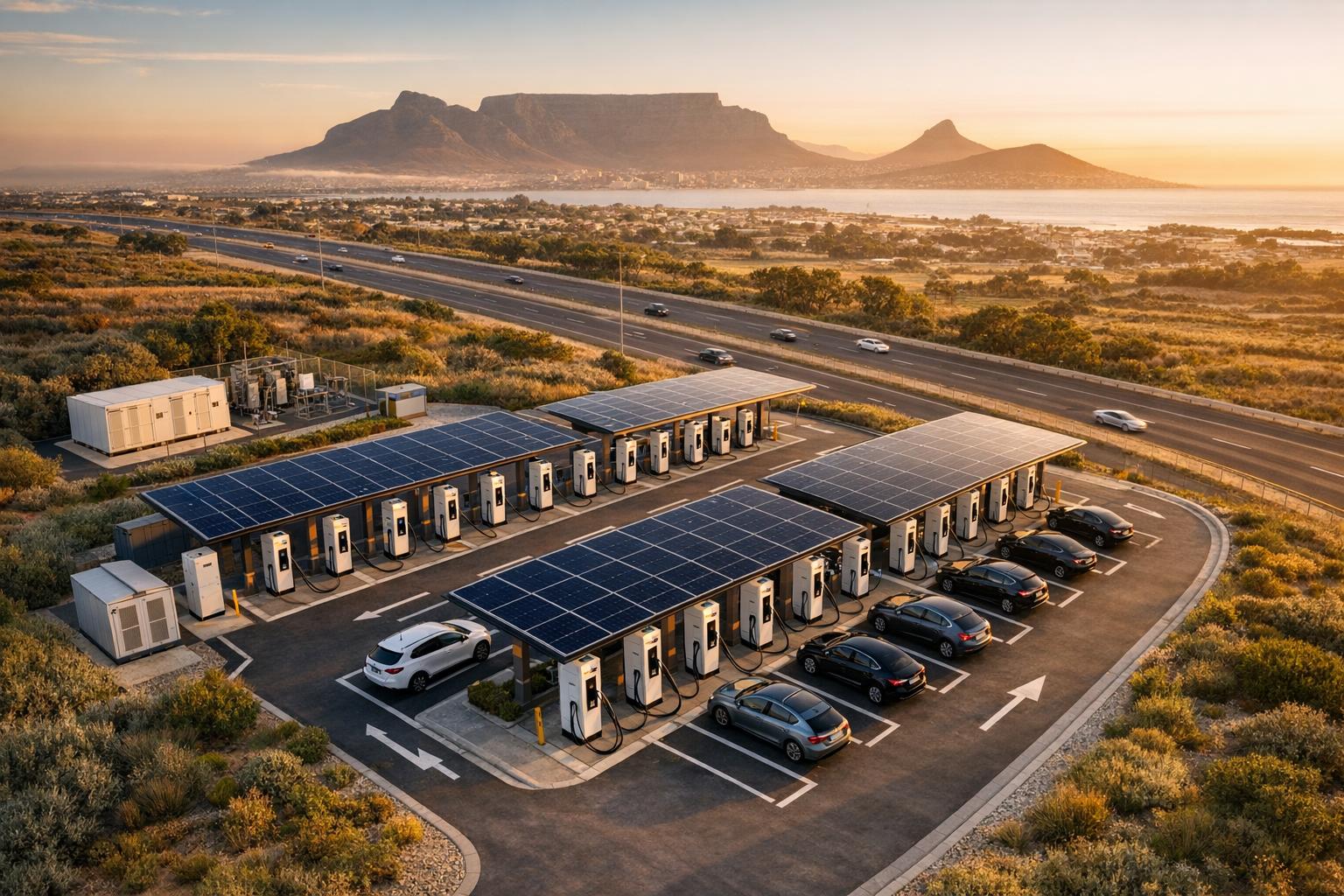
The Eskom–BYD partnership aims to address two major challenges in South Africa’s electric vehicle (EV) market: high costs and limited charging infrastructure. Their plan includes installing 200–300 public EV charging stations by the end of 2026, powered by a mix of Eskom’s grid electricity and solar energy. These stations will support all EV brands and feature ultra-fast 1MW chargers, capable of adding 248 miles (400 km) of range in just five minutes.
Key highlights:
- Affordable EV Options: BYD’s Sealion 5 starts at $27,500 (R499,900), undercutting higher-priced competitors.
- Open-Access Network: Charging stations will be available to all EV brands, not just BYD.
- Solar-Powered Stations: Some hubs will use solar energy to reduce reliance on South Africa’s coal-heavy grid.
- Nationwide Coverage: Charging stations will extend beyond urban areas to smaller towns and highways.
Construction begins in Q2 2026, with the goal of making EVs more practical and accessible across South Africa. This collaboration also includes efforts to create jobs, develop skills, and integrate renewable energy solutions.
BYD Expands Into South Africa With Major Solar Powered EV Investment
sbb-itb-09752ea
Partnership Roles and Contributions
The collaboration between Eskom and BYD clearly defines the responsibilities of each partner. Eskom, leveraging its power infrastructure, builds on its EV fleet program that officially launched on September 9, 2025. Agnes Mlambo, Acting Group Executive for Distribution at Eskom, highlighted this commitment:
"Having successfully rolled out EVs within our fleet on 9 September 2025, we are ready to enable wider adoption by bringing practical and accessible charging infrastructure to South Africans".
This partnership lays the groundwork for a comprehensive national charging network.
BYD takes charge of installing the charging stations and introducing its Flash charging technology. Beyond just deploying hardware, BYD is also fueling demand with a growing lineup of vehicles, including the Dolphin Surf, priced around $18,700, and the Sealion 5 plug-in hybrid at $27,500.
While BYD focuses on technological advancements, Eskom ensures consistent power distribution through strategic grid management. Eskom is implementing demand-side management techniques to balance electricity supply, while BYD is integrating solar and battery storage at key hubs to reduce strain on the grid – especially in areas with limited capacity. This combined effort extends charging access to underserved cities and major highways, aligning with the broader goal of improving accessibility.
The partnership also prioritizes community benefits. Both companies are working on initiatives for skills development, job creation, and small business involvement in South Africa’s clean energy sector, which strengthens grid reliability and supports local economies. Additionally, they are exploring ways to repurpose EV batteries for stationary storage, contributing to a circular economy within the EV industry.
A noteworthy feature of this network is its open-access design, allowing vehicles from all manufacturers – not just BYD models – to utilize the charging stations.
Charging Technology and Renewable Energy Integration
BYD’s ultra-fast 1MW charging technology is set to bring a major leap forward for South Africa’s EV landscape. Unlike conventional chargers, which slow down significantly after reaching 80% capacity, this new technology offers a much faster and more efficient solution. As explained by the Motability Scheme, "Your battery starts to charge much more slowly once it crosses over 80%, because the electrons coming in have to work harder to find space".
This advanced charging system is part of a larger rollout plan, aiming to establish 200 to 300 public charging stations by the end of 2026. These stations will initially connect to Eskom’s national grid, which has a total nominal generating capacity of roughly 47 GW. While this infrastructure meets the immediate energy needs of the project, it also highlights the reliance on South Africa’s existing energy mix.
However, the sustainability of these charging stations depends heavily on their energy sources. Currently, 84.4% of South Africa’s electricity comes from coal, making grid-powered chargers a carbon-heavy option. To address this, BYD and Eskom are exploring solar-powered charging hubs. These stations align with South Africa’s broader renewable energy targets, which include building 20 GW of renewable capacity by 2030 and phasing out 34 GW of coal-fired power by 2050. Solar-powered chargers not only cut emissions but also help stabilize the grid, supporting the country’s shift toward cleaner energy.
For EV owners, adhering to the 80/20 charging rule – keeping the battery charged between 20% and 80% – is key to improving both battery health and grid efficiency. Many EVs now include automatic settings to cap charging at 80%, reducing unnecessary stress on the battery. As South Africa integrates more renewable energy into its infrastructure, practices like these will play a crucial role in balancing sustainability with accessibility. These advancements reflect a strong commitment to building a future-ready EV charging network.
Market Accessibility and Inclusivity
The Eskom-BYD partnership is taking a bold step toward making electric vehicle (EV) charging more accessible and inclusive across South Africa. Unlike proprietary networks that cater only to specific brands, this initiative embraces an open-access model. In simple terms, it means drivers of any EV brand – not just BYD – can use the ultra-fast charging infrastructure. As noted in the announcement, "The charging network will not only be available for BYD vehicles but will also accommodate models from other automakers".
This approach addresses a key hurdle in South Africa’s EV adoption: fragmented infrastructure. The plan includes installing between 200 and 300 public charging stations by the end of 2026, creating a utility-style network that serves all EV drivers. Stella Li, BYD’s Executive Vice President, shared that the goal is to achieve 100% national coverage. This means extending ultra-fast charging capabilities beyond metropolitan areas to smaller towns. These stations will feature 1MW Flash Chargers, capable of delivering about 248 miles of range in just five minutes. By expanding the geographic reach and offering cutting-edge charging speeds, the partnership aims to reduce both the logistical challenges and costs associated with EV ownership.
Affordability is another critical focus. While many plug-in hybrid vehicles in South Africa are priced above R600,000 (roughly $33,000), BYD’s Sealion 5 is more competitively priced at R499,900 (around $27,500). Steve Chang, BYD’s South Africa Managing Director, emphasized the importance of balancing features, efficiency, and affordability:
"High-end features, efficiency, and financial stability shouldn’t be mutually exclusive".
The open-access network enhances this value by ensuring that drivers of lower-cost EVs can still benefit from ultra-fast charging infrastructure.
Another standout feature of the partnership is the integration of solar-powered charging stations. These sites bypass the limitations of Eskom’s grid, which often struggles to meet demand. As Stella Li explained:
"Having solar as an option will allow BYD to build infrastructure outside the main urban centres".
This innovation ensures that rural and semi-urban communities are included in South Africa’s EV transition. By reducing reliance on the grid, solar-powered stations can provide consistent charging capacity, even in areas with weaker infrastructure. This strategy not only broadens access to clean transportation but also promotes equity by making EV technology available across different income levels and locations.
Pros and Cons
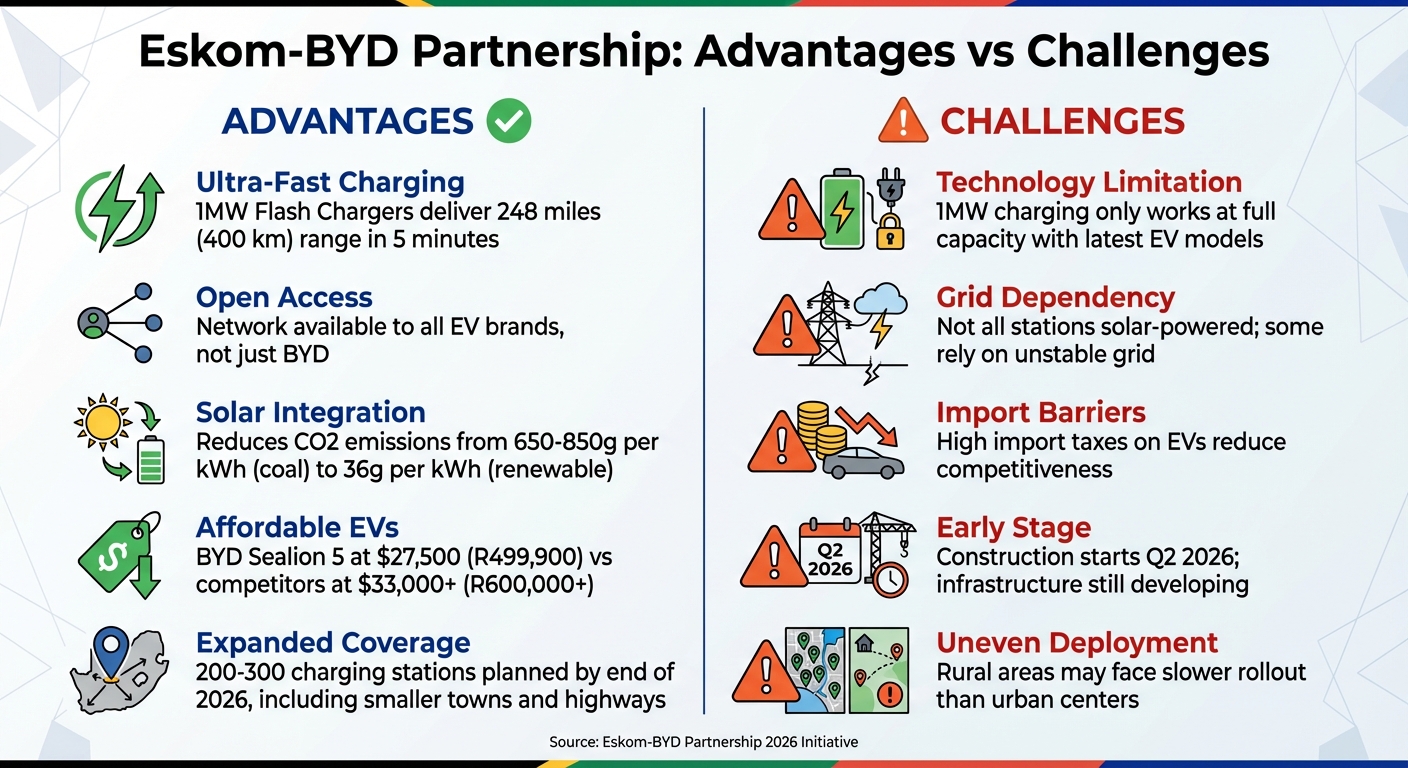
Eskom-BYD EV Charging Partnership: Pros vs Cons Analysis
The partnership presents a mix of promising benefits and notable challenges as it works toward expanding its network through 2026.
One of its standout features is the introduction of ultra-fast charging, which rivals the speed of traditional refueling. The 1MW Flash Chargers can add about 248 miles (400 km) of range in just five minutes. This incredible speed, paired with an open-access model that welcomes vehicles from all EV brands, makes it easier for more drivers to adopt electric vehicles. The rapid rollout also signals a major step forward in infrastructure development. On top of that, solar integration at charging stations helps reduce reliance on Eskom’s coal-heavy grid, which emits between 650g and 850g of CO2 per kWh, compared to just 36g per kWh from renewable energy sources. Affordability is another plus, with models like the Sealion 5 priced at around $27,500 (R499,900), offering a lower-cost alternative to competitors priced above $33,000 (R600,000+).
That said, there are some hurdles. The cutting-edge 1MW charging technology only works at full capacity with the latest EV models, which are not yet common in South Africa. While solar integration is a step in the right direction, not all charging stations will use solar power, making some sites vulnerable to the grid’s instability. High import taxes on EVs also remain a significant obstacle, making them less competitive compared to traditional internal combustion engine vehicles. Additionally, the infrastructure is still in its infancy, with construction only set to start in Q2 2026. Rural areas may face slower deployment compared to urban centers, which could limit accessibility for some regions as EV adoption grows.
Here’s a quick breakdown of the key advantages and challenges:
| Feature | Advantage (Pros) | Challenge/Limitation (Cons) |
|---|---|---|
| Charging Speed | 1MW Flash Chargers provide 248 miles (400 km) of range in just 5 minutes. | Limited to the latest EV models for full performance. |
| Network Access | Open to all EV brands, encouraging broader adoption. | High-traffic locations may face congestion as EV usage increases. |
| Energy Source | Solar integration reduces reliance on the coal-powered grid. | Some stations won’t be solar-powered, relying on an unstable grid. |
| Market Entry | Affordable EV models like the Sealion 5 priced under $27,500 (R500,000). | High import taxes on EVs remain a barrier to affordability. |
| Coverage | Plans to expand into smaller towns and highways. | Infrastructure rollout is in early stages, with construction starting in 2026. |
The success of this partnership will depend on striking the right balance between rapid infrastructure development, technological readiness, and necessary policy changes. These factors highlight how the Eskom-BYD collaboration is working to reshape EV charging and accessibility with renewable energy at its core.
Conclusion
The partnership between Eskom and BYD is setting the stage for a transformative shift in Africa’s electric vehicle (EV) landscape. By combining ultra-fast 1MW charging, renewable energy integration, and an open-access model, this initiative tackles long-standing barriers that have kept EVs largely out of reach for many in Africa, confining them to a luxury market segment.
One of the most promising aspects of this collaboration is its potential for regional scalability. As Stella Li, Executive Vice President at BYD, highlighted:
"South Africa is a very important market… It is the biggest market in the whole African continent. Once we start here, you can duplicate the story into other African countries".
With Eskom generating about 20% of Africa’s electricity, the expertise and infrastructure being developed through this initiative could serve as a foundation for expanding EV adoption across the continent. This aligns with a broader strategy that integrates various clean-energy solutions into the ecosystem.
What sets this model apart is its comprehensive approach to energy and mobility. The collaboration covers battery technology, solar power generation, home energy storage, and vehicle financing – all aimed at addressing challenges like affordability and grid dependency. Affordable EV options, such as the Sealion 5 priced at $27,500 (R499,900), are also playing a crucial role in making electric vehicles accessible to more South Africans.
The plan includes installing 200–300 charging stations by the end of 2026, with construction slated to begin in Q2 of that year. However, success will hinge on striking the right balance between rapid infrastructure deployment, grid capacity, supportive policies, and cost-effectiveness. If executed well, South Africa could emerge as a leader in renewable-powered EV infrastructure.
As Nomonde Kweyi, Marketing Director at BYD South Africa, explained:
"BYD’s presence in South Africa represents our commitment to being more than an automotive brand. We are a technology company delivering comprehensive new-energy solutions for this market".
This vision of integrated, renewable-based transportation could provide a roadmap for other emerging markets looking to embrace the shift to electric mobility. By addressing key hurdles and focusing on accessibility, this partnership is paving the way for a more sustainable and inclusive future.
FAQs
Will these chargers work during load shedding?
The chargers in the planned network by Eskom and BYD will use renewable energy and are built to support electric vehicles, including those requiring next-generation ultra-fast charging. However, it’s still unclear whether these chargers will function during periods of load shedding.
Which EVs can actually use 1 MW fast charging?
At present, some BYD models are designed to support 1 MW fast charging. However, these capabilities will only be accessible once BYD launches vehicles compatible with this ultra-fast charging technology. The company has announced plans to incorporate 1 MW charging into its upcoming electric vehicle lineup.
How much does a 5-minute charge cost?
The article does not include specific information regarding the price of a 5-minute EV charging session.
Related Blog Posts
- SA’s First Solar EV Charging Stations: What to Know
- Kenya’s EV charging rollout inspires South African planners
- South Africa’s EV Policies: Renewable Charging Impact
- Countrywide EV Charging Network: Where We Stand