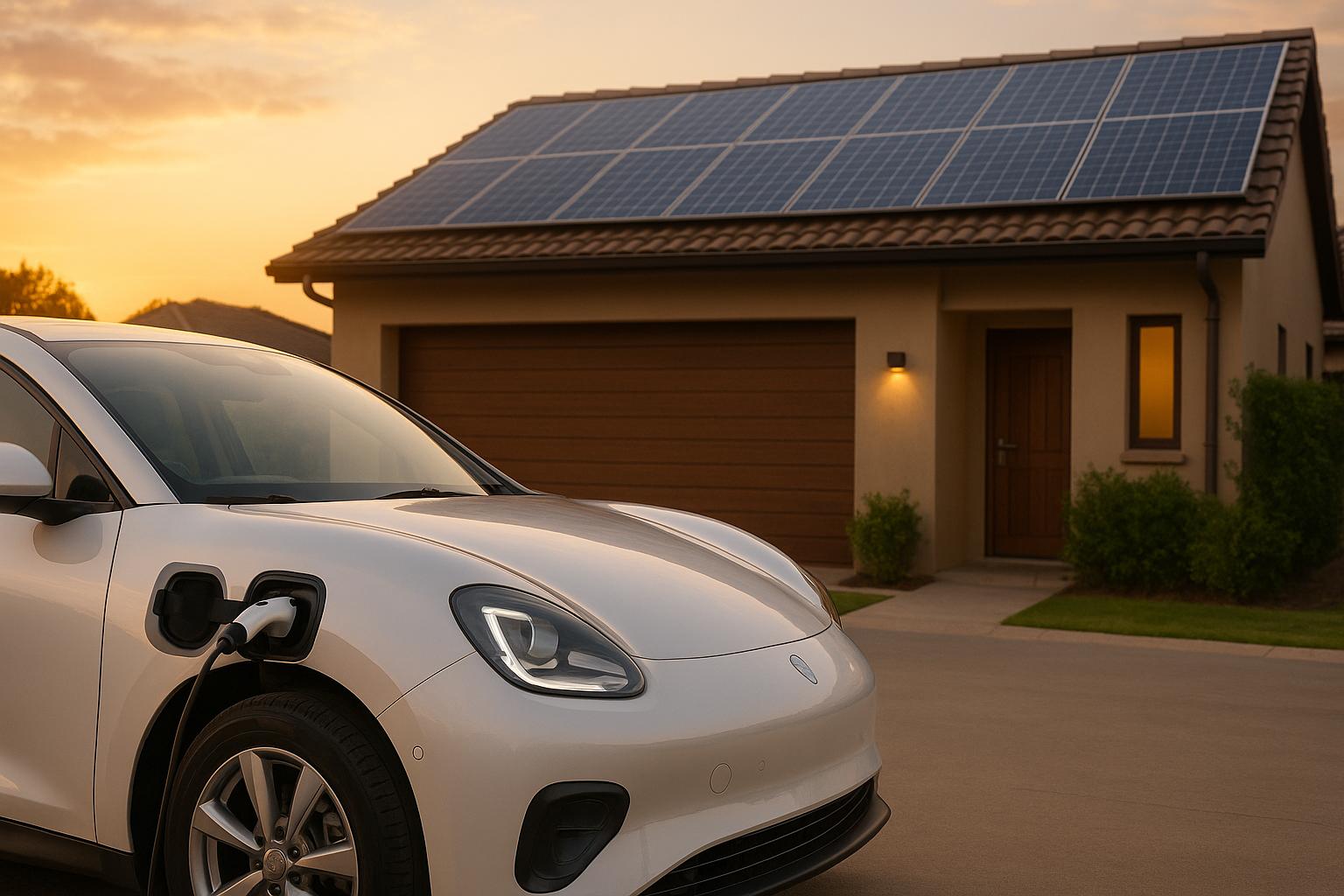
Electric cars (EVs) can save you money in South Africa, but it depends on several factors. Here’s a quick summary:
- Upfront Costs: EVs are more expensive than gasoline cars due to import duties. However, new tax incentives proposed in November 2025 aim to reduce these costs over time by encouraging local EV production.
- Operating Costs: Charging an EV at home costs about half as much as fueling a gasoline car. For example, driving 1,500 kilometers per month costs around $42.75–$57 with an EV, compared to $108 for gasoline. Solar power and off-peak charging can lower costs further.
- Maintenance Costs: EVs require less maintenance – no oil changes, fewer brake replacements, and simpler systems – saving you money over the years.
- Challenges: Load shedding and limited rural charging infrastructure can complicate EV ownership, especially for long-distance drivers.
Key Insight: Over five years, EVs can save you $11,500–$29,200 compared to gasoline cars, depending on your driving habits and charging setup.
Electric Cars Don’t Make Sense In South Africa
Upfront Costs: Electric Cars vs. Gasoline Vehicles
Electric cars generally come with a higher price tag than gasoline vehicles, largely because of hefty import duties and taxes. In contrast, locally assembled gasoline cars benefit from reduced tariffs, making them more affordable. However, as local production of electric vehicles (EVs) increases and battery technology advances, this price gap could shrink, paving the way for more budget-friendly EV options.
Price Ranges for EVs and Gasoline Cars
In South Africa, electric vehicles are priced higher than their gasoline counterparts, primarily due to the reliance on imports. Gasoline vehicles, on the other hand, enjoy cost advantages from established local assembly operations and lower import duties on parts. This results in more competitive pricing across various vehicle segments. While the price difference remains noticeable, advancements in battery production and scaling up manufacturing may gradually make EVs more affordable in the future.
Government Incentives for EV Buyers
To address the high upfront costs of EVs, South Africa has introduced new tax incentives aimed at encouraging local EV manufacturing rather than offering direct rebates to buyers. Proposed in November 2025, these measures focus on reducing import duties, which are a key factor driving up EV prices. By targeting the root cause of these costs, the government hopes to make EVs more accessible over time.
For consumers, this approach means that while showroom prices may not drop immediately, the groundwork is being laid for lower costs as local EV production scales up. This aligns with growing demand for electrified vehicles. For instance, Great Wall Motors (GWM) South Africa plans to expand its range of plug-in hybrid electric vehicles (PHEVs) in 2026 in response to increasing interest.
Currently, South Africa does not offer direct purchase subsidies or tax credits for EV buyers, unlike some other countries. However, the government’s focus on manufacturing incentives underscores its commitment to making EVs more affordable for households in the near future. With the upfront cost landscape clarified, it’s time to explore how operating costs and long-term savings compare between EVs and gasoline vehicles.
Operating Costs: Charging vs. Fueling
Once you’ve purchased an EV, the daily operating costs quickly highlight its economic advantages. Charging at home often costs far less than fueling a gasoline-powered car. Let’s break down the numbers to see how charging stacks up against fueling.
Electricity Costs for Home Charging
Home charging is where EV owners can see the biggest savings. In South Africa, electricity costs between $0.18 and $0.19 per kWh. Most modern EVs use about 15 to 20 kWh to travel 100 kilometers (roughly 62 miles). At $0.19 per kWh, driving 100 kilometers costs between $2.85 and $3.80. For someone who drives 1,500 kilometers (about 932 miles) a month, this translates to monthly charging costs of $42.75 to $57.
Charging overnight is a convenient option for many drivers, ensuring a fully charged battery by morning. This works particularly well for those with predictable daily commutes, especially if they can take advantage of reduced off-peak electricity rates.
Fuel Costs for Gasoline Vehicles
Gasoline cars follow a different cost structure. A fuel-efficient car that uses about 6 liters per 100 kilometers would cost $7.20 per 100 kilometers if gas is priced at $1.20 per liter. Over a month of driving 1,500 kilometers, fuel expenses can reach $108 – nearly double the cost of charging an EV for the same distance. This stark difference highlights the cost-saving potential of switching to electric vehicles.
Solar Power and Off-Peak Charging
EV owners can cut costs even further by using solar power or charging during off-peak hours. Installing solar panels allows you to take advantage of free energy from the sun, significantly lowering charging costs during the day.
Off-peak charging is another smart strategy. Many South African municipalities offer time-of-use electricity tariffs, which can be 30% to 50% cheaper at night. By scheduling your EV to charge between 10 PM and 6 AM, you could reduce your monthly charging costs from $57 to as low as $28.50 to $40.
Load shedding does pose challenges, but it has also motivated many drivers to invest in solar panels combined with battery storage systems. These setups not only help during power outages but also provide long-term savings and charging independence.
The Bigger Picture
With lower electricity rates, renewable energy options, and smart charging strategies, EV owners enjoy a clear financial edge. While gasoline prices fluctuate with global oil markets, electricity costs tend to be more stable, making it easier to plan and manage long-term transportation expenses. For South African drivers, these savings emphasize the economic benefits of owning an EV.
Maintenance Costs: Electric Cars vs. Gasoline Vehicles
When it comes to maintenance, electric vehicles (EVs) have a clear edge over their gasoline-powered counterparts. EVs require fewer trips to the mechanic and generally cost less to repair.
The difference lies in the complexity of their systems. Gasoline vehicles depend on intricate mechanical components that demand regular attention. Think about it: oil changes (which can cost $40–$80 every 5,000–7,500 miles), spark plug replacements, air filter changes, and even transmission repairs – all of these add up over time, creating significant long-term expenses.
On the other hand, electric cars skip many of these headaches. No oil changes, no spark plugs, and no exhaust system repairs mean fewer routine maintenance costs overall.
Maintenance Requirements for EVs
Diving deeper into EV maintenance, their upkeep is relatively straightforward. Most of it revolves around occasional inspections and software updates that can often be handled remotely, rather than frequent mechanical fixes.
Regenerative braking is another game-changer. It reduces wear and tear on the brakes, so EVs need brake service less often than traditional vehicles. However, EVs do have their own quirks – like being tougher on tires. The instant torque and heavier battery packs mean tire rotations are still necessary every 6,000–8,000 miles. Additionally, cabin air filters need replacing from time to time, though these costs are minimal compared to the upkeep of gasoline vehicles.
Of course, some maintenance tasks remain universal. Refilling windshield washer fluid, for instance, is still part of the routine. But many EV manufacturers go a step further by offering over-the-air software updates. These updates can tweak performance or fix minor issues without requiring a trip to the dealership.
In short, the simpler design and reduced service needs of electric cars translate to lower annual maintenance costs. Over five years, these savings can add up significantly for EV owners, making them an appealing choice for cost-conscious drivers.
sbb-itb-09752ea
5-Year Total Cost of Ownership
A five-year cost analysis sheds light on the financial advantages of electric vehicles (EVs). By factoring in the upfront purchase price along with ongoing energy (charging or fueling) and maintenance expenses, it becomes clear how EVs stack up against traditional gasoline vehicles in terms of long-term affordability.
The data shows that while the initial purchase prices of EVs and comparable gasoline vehicles are relatively close, the lower energy and maintenance costs associated with EVs can result in substantial savings over time.
Cost Breakdown Comparison Table
Here’s a side-by-side comparison of a typical EV and a gasoline vehicle over five years:
| Cost Category | Electric Vehicle (BYD Dolphin Surf) | Gasoline Vehicle (Comparable Model) |
|---|---|---|
| Purchase Price | ~$22,600 (R339,900) | ~$23,300 (R350,000) |
| 5-Year Energy Costs | ~$7,500–$15,000 | ~$20,000–$30,000 |
| 5-Year Maintenance Costs | ~$1,667–$2,667 | ~$3,333–$5,000 |
| Total 5-Year Cost | ~$31,800–$40,700 | ~$43,300–$61,000 |
| Total Savings with EV | ~$11,500–$29,200 | – |
On average, EVs save between $11,500 and $29,200 over five years, depending on driving habits and charging patterns. These estimates are based on standard grid electricity rates, but charging during off-peak hours or using solar power could cut energy costs by another 30–50%.
Modern EV batteries come with warranties lasting 8–10 years, and they typically retain 85–95% of their capacity after five years, eliminating the need for battery replacement within this timeframe.
In South Africa, energy costs for EVs are approximately $0.10–$0.20 per kilometer, compared to $0.27–$0.40 per kilometer for gasoline vehicles. For someone driving 15,000 kilometers annually, this translates to yearly savings of about $2,500–$3,000 with an EV.
The choice of EV model also impacts the payback period. Budget-friendly options like the BYD Dolphin Surf offer quicker returns, while mid-range models provide greater range and added features without compromising cost benefits.
Your driving habits play a crucial role, too. Urban commuters who primarily charge at home – where electricity rates are lower – stand to benefit the most. On the other hand, long-distance drivers relying on public DC fast chargers may face higher costs, as these chargers typically cost $0.47–$0.49 per kilowatt-hour compared to standard AC charging at about $0.39 per kilowatt-hour. Even with these higher rates, EVs still prove to be more economical than gasoline vehicles.
Next, we’ll dive into the infrastructure and practical aspects of owning an EV in South Africa.
Infrastructure and Practical Considerations for EV Ownership
When it comes to owning an electric vehicle (EV) in South Africa, it’s not just about crunching the numbers. Practical factors like charging infrastructure and how well an EV matches your daily driving needs play a big role.
Public Charging Station Availability
South Africa’s charging network is growing steadily, but it’s still centered around major cities like Johannesburg, Cape Town, and Pretoria. In these urban hubs, EV owners can find charging stations at shopping malls, office complexes, and along key highways. However, the picture changes outside these areas – rural and remote regions still lack sufficient charging options. This can make long-distance travel tricky and less convenient for those living far from metropolitan centers.
One of the biggest obstacles for EV owners is load shedding. Power outages can throw off home charging schedules and even disrupt public charging stations. This forces EV users to be flexible, often planning their charging times around power availability. While this can be frustrating, the growing interest in greener transportation options suggests that the charging infrastructure will likely improve as demand increases.
Suitability for Different Driving Patterns
Beyond infrastructure, your daily driving habits are key to determining how practical an EV will be for you. If you mostly drive in urban areas, where home charging or nearby public stations are readily available, EV ownership can be a great fit. On the other hand, if your routine involves frequent long-distance travel or trips to areas with limited charging facilities, you might face more challenges. In such cases, careful route planning becomes essential.
Conclusion: Are Electric Cars Worth It in South Africa?
Electric vehicles (EVs) can save you money in South Africa – but only under certain conditions. Their financial advantages depend on three key factors: having reliable access to home charging, government support, and how you typically drive.
Home charging is a game-changer. If you can charge your car at home, especially during off-peak hours or with solar power, your energy costs can be much lower than what you’d spend on fuel. However, South Africa’s load shedding challenges mean you’ll need to plan your charging times carefully.
Government policies are beginning to shape the EV market. In November 2025, South Africa proposed tax breaks for electric vehicle manufacturing to make EVs more affordable and encourage local production. While this is a step forward, the impact on individual drivers will depend on how these policies evolve.
For urban drivers with consistent access to home charging, EVs can make a lot of sense. Lower electricity costs, minimal maintenance, and potential tax incentives can help offset the higher upfront price over time. On the other hand, frequent long-distance drivers or those in areas with limited charging stations might find the practical challenges outweigh the savings – at least for now.
FAQs
How could proposed tax incentives for local EV production in South Africa affect the cost of owning an electric car?
Proposed tax incentives for local electric vehicle (EV) production in South Africa could play a key role in making EVs more accessible. By potentially lowering manufacturing costs, these incentives might pave the way for more competitive pricing, helping to ease the typically higher upfront expense of electric cars.
On top of that, such measures could boost EV adoption, which might drive the development of a stronger charging infrastructure. Over time, this could lead to added convenience and savings for EV owners. However, how much these incentives will actually reduce ownership costs depends on how they’re implemented and whether manufacturers pass the savings on to consumers.
How can EV owners in South Africa manage challenges caused by load shedding?
Load shedding poses a challenge for electric vehicle (EV) owners in South Africa, but there are practical ways to work around it. One effective approach is charging your EV during off-peak hours, when electricity demand is typically lower. This can help ensure your car is charged and ready when needed.
Another smart option is investing in a home solar system with battery storage. This setup provides a reliable backup for charging your EV during power outages, giving you some peace of mind.
Planning ahead makes a big difference too. Keep an eye on load-shedding schedules so you can charge your EV before an outage starts. You might also want to explore public charging stations in areas that experience fewer interruptions. By putting these strategies into action, you can minimize the inconvenience of load shedding and keep your EV running smoothly.
Under what driving habits or conditions are electric vehicles more cost-effective than gasoline cars in South Africa?
Electric vehicles (EVs) can often be easier on your wallet compared to gasoline cars – but it depends on how and where you drive. For example, city driving with lots of stop-and-go traffic works in favor of EVs. They consume less energy at lower speeds and take advantage of regenerative braking, which helps recharge the battery as you slow down. Plus, if you can charge your EV at home, the cost per mile is typically much lower than filling up a gas tank or using public charging stations.
Your driving style matters too. Smooth acceleration, sticking to moderate speeds, and choosing efficient routes can extend your EV’s range and keep energy costs down. Over time, EVs also save money on maintenance – no oil changes and fewer moving parts mean fewer trips to the mechanic, which can add up to noticeable savings compared to traditional gas-powered cars.
Related Blog Posts
- EV Charging Costs in South Africa: Breakdown
- Electric vs Hybrid: Fuel Costs Compared
- This Budget Electric Car Is Shaking Up the SA Market ⚡️
- Load Shedding’s Impact on EV Adoption in SA