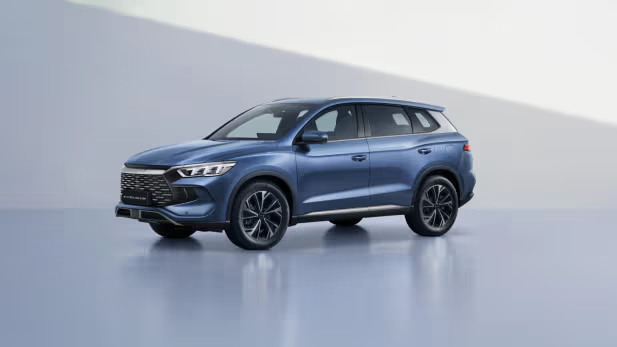
The South African automotive landscape is undergoing a rapid shift towards New Energy Vehicles (NEVs), and the Chinese brand BYD is leading the charge in affordability. The forthcoming launch of the BYD Sealion 5 Plug-in Hybrid SUV is set to be a game-changer, as it is officially positioned to be the country’s most affordable Plug-in Hybrid Electric Vehicle (PHEV).
With an expected launch before the end of 2025, the Sealion 5 is designed to offer a blend of electric-only commuting and petrol-backed long-distance travel, directly addressing range anxiety while making hybrid technology accessible to a wider pool of South African buyers.
Pricing & Positioning: Under the R500K Mark
The most compelling aspect of the Sealion 5 is its aggressive pricing. Initial dealer information suggests the entry-level model will break a significant pricing barrier for the segment.
Estimated Launch Prices:
| Derivative | Estimated Price (Indicative) |
| Comfort (Essential) | R499,900 |
| Dynamic (Premium) | R579,900 |
This entry price of under R500,000 immediately makes the BYD Sealion 5 the most affordable PHEV SUV in Mzansi, undercutting rivals by a significant margin. In terms of size, the Sealion 5 is a practical compact SUV, measuring in at 4738 mm long with a 2712 mm wheelbase, placing it slightly larger than competitors like the Toyota Corolla Cross and Kia Seltos.
Powertrain and Performance: Efficiency Meets Power
The Sealion 5 is built on BYD’s advanced DM-i (Dual Mode-intelligence) platform, which is engineered specifically for plug-in hybrid powertrains. This system prioritises electric driving, using the petrol engine primarily to charge the battery or to assist only under heavy load.
Technical Specifications:
- Engine: 1.5 L naturally-aspirated petrol (72 kW, 122 Nm).
- Electric Motor: Single front-mounted motor (145 kW, 300 Nm).
- System Total Power: BYD claims a maximum system power output of 156 kW.
- Battery: Entry-level Comfort model has a 12.96 kWh Blade Battery.
- Electric Range: Approximately 50 km of pure electric range (WLTP equivalent) is estimated for the Comfort model, perfect for most daily urban commutes.
Power is delivered to the front wheels (FWD) via a Continuously Variable Transmission (CVT). The beauty of this system is its combined range, which exceeds 1,000 km thanks to the petrol backup.
V2L Technology: Your Power Backup
A standout feature is the standard inclusion of Vehicle-to-Load (V2L) technology. This means the Sealion 5 can use the energy stored in its high-voltage battery to power external accessories, appliances, or even provide emergency backup power during load shedding—a highly practical feature for South African conditions.
Trim Levels and Features: Comfort vs. Dynamic
The Sealion 5 will arrive in two well-equipped trim levels, giving buyers a clear choice between outstanding value and luxurious extras.
Comfort (Entry Level)
The base model is far from basic, featuring a comprehensive Advanced Driver Assistance System (ADAS) suite, which includes:
- Forward Collision Warning (FCW)
- Lane Departure Warning (LDW)
- Adaptive Cruise Control
- Auto Emergency Brake
- Blind Spot Detection
Standard interior tech includes a 12.8 inch rotating infotainment screen with Android Auto and Apple CarPlay compatibility, 18-inch wheels, and keyless NFC access.
Dynamic (Premium)
The Dynamic model builds on the Comfort’s solid foundation by adding comfort and safety upgrades:
- Full 360-degree camera system
- Front parking sensors
- Heated and Ventilated driver’s seat with 6-way electric adjustment
- Electric sunroof
- Front $15 \text{ W}$ wireless phone charger
- Electric tailgate and folding mirrors
Plug-in Hybrid Care Tip: Maximising EV Range
To get the most out of the Sealion 5’s PHEV system, particularly the pure electric range, drivers must charge regularly and efficiently:
- Home Charging Routine: Treat the PHEV like a smartphone—plug it in every night. Consistent, slow overnight charging (AC) is the cheapest and healthiest method for the battery.
- Use B Mode: Engage the regenerative braking mode (often labelled “B” or similar) in heavy traffic. This recovers kinetic energy, feeding it back into the battery and extending your electric range while simultaneously reducing brake wear.
For more technical insights and reviews on the latest hybrid and electric motoring trends, you can explore in-depth articles on imotonews.co.za.
The Future is Electric: BYD and the NEV Market
The Sealion 5 is a direct signal that the PHEV market is moving towards affordability. This trend is crucial for South Africa, providing a stepping stone to full battery electric vehicles (BEVs).
For drivers looking to explore sustainable mobility, EV24.africa offers import options for electric cars, expanding choices in the EV market for those ready to commit to a pure-electric lifestyle.
The arrival of the Sealion 5, positioned below the larger Sealion 6, is a key moment for the mid-size SUV segment. If you are considering a hybrid or fully electric SUV, it’s worth comparing your options. You can find listings for new and quality pre-owned NEVs, including rivals like the Chery Tiggo 7 Pro PHEV and various second-hand plug-in hybrids, by checking out auto24.co.za.
Discover additional tips on understanding hybrid technology and its long-term cost benefits by reading more here.
Frequently Asked Questions (FAQ)
Q: What is the main market position of the BYD Sealion 5 in South Africa?
A: The BYD Sealion 5 is positioned as the brand’s most affordable Plug-in Hybrid Electric Vehicle (PHEV) SUV in South Africa, and is expected to be the first PHEV in the market with a starting price under R500,000.
Q: What is the pure electric driving range of the base Sealion 5?
A: The entry-level Comfort model, with its $12.96 \text{ kWh}$ battery, offers an estimated pure electric range of approximately $50 \text{ km}$ (WLTP equivalent), allowing for zero-emission daily commuting.
Q: Does the Sealion 5 have all-wheel drive?
A: The initial launch models of the BYD Sealion 5 in South Africa are expected to be Front-Wheel Drive (FWD), prioritising efficiency over off-road capability.
Q: What is the V2L function used for?
A: V2L (Vehicle-to-Load) allows the car’s high-voltage battery to be used as a power source for external electrical devices, which is highly useful for camping, outdoor activities, or providing emergency power during load shedding.