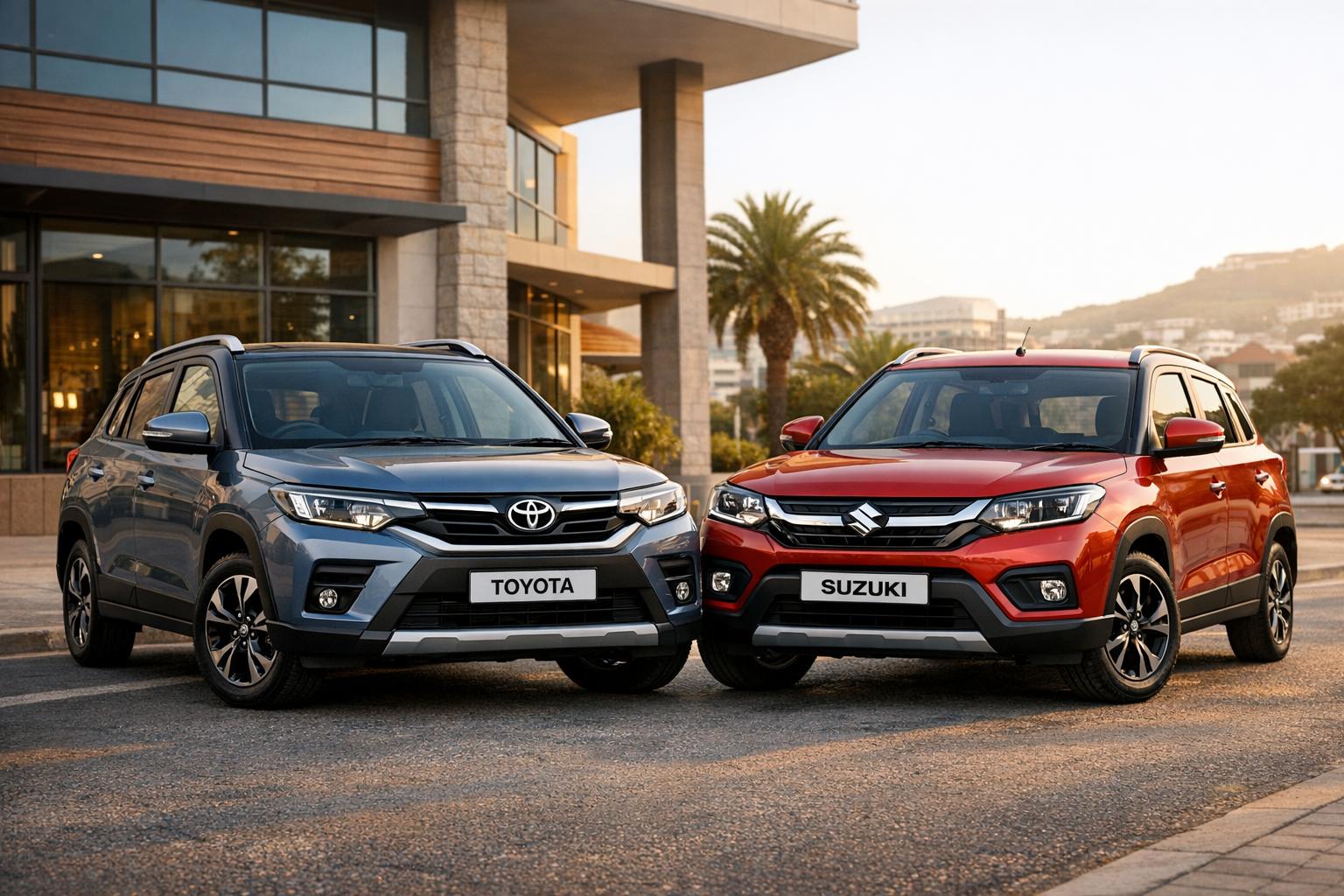
Toyota and Suzuki‘s partnership in South Africa focuses on shared platforms, engines, and manufacturing to cut costs and expand their vehicle lineup. Toyota benefits by filling gaps in its budget-friendly segment, while Suzuki gains access to Toyota‘s larger dealership network and brand reputation. This collaboration has resulted in popular models like the Toyota Starlet (rebadged Suzuki Baleno), Toyota Urban Cruiser (rebadged Suzuki Vitara Brezza), and Toyota Rumion (rebadged Suzuki Ertiga).
Key takeaways:
- Toyota dominates sales of shared models due to its strong brand recognition and higher resale value.
- Suzuki models often offer more features and better warranties at lower prices.
- Cars are manufactured in India, keeping costs low and prices competitive.
- Toyota’s dealer network and brand trust drive its market success, despite higher pricing and fewer features.
This partnership has reshaped the South African car market, offering buyers more affordable options and blending Suzuki’s engineering with Toyota’s market reach.
1. Toyota Starlet vs. Suzuki Baleno
Platform and Design
The Toyota Starlet and Suzuki Baleno share Suzuki’s HEARTECT platform, which is crafted with high-tensile steel to make the chassis both lightweight and sturdy. When viewed from the side or rear, their similarities are hard to miss – rooflines, door placements, and overall proportions are nearly identical. However, Toyota has given the Starlet a touch of individuality with a V-shaped upper grille, a honeycomb-style lower grille, and chrome accents around the fog lamps.
At launch, both cars were powered by a 1.4-liter engine delivering 68 kW and 130 Nm. In 2022, they received an upgrade to a 1.5-liter naturally aspirated engine, which now produces 77 kW and 138 Nm. These subtle design and performance tweaks give each model its own character on the road.
Performance and Features
Both hatchbacks are built for city driving, offering nimble handling, light steering, and a compact turning radius. When it comes to fuel efficiency, the Suzuki Baleno edges ahead, achieving about 5.2 L/100 km in real-world conditions. Meanwhile, the Toyota Starlet averages around 5.6 L/100 km. With their 37-liter fuel tanks, both cars can cover over 700 km on a single tank.
Feature-wise, the Suzuki Baleno GLX stands out with a 360-degree view camera and a head-up display – features not included in the Toyota Starlet Xr. On the other hand, Toyota sweetens the deal with Toyota Connect, which includes an in-car Wi-Fi hotspot and 10–15 GB of complimentary data.
As CAR Magazine observed, "The Starlet’s free in-car Wi-Fi and vivid display is a winner".
Pricing and Market Appeal
Pricing is another key differentiator. In 2022, the Toyota Starlet Xr manual was introduced at R294,900, while the Suzuki Baleno GLX manual came in at R275,900 – making the Baleno about R19,000 more affordable. Warranty and service plans also vary: Suzuki offers a 5-year/200,000 km warranty and a 4-year/60,000 km service plan, while Toyota provides a 3-year/100,000 km warranty and a 3-year/45,000 km service plan.
Despite the price gap, South African buyers often lean toward Toyota. The brand’s strong resale value and extensive dealership network make it a popular choice, even if it comes with a slightly higher upfront cost.
2. Toyota Urban Cruiser vs. Suzuki Vitara Brezza
Platform and Design
Toyota and Suzuki continued their platform-sharing strategy in South Africa, tailoring their compact SUVs to meet local preferences. The Toyota Urban Cruiser and Suzuki Vitara Brezza are essentially the same vehicle, built on the same platform, with only minor differences. Toyota gave the Urban Cruiser a distinct look with a redesigned front bumper and a grille inspired by the Fortuner, along with a few subtle styling updates . Both models are based on the facelifted version of the previous-generation Vitara Brezza.
These compact SUVs were discontinued in South Africa in 2023, making way for newer, larger models built on the Grand Vitara platform. Despite their phase-out, they made a strong impression on the local market. Let’s see how their design choices translated into performance and features.
Performance and Features
Under the hood, both models deliver 77 kW of power and 138 Nm of torque, paired with a fuel consumption rate of 6.2 L/100 km. With a weight of 1,140 kg, these SUVs offer nimble handling, making them well-suited for city driving . The boot provides 328 liters of storage, which can be expanded by folding the rear seats for extra space.
Toyota added some extra flair to the Urban Cruiser with Toyota Connect telematics, which includes an in-car Wi-Fi hotspot and 15 GB of complimentary data – features not offered by Suzuki. The Urban Cruiser Xr trim also comes with premium features like LED fog lamps, cruise control, rain-sensing wipers, an auto-dimming rear-view mirror, and a leather-wrapped steering wheel. These additions helped Toyota carve out a distinct identity for its model.
Pricing and Market Appeal
Toyota sold nearly 26,000 Urban Cruisers in South Africa, more than double the 11,000 Vitara Brezzas sold by Suzuki. This sales advantage came despite Toyota’s higher pricing and shorter warranty coverage. At launch, the flagship Urban Cruiser Xr manual was priced at roughly $17,350, slightly higher than Suzuki’s more budget-friendly options .
Suzuki offered a more comprehensive 5-year/200,000 km warranty with a 4-year/60,000 km service plan, compared to Toyota’s 3-year/100,000 km warranty and three services at 45,000 km intervals. However, Toyota’s stronger brand reputation and higher resale value in South Africa played a crucial role in its market dominance.
Today, both models remain sought-after options in the used car market. Priced under $17,700, they offer budget-conscious buyers reliable and practical compact SUVs.
3. Toyota Rumion vs. Suzuki Ertiga
Platform and Design
The Toyota Rumion and Suzuki Ertiga share the same foundation, with the Rumion being a rebadged version of the Ertiga . Both vehicles measure about 4,395 mm (approximately 14 feet 5 inches) in length and feature a three-row cabin with sloping A-pillars. While the overall structure is nearly identical, Toyota has added subtle touches to set the Rumion apart. These include a distinctive three-slat front grille, unique 15-inch wheels, and Toyota-specific badging. Higher trims of the Rumion also boast Toyota Connect-enabled touchscreen displays. Both models offer a generous cargo capacity of 550 liters, making them practical choices for families.
Performance and Features
Both vehicles are powered by the same 1.5-liter four-cylinder petrol engine, delivering 77 kW (105 PS) and 138 Nm of torque. Buyers can choose between a five-speed manual or a four-speed automatic transmission . As a result, their performance, fuel efficiency, and handling are identical. Inside the cabin, the similarities continue with features such as steering-wheel-mounted controls and ventilated cupholders, emphasizing that the differences between the two models are mostly aesthetic.
Pricing and Market Appeal
Despite their shared mechanics and design, the Toyota Rumion and Suzuki Ertiga take slightly different approaches to market positioning. When the Toyota Rumion launched in South Africa in late 2021, its base model was priced at about $15,900 (R245,600), while the top-spec TX automatic version reached around $20,600 (R317,200) . As is often the case in Toyota-Suzuki collaborations, the Rumion is priced higher than the Ertiga.
Interestingly, this pricing strategy doesn’t always translate to higher sales for Toyota. For example, in April 2023, the Suzuki Ertiga outsold the Toyota Rumion, with 412 units sold compared to 345. This reflects Suzuki’s strength in the MPV segment, where affordability, extensive features, and longer warranty coverage resonate with buyers.
"The only Suzuki model to consistently outsell its Toyota counterpart is the Ertiga MPV and XL6 siblings, but those compete in a niche market where Suzuki had already established themselves as the class leaders".
Even though Toyota benefits from a dealer network that’s nearly twice the size of Suzuki’s, Suzuki’s established reputation in the MPV market gives it a competitive edge. Their focus on value and customer-centric features continues to attract buyers in this segment.
sbb-itb-09752ea
Here’s why so many Toyotas are actually Suzukis – Has it worked for both brands?
Pros and Cons

Toyota vs Suzuki Shared Models Comparison: Price, Features, and Warranty in South Africa
Looking at the collaboration between Toyota and Suzuki, it’s clear that this partnership brings both benefits and challenges for South African buyers. By combining Toyota’s branding power with Suzuki’s cost-efficient Indian production, they’ve managed to offer affordable subcompact cars that fill the gaps left by older models like the Etios and Agya.
As Martin Pretorius from All Things Motoring puts it, "The fact that they [Toyota] are willing to endorse various Suzuki products by selling them under their own name speaks volumes for the quality of those Suzukis".
However, this collaboration isn’t without its compromises. Toyota-badged versions of Suzuki models come with a higher price tag, even though the mechanics are identical. For example, when the Starlet launched in June 2022, its prices ranged from $14,700 (R226,200) to $20,400 (R313,300), while Suzuki’s Baleno offered similar specs at a lower cost. On top of that, Suzuki models tend to include more features and come with better warranty and service plans. While Toyota offers a standard three-year/45,000 km service plan and a 100,000 km warranty, Suzuki provides more extensive options.
Another key factor is brand perception, which heavily influences resale value. Toyota’s strong dealer network and established reputation give it a significant edge. This is evident in sales figures, where the Starlet outsells the Baleno by a staggering 20:1 ratio, highlighting the strategic advantage Toyota brings to the table.
| Factor | Toyota (Shared Models) | Suzuki (Original Models) |
|---|---|---|
| Price | Higher premium | More affordable |
| Brand Reputation | Extensive dealer network; strong trust | Smaller network; growing presence |
| Feature Variety | Fewer features for the price | Higher spec/more features |
| Warranty/Service | 3-year/45,000 km service; 100,000 km warranty | More extensive plans |
| Resale Value | Higher perceived residual value | Lower than Toyota |
Ultimately, the decision comes down to buyer priorities. If you’re looking for maximum features and a stronger warranty, Suzuki might be the better choice. But if brand reputation, easier access to dealerships, and higher resale value matter more, Toyota takes the lead. This partnership reflects a smart strategy for both brands: Toyota secures quality subcompact models while maintaining a premium edge, and Suzuki benefits from Toyota’s robust market presence.
Conclusion
The Toyota-Suzuki partnership has brought a fresh dynamic to South Africa’s affordable car market, merging Suzuki’s engineering prowess with Toyota’s extensive dealer network and trusted reputation. Models like the Starlet, Urban Cruiser, and Rumion have hit the sweet spot, catering to entry-level and compact car buyers while keeping prices within reach. A standout example is the Starlet – South Africa’s second-best-selling car in January 2022, with nearly 1,500 units sold. This achievement highlights the power of this collaboration and its ability to meet market demands effectively.
For South African car buyers, this partnership has translated into more options and better value, especially in segments that previously relied on outdated models or had limited choices. The collaboration has shaken up the market, directly challenging competitors like the Volkswagen Polo Vivo. This shift has created a landscape where buyers now weigh priorities like feature-packed models versus strong resale value. The success of this venture sets the stage for even more exciting developments.
Looking ahead, the partnership appears to be evolving beyond simple badge engineering. The introduction of hybrid technology, showcased in models like the Urban Cruiser Hyryder, signals a move toward deeper, more advanced collaborations. That said, both brands are careful to maintain their distinct identities. Suzuki, for instance, has made it clear that flagship models such as the Swift and Jimny will remain exclusive to its lineup, ensuring each brand continues to stand apart.
The numbers tell the story: Suzuki South Africa saw a 73% year-on-year sales increase in January 2022, while Toyota continues to dominate sales of their shared models. This partnership is clearly on a growth trajectory, as both companies leverage their strengths to solidify their positions in South Africa’s competitive automotive market. As Deon van der Walt from TopGear SA aptly puts it:
"It makes sound business sense… Toyota leverages its network to offer models that outperform expectations".
With this mutually rewarding collaboration, Toyota and Suzuki are well-positioned to deepen their impact in one of Africa’s most critical automotive markets.
FAQs
Why are Toyota versions of Suzuki cars more expensive despite being similar?
Toyota-branded versions of Suzuki cars often carry a steeper price tag, even though they share the same key components like the drivetrain and chassis. This price difference boils down to the Toyota brand premium – a reflection of Toyota’s reputation for reliability, strong resale value, and a widespread dealer network. Simply put, people are willing to pay extra for the trust and peace of mind that comes with the Toyota badge.
When Toyota rebadges Suzuki models, the changes are mostly cosmetic – think tweaks to the grille, lights, or trim. These minor updates don’t add much to production costs. Instead, Toyota uses its brand strength to justify a higher price point, banking on its image rather than introducing significant mechanical upgrades. Ultimately, the price gap highlights brand perception and pricing strategy, not any real difference in engineering or performance.
How does the Toyota-Suzuki partnership affect the resale value of vehicles in South Africa?
The partnership between Toyota and Suzuki has had a noticeable effect on the resale value of their shared models in South Africa, especially those carrying the Toyota badge. Toyota’s reputation for dependability, its widespread service network, and the trust it has earned as a brand drive higher demand for these vehicles in the used car market. Buyers are reassured by Toyota’s strong after-sales support and the easy availability of spare parts, which helps maintain higher resale prices compared to the Suzuki-branded equivalents.
Take the Toyota Starlet, for instance – a rebadged version of the Suzuki Baleno. The Starlet consistently holds better resale value than the Baleno. The same holds true for other models born from this collaboration, like the Toyota Vitz, Urban Cruiser, and Rumion. For South African buyers, this partnership translates into cars that not only perform well but also retain their value, making them a smart choice whether you’re purchasing new or pre-owned.
How do the warranty and service plans differ between Toyota and Suzuki models in South Africa?
Currently, there’s no comprehensive breakdown of how the warranty and service plans differ between Toyota and Suzuki models sold in South Africa. While these two brands work together on platform-sharing and rebadging, their warranty and service offerings may still depend on each manufacturer’s individual policies.
To get precise details about warranty durations, coverage, or available service plans, it’s a good idea to visit the official South African websites for Toyota and Suzuki or reach out to their authorized dealerships. They’ll have the latest and most accurate information specific to each brand’s lineup.
Related Blog Posts
- How Toyota Tailors Cars for South Africa
- Which Brands Offer the Best Resale Value in South Africa?
- Top Car Brands with the Best Customer Satisfaction Ratings
- Most reliable car brands in South Africa: Our 2025 picks