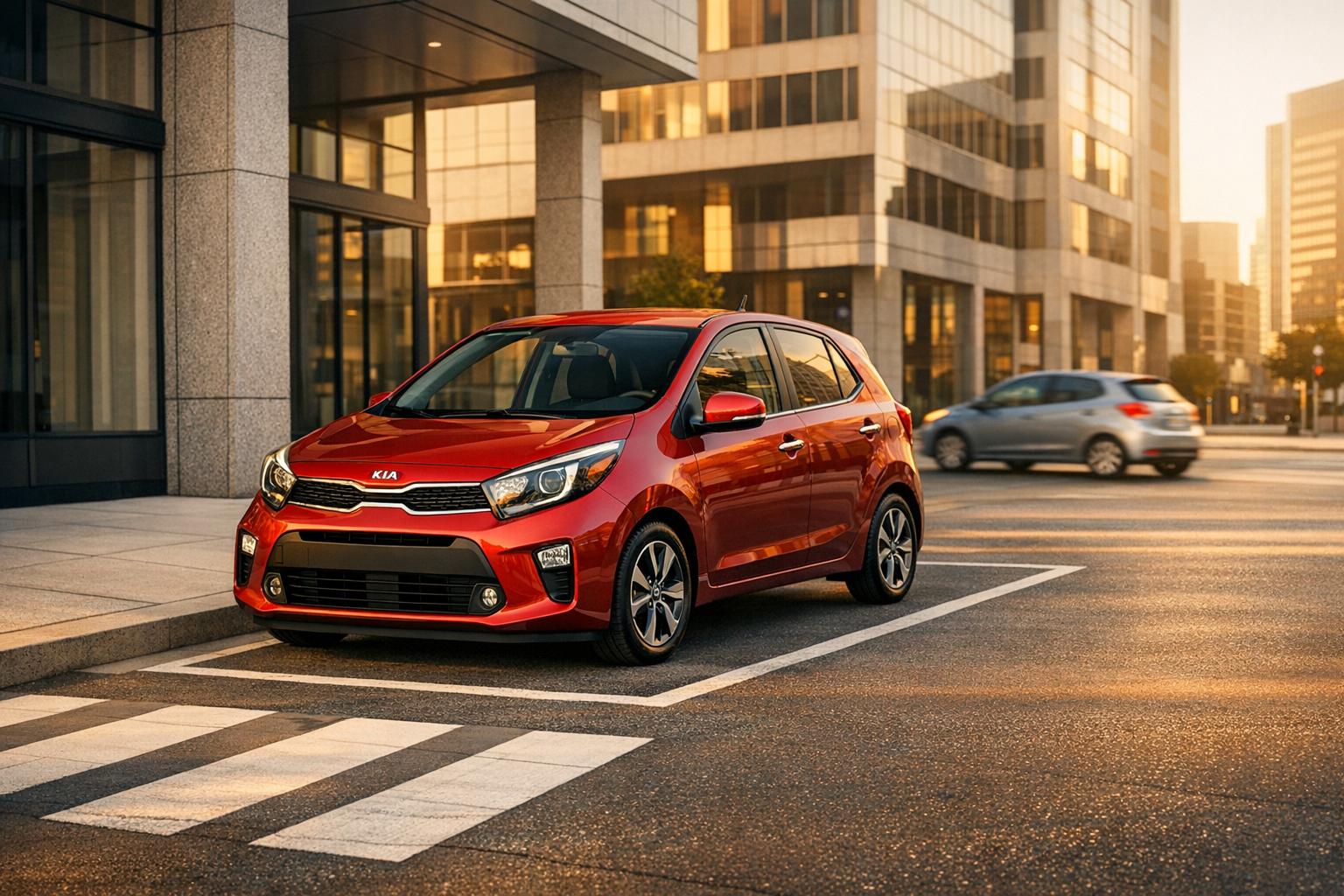
The Kia Picanto is a strong contender for city drivers looking for a compact, efficient, and affordable car. With over 100,000 units sold in South Africa since 2004, it boasts features like excellent fuel economy (5.2–5.7 L/100 km or 41–45 mpg), a 5-year/unlimited mileage warranty, and low maintenance costs. However, its base model lacks some key safety features like Electronic Stability Control (ESC), which competitors like the Suzuki Swift include as standard.
Here’s a quick breakdown:
- Kia Picanto: Great fuel efficiency, reliable ownership costs, and a premium interior. Downsides include a higher price and limited safety features on base trims.
- Suzuki Swift: Lower starting price, standard ESC, and better cargo space. However, it has a shorter warranty and less refined interiors.
- Hyundai Grand i10: Offers more space, lower maintenance costs, and a longer drivetrain warranty. But it lags in fuel efficiency and safety ratings.
Quick Comparison:
| Feature | Kia Picanto | Suzuki Swift | Hyundai Grand i10 |
|---|---|---|---|
| Starting Price | Higher | Lower | Moderate |
| Fuel Efficiency | 5.2–5.7 L/100 km | 4.9 L/100 km | 5.9 L/100 km |
| Warranty | 5 years/unlimited km | 5 years/124,000 miles | 7 years/124,000 miles |
| Safety Features | ESC on higher trims | ESC standard | Basic safety features |
| Cargo Space | 233–255 liters | 268 liters | 42.4 cubic feet |
The Kia Picanto is a dependable choice for urban driving, but its rivals may offer better value depending on your priorities, such as safety, space, or affordability.
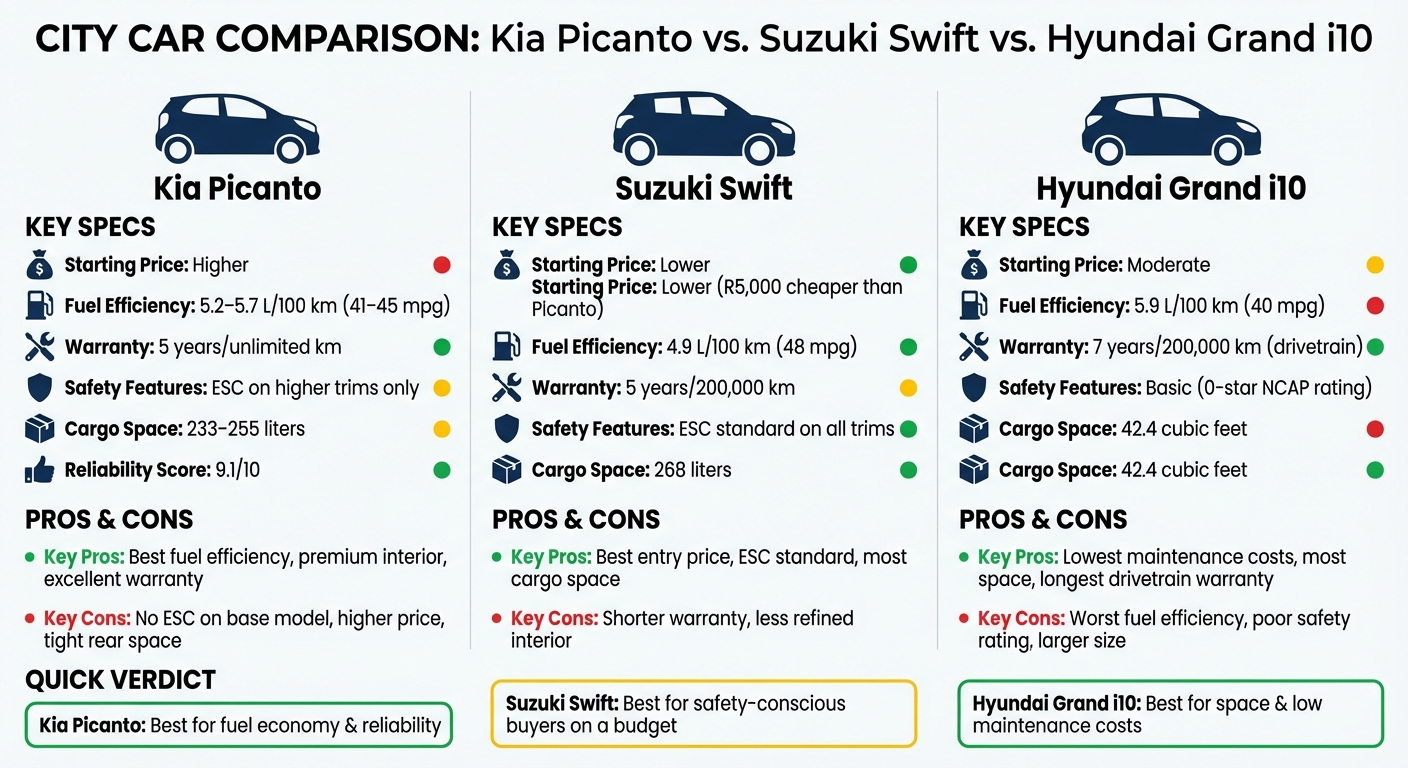
Kia Picanto vs Suzuki Swift vs Hyundai Grand i10 City Car Comparison
1. Kia Picanto
Safety Ratings
The Kia Picanto is built with 44% advanced high-strength steel, reinforced with hot-stamping in critical areas like the floor pan and passenger cell. Standard safety features include dual front airbags, ABS, Electronic Brakeforce Distribution, and ISOFIX child seat anchors. Even the base LX model is equipped with a reverse-view camera with parking guidelines. However, more advanced safety features, such as Electronic Stability Control (ESC) and Hill-start Assist Control (HAC), are only available on the higher EX and EX Plus trims, leaving the entry-level LX without these key systems.
"For me, stability control is non-negotiable. It’s a safety feature that is mandatory on European cars but it’s not available in the entry-level Kia Picanto 1.0 LX models." – Ané Albertse, AutoTrader
In terms of braking performance, the Picanto delivers strong results, achieving an emergency stop from 100 to 0 km/h in just 3.08 seconds. The EX trim also includes a Rear Occupant Alert function, while the EX Plus adds rear parking distance sensors. Together, these features contribute to the Picanto’s reputation for safety and reliability, making it a practical choice for cost-conscious drivers.
Reliability and Ownership Costs
When it comes to reliability, the Picanto scores an impressive 9.1/10 from MotorEasy. The most common repair claims involve the braking system, averaging £155.88 per repair (47.37% of claims), and suspension components, averaging £127.31 (17.54% of claims). Kia also offers a 2-year/30,000 km service plan with 15,000 km intervals, helping to keep maintenance costs manageable.
Insurance costs for the Picanto range between R423 and R827 per month, depending on coverage. Additionally, the automatic transmission holds its value better, depreciating only 7% over two years compared to 22% for the manual variant. These factors make the Picanto an economical option for long-term ownership.
Performance and Fuel Efficiency
The Picanto offers two engine options: a 1.0-liter three-cylinder with 49 kW and 95 Nm of torque, and a 1.2-liter four-cylinder producing 62 kW and 122 Nm. In real-world conditions, the 1.0-liter manual achieves an average fuel consumption of 5.2 L/100 km (45 mpg), while the 1.2-liter averages 5.7 L/100 km (41 mpg) – closely matching Kia’s official figures. With a 35-liter fuel tank, the Picanto can cover approximately 381 to 435 miles on a single fill-up.
Weighing just 2,120 lbs, the Picanto benefits from excellent fuel efficiency and nimble handling. Its compact size, with a 141-inch length and a tight 9.4-meter turning circle, makes it ideal for city driving and easy parking. While the 1.0-liter engine is well-suited for urban commutes, it can feel underpowered at highway speeds (around 75 mph). For better performance during overtaking or long-distance cruising, the 1.2-liter engine is the better choice.
Affordability and Value
The Kia Picanto strikes a balance between affordability and features. The trunk offers 233–255 liters of space, which is adequate for daily errands but may feel tight for larger items. Rear legroom is also limited, especially for passengers taller than 5’5".
The 2024 facelift has brought a fresh look to the Picanto, featuring a redesigned "Tiger Nose" grille, updated headlamps, and a horizontal light bar on the tailgate, giving it a sleek, modern vibe perfect for urban settings. All models come with an 8-inch touchscreen that includes wireless smartphone integration as standard.
"The Picanto manages to feel fairly upmarket, despite its budget-segment placement and is a pleasing little thing to pilot." – CAR Magazine
2. Suzuki Swift
Safety Ratings
The Suzuki Swift comes packed with essential safety features right out of the gate. One standout is Electronic Stability Control (ESC), which is included as standard across the entire Swift lineup. In contrast, the Kia Picanto only offers this feature in its higher-tier models, meaning buyers have to spend more to access this critical safety system.
"The Swift, which not only offers more interior packing space, is equipped with stability control as standard across the range." – CAR Magazine
Performance and Fuel Efficiency
Beyond safety, the Swift shines in performance and efficiency, making it a great choice for city driving. The Swift 1.2 GLX delivers 61 kW and 113 Nm, which is sufficient for urban commutes, even though its torque is slightly lower than the Picanto. The mild-hybrid version steps things up with 81 hp and an extra 44 lb-ft of torque from hybrid assist. This setup pushes fuel efficiency to an impressive 56–64 mpg, thanks in part to its lightweight design, tipping the scales at just 2,092 pounds.
"The Swift Hybrid is not expressly sporty, but it is very light. Suzuki pegs the curb weight at a bantam 2,092 pounds. That certainly helps with its impressive fuel economy." – Alex Kierstein, MotorTrend
The non-hybrid Swift also holds its own, boasting a claimed fuel consumption of 4.9 L/100 km (48 mpg), narrowly edging out the Picanto’s 5.0 L/100 km (47 mpg). Both cars come with a 2-year/30,000 km service plan, adding to their practicality for everyday use.
Affordability and Value
When it comes to price, the Swift GLX manual is about $5,000 cheaper than the base Kia Picanto LX, making it a more budget-friendly option for many buyers. The Swift also offers a bit more storage space, with 268 liters of boot capacity compared to the Picanto’s 255 liters. Warranty coverage differs slightly: the Swift includes a 5-year/200,000 km warranty, while the Picanto offers a 5-year/unlimited km plan, which could appeal to those who drive long distances.
With its lower price, standard safety features, and impressive fuel efficiency, the Suzuki Swift stands out as a smart choice for urban drivers looking for a practical and affordable hatchback.
3. Hyundai Grand i10
Affordability and Value
The Hyundai Grand i10 stands out as a wallet-friendly option for city driving. It offers both lower upfront costs and reduced maintenance expenses. For instance, in a 2020 comparison, the Grand i10 1.2 Fluid was priced at $14,700 (R219,900), which was about $730 (R11,000) less than the Kia Picanto 1.2 Smart. When it comes to servicing and repairs, Hyundai parts are notably cheaper, giving the Grand i10 a clear advantage in total ownership costs.
"In this department [parts prices], the Hyundai blew the Kia out of the water, with servicing-, maintenance- and accident repair parts being considerably less expensive…" – Martin Pretorius, AutoTrader
Another highlight is its 7-year/124,000-mile (200,000 km) drivetrain warranty, which outlasts Kia’s 5-year/unlimited mileage coverage. Both brands, however, include a 2-year/18,600-mile (30,000 km) service plan, simplifying early ownership for buyers.
Performance and Fuel Efficiency
Under the hood, the Grand i10 features a 1.2-liter engine designed for higher top-end power, delivering 64 kW (86 hp) and 120 Nm (89 lb-ft) of torque. While this setup favors performance, it compromises fuel efficiency slightly, with a claimed consumption of 5.9 L/100 km (40 mpg) – higher than the Picanto’s 5.0 L/100 km (47 mpg). This makes the Grand i10 less appealing for those prioritizing fuel savings during city commutes.
"The Hyundai version of this ‘Kappa’ engine is tuned for slightly more top-end power, while the Kia version is optimised for more low-rev torque and lower fuel consumption." – Martin Pretorius, AutoTrader
For a more fuel-efficient alternative, the 1.0-liter manual variant of the Grand i10 offers a consumption rate of 5.5 L/100 km (43 mpg), a reasonable trade-off for buyers willing to sacrifice a bit of power. At 150 inches (3,815 mm) in length, the Grand i10 is longer than the Picanto’s 141 inches (3,595 mm). While this extra length might make parking in tight spots a bit more challenging, it translates to noticeably better interior space.
Reliability and Ownership Costs
Practicality is another area where the Grand i10 excels. With the rear seats folded, it offers 42.4 cubic feet of cargo space, significantly more than the Picanto’s 35.7 cubic feet. This added room is ideal for groceries, sports equipment, or weekend trips. Additionally, the Grand i10 provides more rear-seat legroom, making it a better option for families or those who frequently carpool. Combined with its robust warranty and extra storage capacity, it’s a solid choice for everyday urban needs.
"The Hyundai’s very strong warranty, competitive specification level, and superior practicality pushes it into second place here, and it would grab the winning spot if the ability to carry more than two occupants or lots of luggage is a priority." – Martin Pretorius, AutoTrader
The Grand i10 also performs well in terms of resale value, showing strong resistance to depreciation in South African markets. However, safety features in older or entry-level trims may leave some buyers hesitant. Most models include only two airbags and ABS, with no electronic stability control (ESC) in many variants. In a December 2025 Global NCAP test, the Grand i10 scored 0 stars for adult occupant protection and 3 stars for toddlers, which could be a concern for safety-conscious drivers.
sbb-itb-09752ea
What Goes Wrong With A KIA PICANTO? Buyers Guide & Review
Pros and Cons
Here’s a quick comparison of each vehicle’s strengths and weaknesses for urban driving:
| Vehicle | Pros | Cons |
|---|---|---|
| Kia Picanto | – Great fuel efficiency: 5.2–5.7 L/100 km (41–45 mpg) – Strong warranty: 5-year/unlimited mileage coverage – Highly reliable: 99.3% reliability score, with only 6% of owners reporting issues – Premium interior touches: Leather-wrapped steering wheel and 8-inch touchscreen with wireless Apple CarPlay/Android Auto – Easy to park and maneuver: 9.4-meter turning circle and compact 141-inch length | – No ESC on base models: The LX trim lacks electronic stability control – Tight rear space and small trunk: Boot capacity of 233–255 liters – High engine revs on highways: 3,500–4,000 rpm at highway speeds – Slightly higher starting price: Costs about $340 more than the Suzuki Swift |
| Suzuki Swift | – Better entry price: Around $340 cheaper than the Picanto LX – Comprehensive safety features: Electronic stability control comes standard across all trims – More cargo space: 268 liters of trunk capacity – Impressive fuel efficiency: 4.9 L/100 km (48 mpg) | – Shorter warranty: 5 years/124,000 miles compared to the Picanto’s unlimited mileage – Less polished interior: Cabin materials and finish aren’t as refined as the Picanto |
| Hyundai Grand i10 | – Lower maintenance costs: Affordable servicing and parts – Highly practical: Offers 42.4 cubic feet of cargo space and ample rear legroom – Best drivetrain warranty: 7 years/124,000 miles – More power: 64 kW (86 hp) and 120 Nm (89 lb-ft) of torque | – Least fuel-efficient: 5.9 L/100 km (40 mpg), about 18% worse than the Picanto – Low safety rating: Scored 0 stars for adult occupant protection in the Global NCAP test (December 2025) – Larger size: 150-inch length can make parking in tight spots tricky |
The Kia Picanto shines with its fuel economy and reliability, making it a smart pick for budget-conscious urban drivers. Meanwhile, the Suzuki Swift appeals to safety-minded buyers, thanks to its standard electronic stability control, even on base trims. On the other hand, if you’re looking for extra space and lower maintenance costs, the Hyundai Grand i10 is a practical choice, though you’ll trade off some fuel efficiency for the added room.
Conclusion
The Kia Picanto has made its mark as a dependable city car, with over 100,000 units sold since its debut in 2004. Its standout feature? A 5-year/unlimited kilometer warranty, which is a big plus for drivers who rack up the miles. Add to that its real-world fuel efficiency of around 5.7 L/100 km (about 41 mpg), and you’ve got a car that handles city life with ease.
Of course, no car is perfect. The base LX model lacks Electronic Stability Control (ESC), and its price tag of R260,995 makes it about R5,000 pricier than the Suzuki Swift, despite offering less cargo space. Additionally, Chad Lückhoff from AutoTrader pointed out that the Picanto has the highest parts basket cost, equating to 69.92% of its purchase price.
For buyers prioritizing safety, the Suzuki Swift, with its standard ESC and lower starting price, might be the better option. On the other hand, those who drive long distances and value a strong warranty and upgraded interior features should look at the Picanto EX or higher trims. If space is your main concern, the Hyundai Grand i10 could be the right fit.
Ultimately, your choice depends on what matters most for your urban driving needs – whether it’s safety, warranty protection, or practicality.
FAQs
What safety features does the base model of the Kia Picanto include, and are there any concerns?
The Kia Picanto base model comes with some key safety essentials, including dual front airbags, anti-lock brakes (ABS), and ISOFIX anchors for securing child seats. Its structure integrates high-strength steel, adding extra reinforcement to the passenger cabin and enhancing protection during crashes. These features make it a practical choice for everyday city driving.
That said, the base model doesn’t include advanced safety tech like lane-keeping assist or automatic emergency braking – features that are typically reserved for higher trims or newer models. Plus, as a compact car, the Picanto’s smaller size and lighter frame may not provide the same level of protection in serious collisions as larger vehicles. While it’s a dependable option for urban commutes, buyers prioritizing advanced safety features might want to explore trims with more robust options.
How does the Kia Picanto perform in terms of fuel efficiency compared to other city cars?
The Kia Picanto has earned a reputation for being a fuel-savvy choice, especially for city driving. It boasts an estimated fuel economy of about 45 miles per gallon (MPG) in real-world conditions, aligning closely with the manufacturer’s claims. This means fewer trips to the pump and more savings for those navigating busy urban streets.
Among city cars in its category, the Picanto competes strongly, often matching or surpassing the fuel efficiency of similar models built for economical urban travel. With its mix of affordability, low running costs, and impressive mileage, it’s a practical pick for anyone looking to keep their city commutes light on the wallet.
Is the Kia Picanto worth its price for a reliable city car?
The Kia Picanto is a solid pick for navigating city streets, offering a blend of dependability and practicality at a price that aligns with its benefits. With great fuel efficiency, a stylish design, and a track record of reliability, it’s an excellent option for urban drivers seeking a compact, hassle-free vehicle.
Although its initial price might be a bit higher than some rivals, the low upkeep costs and long-term reliability make it a wise choice for anyone valuing durability and ease of ownership in a city-friendly car.
Related Blog Posts
- The cheapest new cars in South Africa under R250,000
- Best Cars Under R300K in South Africa (2025 Update)
- Top 5 city cars for Johannesburg, Cape Town and urban driving
- Top 5 Cars to Buy in South Africa for Less Than R 150 000