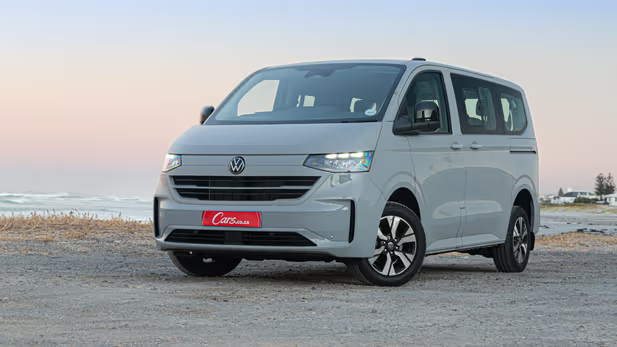
The automotive world was abuzz when Volkswagen announced that its latest Transporter would share underpinnings with Ford’s Transit platform. For VW loyalists in South Africa, this collaboration raised questions: would the legendary Transporter lose its identity, or could it combine the best of both brands? Priced at R1,174,600, the Transporter 2.0 TDI Kombi SWB Life attempts to balance commercial vehicle practicality with passenger comfort – but does it succeed?
Understanding the VW-Ford Partnership
The seventh-generation (T7) Volkswagen Transporter represents a significant shift in the brand’s people-mover strategy. Through a commercial vehicle collaboration with Ford, the new Transporter is built on the Blue Oval’s acclaimed Transit/Tourneo platform – a move that combines Ford’s expertise in creating durable, practical workhorses with Volkswagen’s traditional strengths in refinement and car-like driving dynamics.
This partnership presents both opportunities and risks. When executed well, it could deliver a vehicle that’s supremely practical yet comfortable enough for family duties. However, there’s also the danger of diluting what made each brand’s vans special to their respective fan bases.
For those tracking the latest developments in South Africa’s evolving automotive landscape, imotonews.co.za provides comprehensive coverage of new models, industry trends, and expert reviews.
Who Is the Transporter Kombi For?
The Transporter Kombi occupies a unique space in South Africa’s people-mover segment. It competes directly with its Ford Tourneo Custom sibling and the Mercedes-Benz Vito, while also facing pressure from more passenger-focused alternatives like the Hyundai Staria and the exceptionally comfortable Kia Carnival.
This particular Life SWB (short wheelbase) specification sits in the middle of the Transporter passenger van range, which spans from R933,500 to R1,342,400. It’s targeted at families or businesses needing flexible seating and cargo space in a package that’s still manageable for urban driving.
If you’re weighing up whether a van-based people carrier suits your needs, or if you’d prefer a traditional SUV or sedan, exploring the used market at auto24.co.za reveals alternatives like the Toyota Fortuner, Land Rover Discovery, or even luxury sedans like the BMW 5 Series – each offering different approaches to transporting families with varying levels of practicality and comfort.
Design That Balances Identity and Practicality
While the Transporter shares its fundamental architecture with the Ford Transit, Volkswagen’s designers have worked hard to give it a distinct visual identity. The body-colored grille, reshaped bumper, and full LED headlamps (standard even on this mid-spec Life variant) create a more upmarket front-end appearance compared to the equivalent Ford Tourneo Trend.
The design also nods to Volkswagen’s heritage – squint slightly and you’ll catch echoes of the beloved T5 generation. Neat dual-tone 17-inch alloy wheels wrapped in chunky tires enhance both visual appeal and ride comfort.
At 5,048mm long and 1,972mm wide, with a wheelbase of 3,100mm, the Transporter is genuinely spacious. Yet at just under 2 metres tall, it fits comfortably into most underground parking – a practical consideration for South African shoppers and city dwellers.
Functional Family Features
The Transporter’s commercial van heritage shines through in its thoughtful design details:
- Dual sliding side doors on both sides make access easy, particularly in tight parking spaces
- Low floor height simplifies entry and exit for children and elderly passengers
- Sliding windows on the side doors provide ventilation (a feature oddly missing from the equivalent Ford Tourneo Trend)
- Roller blinds for second-row passengers add privacy and sun protection
All six rear seats are individual, rail-mounted chairs that can be easily repositioned or removed entirely. At 28kg each, they’re significantly lighter than previous Transporter generations, making reconfiguration less of a back-breaking exercise. This modular arrangement means you can carry five passengers with a mountain of luggage by removing the three rearmost seats.
Interior Space and Comfort
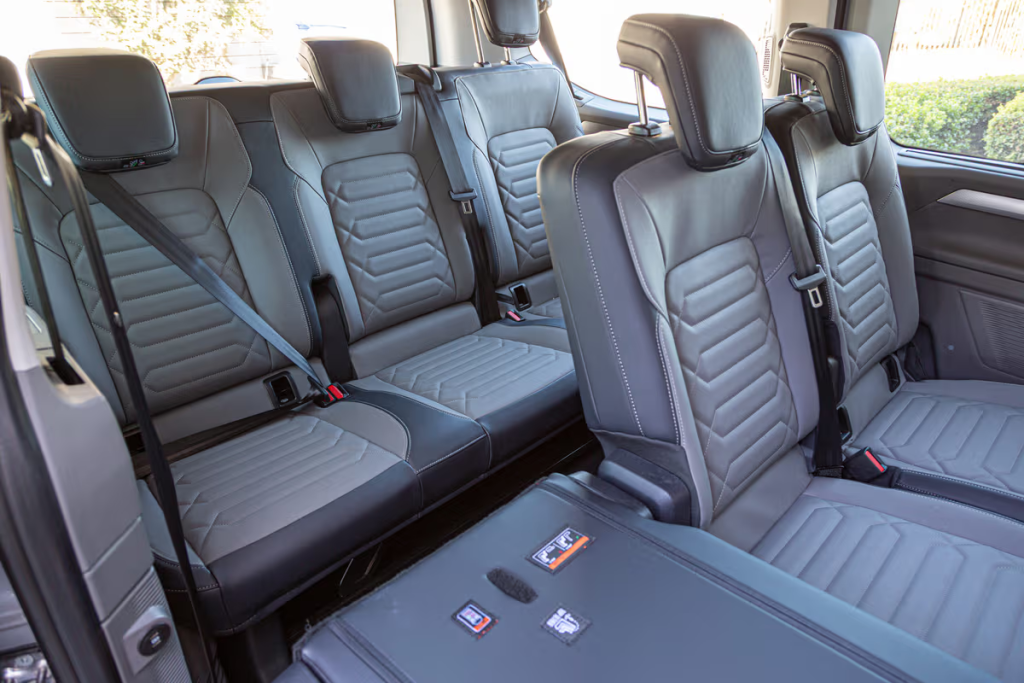
Step inside and you’re greeted by commanding forward visibility and a dashboard that, from the mid-line trim upwards, differs substantially from the Ford version. While hard-wearing plastics dominate (this is fundamentally a commercial vehicle), Volkswagen has made efforts toward a more premium feel through thoughtful color combinations – grey and black plastics complemented by attractive artificial leather upholstery in matching hues.
Tech and Infotainment
The driver faces a crisp 12-inch digital instrument display, while the center console features an even larger 13-inch infotainment touchscreen. As with many modern vehicles, some frequently used controls have been integrated into the screen rather than remaining as physical switches – particularly the HVAC system and the heated front seats (a welcome surprise feature at this price point).
Fortunately, reasonably prominent shortcut buttons at the bottom of the screen ease navigation. Standard Android Auto and Apple CarPlay compatibility ensures seamless smartphone integration, and USB-C ports are scattered throughout the cabin, including for rear passengers.
Storage Compromises
Here’s where the Transporter stumbles. Despite the column-mounted gear shifter freeing up considerable space at the base of the center console, Volkswagen hasn’t utilized this area well. The result is surprisingly limited oddments storage around the driver, forcing reliance on unpadded door pockets and dashboard recesses where items slide around frustratingly.
Ford’s designers handled this aspect better in the Tourneo. It’s an irritating oversight in an otherwise well-thought-out cabin. At least the front passenger enjoys two lidded glove compartments.
Cargo Versatility: Van DNA Showing Through
When you need to prioritize cargo over passengers, the Transporter delivers impressively. The short-wheelbase version is already 146mm longer and 128mm wider than its predecessor, translating to substantially more interior volume.
Key cargo specifications:
- Width between rear wheel housings: 1,392mm (148mm increase)
- Cargo floor length: 2,602mm
- Roof load capacity: 170kg (up 20kg from the previous generation)
With all rear seats removed, you gain genuinely commercial-grade load space. The individual seat arrangement means you can configure the cabin precisely for your needs – perhaps five seats with extended luggage area, or full eight-seat capacity for the weekend soccer team run.
One minor frustration: there’s no powered tailgate. While lifting it open is manageable, closing requires pulling down a strap with considerable effort.
Driving Dynamics: Finding the Balance
Volkswagen’s people carriers historically distinguished themselves through car-like refinement compared to utilitarian van-based rivals. With the T7 now sharing Ford’s Transit underpinnings – a platform admired for toughness and practicality but known for feeling more workmanlike than plush – has Volkswagen maintained its refinement edge?
Ride Quality and Handling
The answer is: mostly, yes. Volkswagen and Ford have struck a reasonable balance. There’s inherent firmness in the ride that occasionally transmits through to passengers on rougher surfaces, but overall comfort levels are good – certainly better than a typical double-cab bakkie.
Road holding feels secure and composed, even when loaded. We were pleasantly surprised by the Transporter’s maneuverability given its dimensions. Light steering and a tight turning circle (better than a Golf 8.5, according to manufacturer data) make urban driving easier than you’d expect from a vehicle exceeding 5 metres in length.
The commanding driving position provides excellent visibility, supplemented by a rear-view camera and park distance sensors. Sensible physical buttons on the steering wheel (rather than touch-sensitive nonsense) make controlling key functions straightforward.
Refinement Considerations
One area where the Transporter doesn’t quite match older VW people carriers is cabin noise. Road and wind noise are more noticeable at highway speeds than you might expect at this price point. It’s not excessive, but previous-generation Volkswagen buses were quieter.
For families considering their transport options, whether you prioritize refinement, space, or value, browsing listings at auto24.co.za reveals alternatives like the Mercedes-Benz V-Class for superior luxury, or more affordable seven-seaters like the Kia Sorento or Mazda CX-9 that sacrifice ultimate space for better refinement.
Engine Performance and Real-World Efficiency
The Transporter Life is powered by Ford’s 2.0-litre single-turbo diesel engine producing 125kW at 3,500rpm and 390Nm of torque between 1,750-2,500rpm. Power reaches the front wheels through an eight-speed automatic transmission with the shifter conveniently mounted on the steering column.
Acceleration and Power Delivery
Volkswagen doesn’t quote an official 0-100kph time, but independent testing recorded 12.14 seconds. While hardly rapid, it’s actually quicker than the heavier long-wheelbase Ford Tourneo Custom (13.69 seconds), and the Transporter feels livelier in everyday driving.
For most situations, power proves adequate. The Kombi keeps up with urban traffic and cruises comfortably on highways. Where it struggles is when quick acceleration or immediate response is needed – the engine can feel caught flat-footed, requiring patience for overtaking maneuvers.
Load the Transporter with passengers and luggage to capacity, and family road trips become leisurely affairs with minimal reserve power for overtaking at highway speeds.
Fuel Consumption
Volkswagen claims 8.0 L/100km average consumption. In real-world driving with minimal load, expect around 9.0 L/100km – respectable for a 2-tonne vehicle of these dimensions. The 70-litre diesel tank should deliver approximately 750km range between fill-ups.
However, this figure assumes light loads. Fully utilizing the Kombi’s eight-seat and cargo capacity will likely push consumption toward 10.0 L/100km based on experiences with similar configurations.
Practical tip: Regular diesel engine maintenance is crucial for longevity and efficiency. Ensure fuel filters are changed at recommended intervals (typically every 30,000-40,000km), and address any diesel injector issues promptly to prevent expensive repairs. Using quality diesel from reputable stations also helps prevent fuel system contamination.
For those interested in reducing fuel costs and environmental impact, EV24.africa offers import options for electric vehicles, though fully electric people movers of this size remain limited globally. As charging infrastructure expands across South Africa, electric alternatives may become more viable for families prioritizing sustainability.
Safety and Assistance Features
The Life specification includes six airbags and a comprehensive suite of active safety technologies:
- Forward collision warning with automatic emergency braking
- Lane-keeping assistance
- Park distance sensors front and rear
- Rear-view camera
Notably absent is adaptive cruise control – a disappointing omission given the Transporter’s suitability for long-distance family travel. ISOFIX child seat anchors are fitted to the side seats in both the second and third rows.
This particular model hasn’t yet undergone Euro NCAP crash testing, though the Ford Transit Custom platform on which it’s based has achieved strong safety ratings.
The braked towing capacity of 2,800kg represents a 300kg increase over the previous Transporter generation, making it suitable for towing caravans or boat trailers for family adventures.
Ownership Costs and Warranty
At R1,174,600, the Transporter 2.0 TDI Kombi SWB Life isn’t cheap. You’re paying for space, versatility, and the VW badge. It comes with:
- 3-year/120,000km warranty
- 5-year/60,000km maintenance plan
- 12-year anti-corrosion warranty
- Service intervals: 15,000km or annually
These ownership benefits provide peace of mind, particularly for families planning to keep the vehicle long-term.
Should You Buy the Transporter Kombi?
The seventh-generation Volkswagen Transporter Kombi occupies an interesting middle ground. It’s more versatile than dedicated passenger vehicles like the Kia Carnival or Hyundai Staria, but not as refined or comfortable for purely passenger duties. Conversely, it offers more passenger-focused design than purely commercial alternatives.
Consider the Transporter Kombi if:
- You need genuine eight-seat capacity with frequently reconfigurable space
- Regular cargo-hauling ability matters alongside passenger transport
- You value maneuverability for urban driving despite the size
- The VW brand appeals and you want something different from typical SUVs
Look elsewhere if:
- Passenger comfort is your absolute priority (consider the Kia Carnival)
- You need maximum refinement and don’t require cargo flexibility
- The high price seems steep compared to more car-like seven-seaters
- Cabin noise levels and firm ride quality concern you
For comprehensive reviews, comparison tools, and the latest automotive news from across South Africa, visit imotonews.co.za regularly to stay informed about new developments in the people-mover segment.
The Transporter Kombi represents progress for Volkswagen – expanded capabilities and practicality through the Ford partnership. However, this breadth comes with compromise. It attempts to be all things to all people, and inevitably falls slightly short of excellence in any single area. For buyers whose needs genuinely span passenger comfort and cargo versatility, this compromise may prove worthwhile.