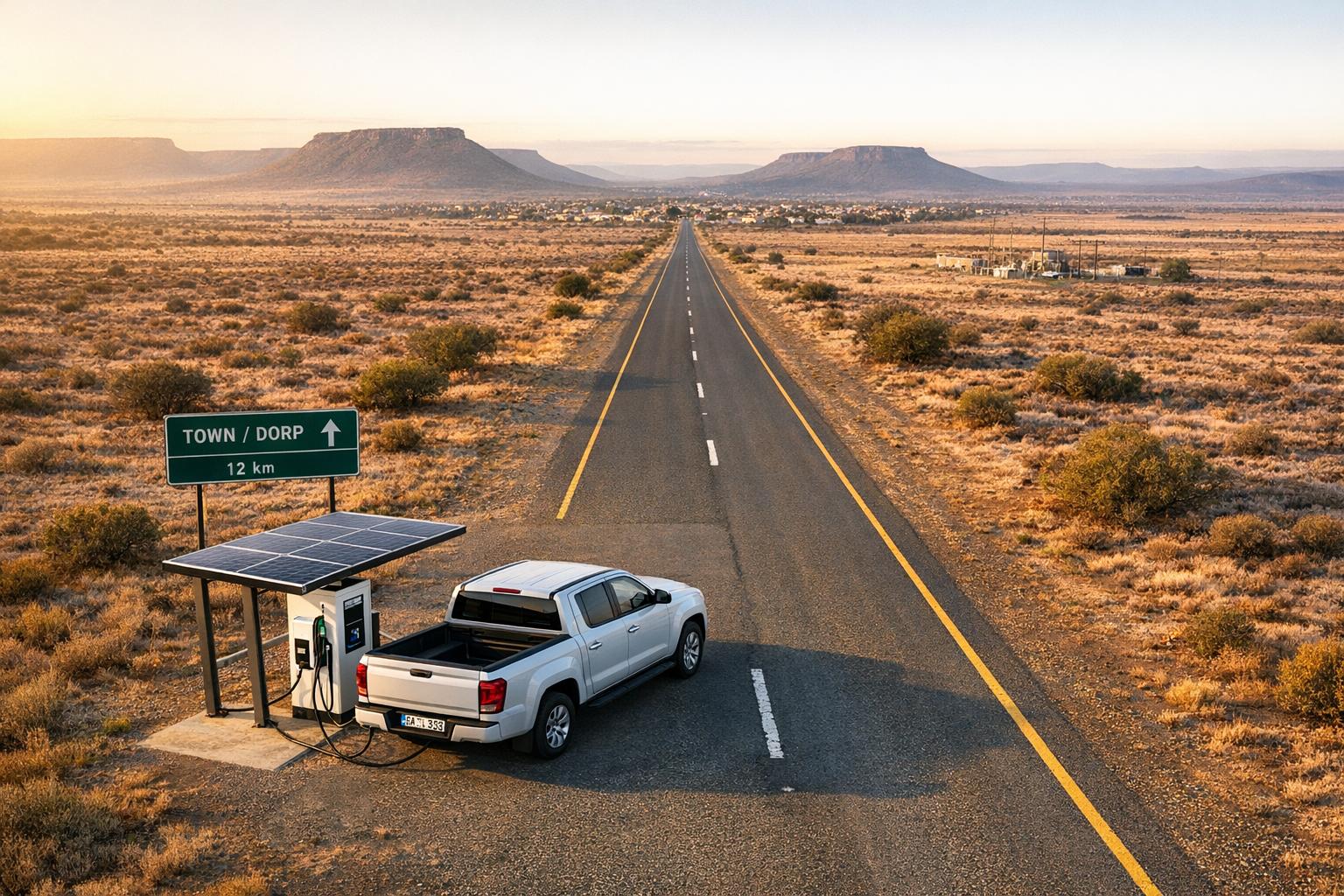
Yes, but there are challenges. South Africa is seeing growth in electric vehicle (EV) sales – up over 80% between 2023 and 2025. Electric bakkies, like the Riddara RD6 and BYD Shark 6, are entering the market, offering lower running costs and reduced maintenance compared to diesel models. However, barriers like limited charging infrastructure, load-shedding, and high upfront costs hinder adoption.
Key Points:
- EV Growth: EV sales rose to 1.2% of new car sales by mid-2025, but diesel bakkies still dominate.
- Charging Issues: Only 600 public chargers exist (vs. 4,800 fuel stations), with load-shedding disrupting reliability.
- Cost Barriers: Import duties inflate prices by 59–72%, making EVs less accessible.
- Long-Term Savings: EVs cost around R0.93/km to run compared to R2.40/km for diesel. Maintenance costs are 60–70% lower.
- Government Support: From March 2026, manufacturers benefit from a 150% tax deduction on EV-related investments.
Challenges to Solve:
- Expand charging infrastructure, especially in rural areas.
- Reduce import duties to lower EV prices.
- Address load-shedding with off-grid charging solutions.
Electric bakkies are gaining traction, but widespread adoption will require addressing infrastructure, affordability, and reliability issues.
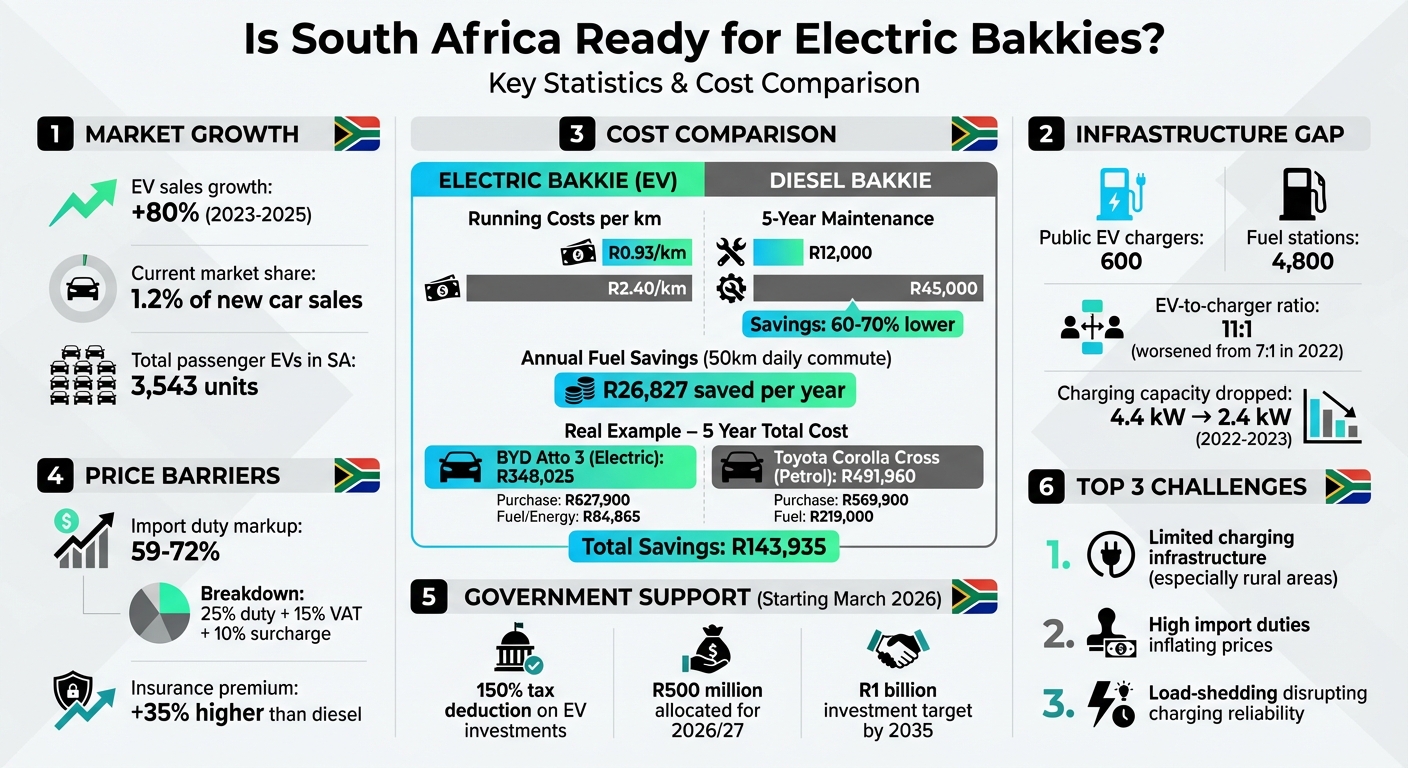
Electric vs Diesel Bakkies: Cost Comparison and Key Statistics for South Africa
2025 BYD Shark 6 Review | SA’s Most Powerful Plug-In Hybrid Bakkie
sbb-itb-09752ea
Charging Infrastructure Problems
South Africa’s electric vehicle (EV) charging infrastructure is lagging far behind its traditional fuel stations. With only 600 public EV chargers compared to 4,800 fuel stations, the EV-to-charger ratio has worsened from 7:1 to 11:1 between 2022 and 2023. Charging capacity has also dropped significantly, from 4.4 kW to just 2.4 kW during the same period.
Too Few Public Charging Stations
The majority of public chargers are concentrated in Gauteng, the Western Cape, and KwaZulu-Natal. This leaves vast areas, such as the Northern Cape, North West, and Limpopo, with little to no access to charging facilities.
"Tshwane’s Basic Charge is a good example of a hindrance to expansion in Pretoria. We actively avoid Pretoria as a result, as it makes installing chargers financially unfeasible from the onset."
- Hilton Musk, Head of E-mobility, Rubicon
The financial barriers to setting up public chargers are steep. Installation costs range from R500,000 to R2 million, with a 200 kW DC fast charger at a high-traffic site costing up to R2.5 million. Operators only expect profitability once the EV fleet approaches 100,000 units. However, as of now, there are just 3,543 passenger EVs in the country. This chicken-and-egg scenario has caused some operators to slow their rollout of DC fast chargers, waiting for higher EV adoption rates to justify further investment.
On top of these geographic and financial challenges, the country’s unstable electricity grid adds another layer of complexity.
Load-Shedding Affects Charging Reliability
South Africa’s frequent load-shedding disrupts grid-tied chargers, leaving them offline and amplifying range anxiety for EV drivers. This problem is particularly acute in areas already lacking sufficient charging infrastructure. For bakkie drivers in demanding work environments, the lack of reliable charging access makes EV adoption even more challenging.
"Grid-tied chargers are not a long-term solution in a country facing chronic electricity shortages. As electric vehicle uptake grows, grid-tied charging simply transfers additional pressure onto an already failing system."
- Joubert Roux, Co-founder, Zero Carbon Charge
To address this, some operators are experimenting with off-grid solutions. In December 2024, Charge (formerly Zero Carbon Charge) launched South Africa’s first fully off-grid EV charging station on the N12 between Klerksdorp and Wolmaransstad. This station features ultra-fast chargers powered by solar panels and battery storage. Looking ahead, the company plans to add two more off-grid stations along the N3 corridor by May 2026, supported by a R100 million equity investment from the Development Bank of Southern Africa.
While off-grid charging stations eliminate dependence on the unstable grid, they come with higher initial costs and face regulatory hurdles, which slow down their broader adoption.
Affordability and Cost Barriers
Upfront costs are a major obstacle for many South African buyers considering electric bakkies. While these vehicles promise savings over time, their initial price – further inflated by import duties and taxes – makes them unattainable for a large segment of consumers.
High Purchase Prices and Import Duties
Electric bakkies face significant markups, ranging from 59% to 72%, due to steep import duties and taxes. These include a 25% duty, a compounded 15% VAT, and an additional 10% surcharge. On top of that, all bakkies are subject to an ad valorem luxury tax, which applies under an outdated R200,000 threshold. Industry leaders are advocating to raise this threshold to R400,000, which could make entry-level models more accessible.
"We must compete on equal terms with vehicles that are heavily subsidised and dumped. We are in favour of more duties, or we will become a country of customers and not manufacturers."
- Billy Tom, Managing Director, Isuzu Motors South Africa
To address these challenges, the government plans to introduce measures aimed at bolstering local production. Starting March 1, 2026, qualifying capital investments in EV production will be eligible for a 150% tax deduction. Additionally, EVs will be exempt from VAT on sales, and both vehicles and components will avoid customs duties. However, these benefits are primarily aimed at manufacturers, leaving individual buyers to shoulder the high upfront costs. While these taxes inflate sticker prices, the long-term savings of electric bakkies can help offset these initial expenses.
Lifetime Costs: Electric vs. Diesel Models
Despite higher upfront costs, electric bakkies offer significant savings over their lifetime. The running cost for an EV is about R0.93 per kilometer, compared to R2.40 per kilometer for petrol or diesel vehicles. For instance, a commuter driving 50 kilometers daily could save around R26,827 annually on fuel by switching to electric.
Maintenance costs are another area where EVs shine. Over five years, an electric bakkie typically requires about R12,000 in maintenance, compared to R45,000 for a diesel equivalent. Without components like oil filters, timing belts, or exhaust systems, routine servicing expenses are significantly reduced.
A side-by-side comparison underscores these savings. The BYD Atto 3 (electric) is priced at R627,900, while the Toyota Corolla Cross 1.8 (petrol) costs R569,900. Over five years, the BYD’s fuel and energy costs total R84,865, compared to R219,000 for the Toyota. When factoring in maintenance and depreciation, the BYD’s total 5-year cost comes to R348,025, saving buyers R143,935 compared to the Toyota’s R491,960.
That said, two factors could diminish these savings. Insurance for EVs is about 35% more expensive than for diesel models, largely due to higher battery replacement costs and the vehicles’ faster acceleration profiles. Additionally, while home charging is economical (municipal rates range from R3.26 to R5.15 per kWh), relying on public fast chargers for long trips can push energy costs to levels comparable to diesel fuel.
"The savings begin the moment you drive your BEV off the showroom floor – never again stopping at a petrol or diesel pump as long as you drive electric."
- EV NOW
Closing the affordability gap is critical for South Africa’s shift from diesel to electric bakkies. For buyers who can handle the upfront cost and have access to home charging, the financial benefits of EVs are clear. However, for those without these advantages, diesel models remain the more practical choice. These cost considerations will play a key role in shaping South Africa’s adoption of electric bakkies.
Consumer Attitudes and Market Demand
South African consumers remain skeptical about electric bakkies, largely due to challenges with charging infrastructure and high upfront costs. While EV sales in the country grew by over 80% annually between 2023 and 2025, they still represent just 1.2% of new car sales as of 2025. This disconnect between growing interest and actual purchases highlights key concerns that manufacturers and policymakers must address.
Concerns About Battery Life and Range
Range anxiety is no longer just about how far an EV can go – it’s increasingly about whether chargers will work when needed. A recent poll revealed that 31% of EV users encountered non-functional public chargers, 43% needed assistance to restore service, and only 25% reported never having issues.
These problems directly impact the convenience of daily driving. For example, in December 2025, a MyBroadband reader traveling long-distance faced a frustrating situation at a 60kW GridCars station in a mall. Although the app indicated the charger was online, it turned out to be offline. Without an RFID card for offline mode and with the site manager unavailable during a lunch break, the driver endured a two-hour delay while waiting for the charger’s breaker to be reset. Such incidents make the quick refueling of diesel vehicles look much more appealing – especially since the average South African driver travels only about 27 miles (43 kilometers) per day.
Rural areas face even more significant challenges. Most charging stations are concentrated in major cities like Johannesburg, Cape Town, and Durban, leaving secondary markets underserved. This lack of infrastructure has led some EV owners to consider switching to plug-in hybrids for long-distance travel, avoiding the unreliability of public charging networks. These issues stand in stark contrast to the dependable performance of diesel bakkies.
Preference for Diesel Models
Diesel bakkies continue to dominate the market, thanks to their proven reliability and ability to handle tough conditions. A Ford South Africa study found that 71% of respondents would be more likely to buy an EV if it offered better towing capacity, while 70% valued off-road capability. Diesel bakkies have consistently delivered on these fronts for decades.
"Myths and misinformation still cloud South African consumers’ views on driving an electric vehicle. There are still concerns that an electric vehicle can’t carry as much luggage/payload as an equivalent vehicle with an internal combustion engine."
- Ford South Africa Research Study
Another major obstacle is the lack of charging infrastructure, with 75% of survey respondents identifying it as a key barrier to EV adoption. While 40% of South African car owners are considering buying an EV within the next five years, turning that interest into actual sales will require solving these practical issues that currently favor diesel vehicles.
"This research highlights the need for continued efforts to educate the public about electrified vehicles, address concerns about cost, range and infrastructure, and promote the benefits of electric mobility."
- Sunil Sewmohan, Executive Director of Product Marketing, Ford South Africa
Electric Bakkie Models Entering South Africa
With the challenges of infrastructure and lingering doubts in the market, manufacturers are stepping up by introducing electric bakkie models designed to tackle these concerns. These vehicles showcase diverse approaches – ranging from fully electric designs to range-extended hybrids – all aimed at easing the transition from diesel-powered engines.
Models to Watch: Changan Hunter REEV, Riddara RD6, JAC T9
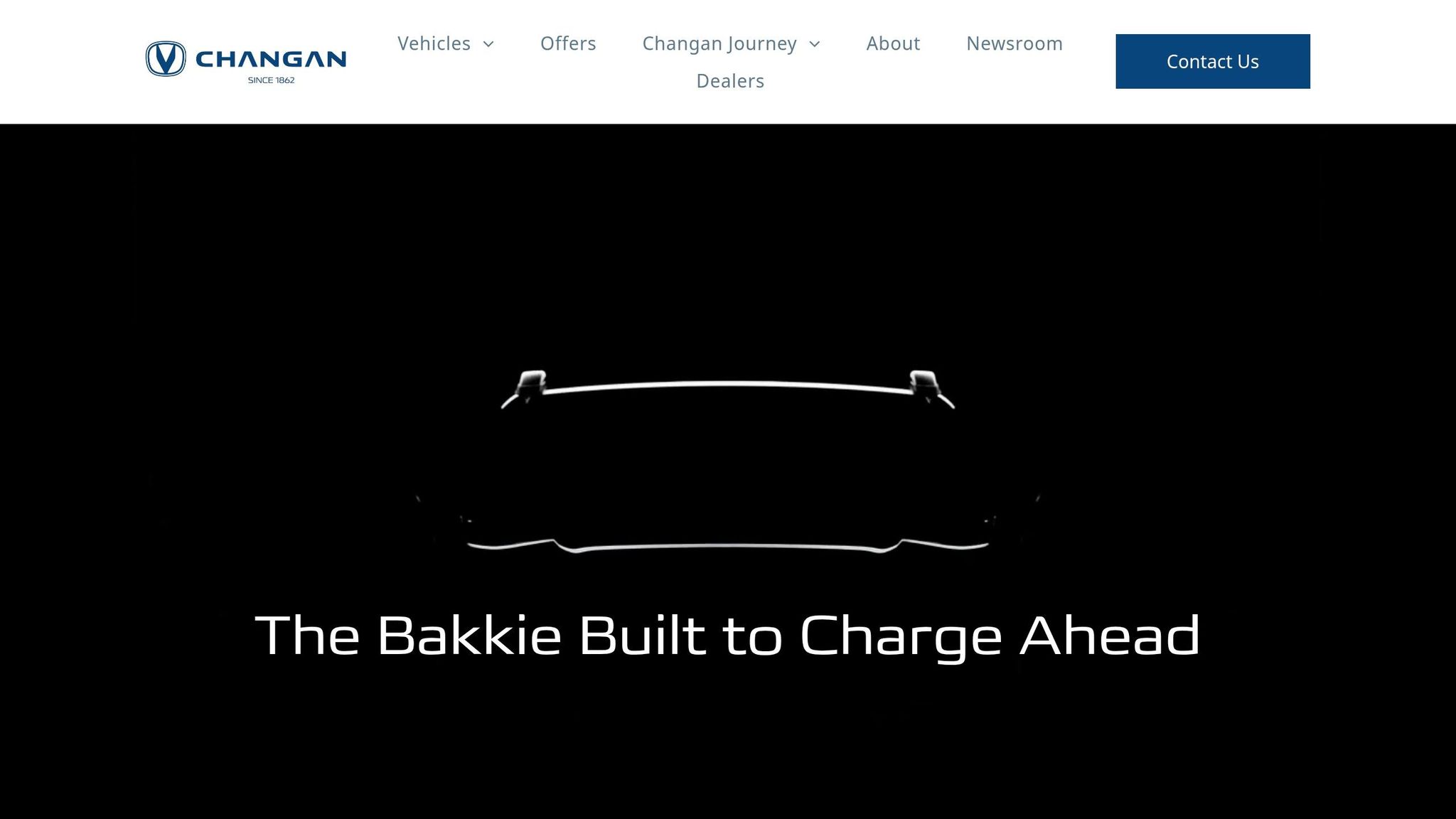
Here’s a closer look at some standout models making waves in the electric bakkie market.
The Changan Hunter REEV offers a solution for range anxiety with its range-extended system. Instead of relying solely on battery power, it features a 2.0-liter petrol engine that acts as a generator for a 31.18 kWh battery, which powers two electric motors. This configuration provides a combined range of 1,000 km (621 miles). Starting at R799,900 (around $44,400 USD), the Hunter REEV delivers 200 kW and 470 Nm of torque, a towing capacity of 2,200 kg (4,850 lbs), and a payload of 1,000 kg (2,205 lbs). It also comes with an 8-year/150,000 km battery warranty and a 5-year/90,000 km maintenance plan.
The Riddara RD6, South Africa’s first all-electric unibody bakkie, is built on Geely’s SEA platform – the same platform used in the Volvo EX30. Its unibody design enhances agility and ride comfort, while its Vehicle-to-Load (V2L) technology can supply up to 6 kW to power tools or appliances – perfect for load-shedding scenarios. The AWD version produces 315 kW and 595 Nm of torque, accelerating from 0 to 100 km/h (0–62 mph) in just 4.5 seconds. Its 73 kWh battery offers a range of 424 km (263 miles), and a 110 kW DC fast charger can recharge the battery from 30% to 80% in just 30 minutes. With a towing capacity of 3,000 kg (6,614 lbs) and a water fording depth of 815 mm (32 inches), it’s built to compete with traditional diesel bakkies. Pricing for the RD6 will be announced closer to its May 2025 launch.
"The ICE [internal combustion engine] age is over with the arrival of the new Riddara RD6."
- Gideon Wolfaardt, CEO, Enviro Automotive Group
The JAC T9 lineup is expanding with a 2.0L TGDI plug-in hybrid (PHEV) model, set for a Q2 2025 release. While details are still limited, this model is positioned as a bridge between diesel and fully electric powertrains.
Comparing Key Features
Here’s how these models stack up across critical performance metrics:
| Feature | Changan Hunter REEV | Riddara RD6 (AWD) | Riddara RD6 (RWD) |
|---|---|---|---|
| Powertrain Type | Range-Extended EV | Battery Electric (BEV) | Battery Electric (BEV) |
| Power Output | 200 kW (268 hp) | 315 kW (422 hp) | 200 kW (268 hp) |
| Torque | 470 Nm (347 lb-ft) | 595 Nm (439 lb-ft) | 384 Nm (283 lb-ft) |
| Battery Size | 31.18 kWh | 73 kWh | 73 kWh |
| Electric Range | 145 km (90 mi) | 424 km (263 mi) | 424 km (263 mi) |
| Combined Range | 1,000 km (621 mi) | 424 km (263 mi) | 424 km (263 mi) |
| Payload | 1,000 kg (2,205 lbs) | 1,030 kg (2,271 lbs) | 1,000 kg (2,205 lbs) |
| Towing (Braked) | 2,200 kg (4,850 lbs) | 3,000 kg (6,614 lbs) | 3,000 kg (6,614 lbs) |
| Ground Clearance | 220 mm (8.7 in) | 225 mm (8.9 in) | 220 mm (8.7 in) |
| Price (from) | R799,900 (~$44,400) | TBA | TBA |
These electric bakkies provide a range of options for addressing buyer concerns, offering solutions to the challenges of range and infrastructure while aiming to shift preferences away from diesel.
Solutions to Increase Electric Bakkie Adoption
Boosting electric bakkie adoption requires tackling challenges like charging infrastructure and affordability. This can be achieved through a mix of government policies and private sector investments.
Government Incentives and Policy Support
Starting March 1, 2026, businesses investing in qualifying electric vehicle (EV) infrastructure can benefit from a 150% tax deduction on buildings, plants, and machinery. For example, a R1 million (~$55,500) investment qualifies for a R1.5 million (~$83,250) tax deduction. To support this, the government has allocated R500 million (~$27.8 million USD) for the 2026/27 financial year and plans to invest R1 billion (~$55.5 million USD) to expand local EV production by 2035.
While these manufacturing incentives lay the groundwork, consumer-focused measures are just as important. Industry leaders are advocating for reduced import duties on EVs to match the 18% duty applied to internal combustion engine (ICE) vehicles. The government is also considering options like tax rebates or subsidies to make EVs more affordable for buyers.
"The higher upfront costs of EVs remain a significant hurdle for many consumers. By addressing this, these incentives have the potential to make EVs more accessible." – Maretha Gerber, President and Group CEO, Daimler Truck Southern Africa
Other fiscal strategies, such as increasing carbon taxes and fuel levies, aim to discourage ICE vehicle use and align with South Africa’s climate goals. Notably, the transport sector ranks as the third-largest source of emissions, with road transport contributing 91.2% of that total. While government policies create a favorable environment for EV production, private investment is stepping in to fill immediate infrastructure gaps.
Private Investment in Charging Networks
Private sector involvement is critical for developing the charging infrastructure needed to support electric bakkies. To address grid challenges, Zero Carbon Charge is building 120 off-grid, solar-powered EV charging stations, bypassing load-shedding issues entirely. In January 2026, South Africa’s first off-grid solar station for electric trucks was launched in Wolmaransstad on the N12, a project supported by SANY and the Development Bank of Southern Africa (DBSA).
"What we demonstrated today is the beginning of the future of green mobility. Electric trucks are going to become a reality sooner than passenger EVs, because the economics, the routes and the operational logic all align." – Joubert Roux, Co-Founder and Chair, Zero Carbon Charge
Currently, South Africa has over 500 public charging stations, with GridCars managing more than 70% of them. In February 2026, the Eastern Cape added 13 universal public EV charging stations through an R11.4 billion public-private partnership. However, private investors face hurdles like regulatory delays, with approval times for off-grid stations reportedly exceeding 1,000 days. They are also pushing for clearer financial policies, such as VAT certainty on electricity sales and faster tax write-offs for battery storage assets.
"Government doesn’t need to build the network, but it must create the conditions for the private sector to scale it." – Joubert Roux, Co-Founder and Chair, Zero Carbon Charge
Off-grid microgrids are emerging as a practical solution, adding clean energy capacity without putting additional strain on South Africa’s already limited electricity supply.
Lower Emissions for Fleet Operations
Fleet operators stand to gain significantly from the lower running costs of electric bakkies. Monthly fuel and electricity costs for an EV range from R1,000 to R1,800 (~$55–$100 USD), compared to R2,200 to R3,500 (~$122–$194 USD) for petrol vehicles. Similarly, monthly service and maintenance costs for EVs are approximately R300 to R500 (~$17–$28 USD), much lower than the R800 to R1,500 (~$44–$83 USD) required for ICE vehicles. These savings translate to about 50% lower fuel costs and 60–70% lower maintenance costs.
Beyond cost efficiency, electric bakkies produce zero tailpipe emissions, reducing urban air pollution and boosting a company’s environmental credentials. Fleet operators are encouraged to focus on the total cost of ownership (TCO) rather than the upfront purchase price. Investing in on-site solar charging stations can also help mitigate the risks posed by grid instability.
"Demand for Toyota’s hybrid models has grown significantly in recent years. In 2024, Toyota sold 13,604 hybrid vehicles, more than double the figure recorded in the previous year." – Refilwe Ramatlhodi-Ndhlovu, Manager of Corporate Communications, Toyota South Africa Motors
South Africa is already seeing a shift. Between 2023 and 2025, EV sales grew by over 80%, though they still account for just 1.2% of new car sales. Hybrid vehicles are gaining even more traction, with plug-in hybrid electric vehicle (PHEV) sales increasing by 241% as fleet operators seek a middle ground between ICE and fully electric models to manage load-shedding risks.
Conclusion: Is South Africa Ready for Electric Bakkies?
South Africa is at a pivotal moment in its journey toward adopting electric bakkies. With over 500 public charging stations, growing investments in off-grid solar solutions, and R1 billion in government incentives aimed at boosting local EV production, the groundwork is being laid for change. But the road ahead is far from smooth. A hefty 25% import duty inflates EV prices by R200,000 to R300,000 compared to diesel alternatives, and the country’s ongoing load-shedding issues cast doubt on charging reliability.
Despite these obstacles, some early adopters and fleet operators are beginning to embrace electric bakkies for their long-term benefits. For those covering over 2,500 to 3,000 kilometers (around 1,550 to 1,860 miles) a month, the math works out: running costs drop to about 40¢ per kilometer compared to R2.50 for diesel. Models like the Riddara RD6 are proving that EVs can deliver on performance, offering competitive payload and towing capacities, plus features like a 6kW Vehicle-to-Load system – a practical solution during power outages.
"The iPhone moment in telecoms is now happening to automotive… South Africa will not be an exception to this rule. It’s just a matter of time." – Greg Cress, Principal Director, Accenture South Africa
The shift won’t be immediate. EVs accounted for just 1.2% of new car sales recently, even with an over 80% growth between 2023 and 2025. However, momentum is expected to build as tariffs are reduced, charging infrastructure expands, and more affordable EV models hit the market. With nearly half of South Africa’s vehicle production destined for export to regions phasing out internal combustion engines by 2035, adapting to EVs is not optional – it’s inevitable.
While South Africa isn’t fully prepared yet, the groundwork is there. As highlighted earlier, challenges like infrastructure and pricing remain significant, but the next three to five years will be critical. This period could see electric bakkies transition from a niche choice to a mainstream option in the market.
FAQs
Can I rely on charging during load-shedding?
Charging electric vehicles during load-shedding in South Africa is no easy task. Scheduled power outages often leave both home and public charging stations out of action. Without backup systems in place, home chargers become useless, while public stations may also go offline. Solutions like solar-powered charging stations are starting to emerge, offering some hope. However, for these to become reliable on a larger scale, significant upgrades to infrastructure, dependable backup systems, and grid improvements are essential. For now, charging during load-shedding remains unreliable, though advancements in the future could change that.
Is an electric bakkie cheaper overall than diesel?
Electric pickup trucks, often called bakkies, tend to cost less to operate compared to diesel vehicles. This comes down to a few key factors: electricity is generally more affordable and stable in price than fuel, and these trucks require less maintenance. While the starting price is higher – around $27,500 (R500,000) – the savings on fuel and maintenance over time can make them a smarter financial choice, particularly for those who drive long distances regularly or manage fleets. That said, challenges like limited charging infrastructure and the steep initial cost still need to be addressed.
Should I choose a BEV, PHEV, or range-extender bakkie?
Choosing between a BEV (Battery Electric Vehicle), PHEV (Plug-in Hybrid Electric Vehicle), or a range-extender bakkie comes down to your driving habits and the current state of infrastructure in South Africa. BEVs are great for zero-emission driving but rely heavily on charging networks, which are still growing. On the other hand, PHEVs and range-extender models combine electric power with traditional fuel, offering more flexibility for longer journeys or regions where charging stations are scarce. This makes them a practical option for many drivers while the EV network continues to develop.
Related Blog Posts
- Electric vs Petrol: Trends in South Africa
- South Africa’s EV Policies: Renewable Charging Impact
- Load Shedding’s Impact on EV Adoption in SA
- Electric Vehicle Adoption in South Africa: Progress Update