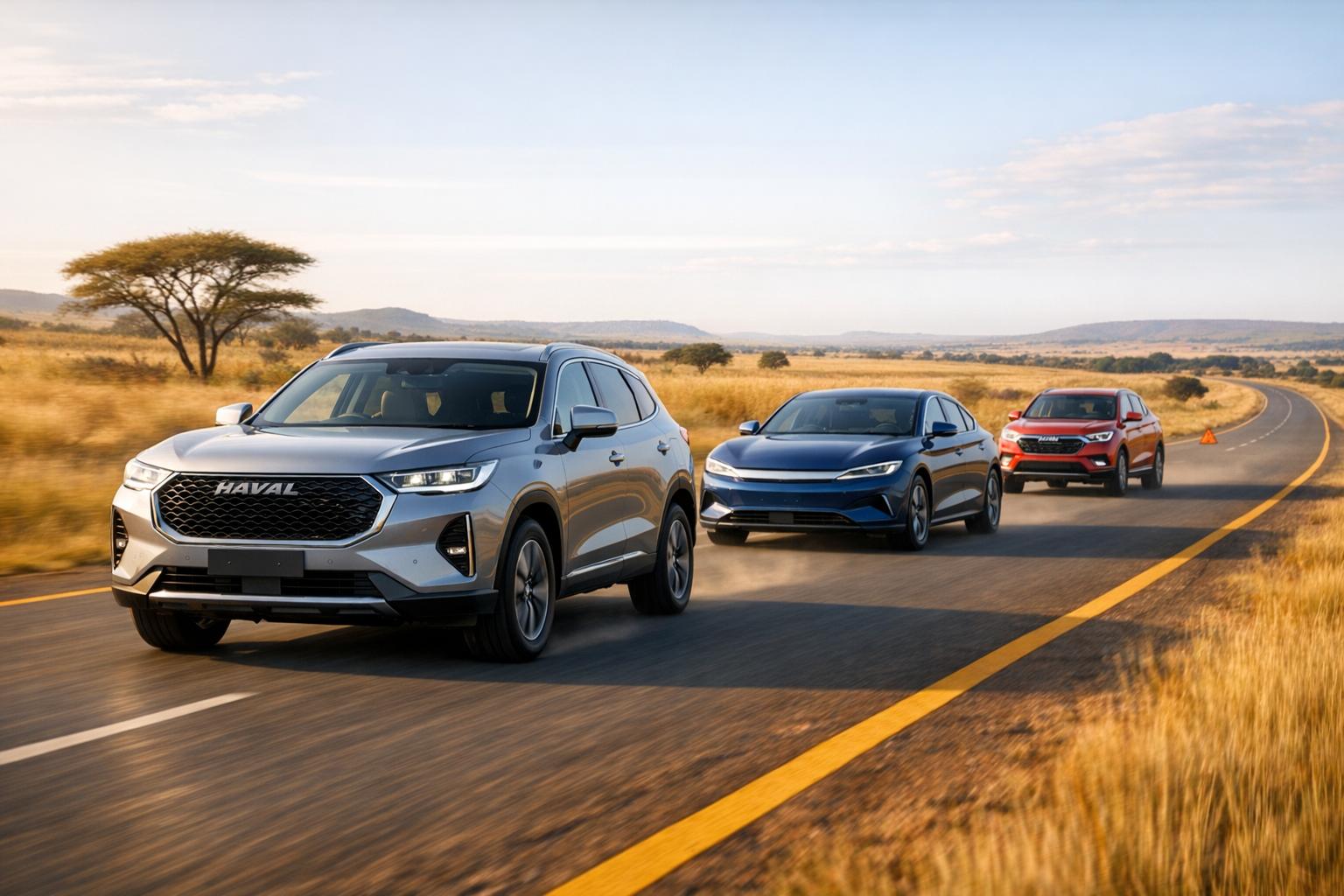
Chinese car brands like Haval, Chery, and BYD are gaining traction in South Africa, but are they dependable? Here’s a quick look:
- Haval (GWM): Known for improved build quality and safety, scoring 88.3 in reliability assessments. However, fuel consumption is high, and parts availability can be slow.
- Chery: Offers budget-friendly pricing and a 1-million-kilometer engine warranty. Yet, safety ratings and CVT reliability lag behind competitors.
- BYD: Excels in electric vehicles with durable Blade Battery technology and lower maintenance costs. Its smaller dealer network may pose challenges for some buyers.
Quick Comparison
| Brand | Strengths | Weaknesses |
|---|---|---|
| Haval | High reliability, robust safety features | High fuel usage, parts delays |
| Chery | Budget-friendly, long warranties | Safety concerns, CVT reliability |
| BYD | EV innovation, low maintenance | Limited service network |
While Chinese cars now rival established brands in features and pricing, service availability and long-term reliability remain key considerations. Choose based on your priorities: affordability, EV technology, or overall reliability.
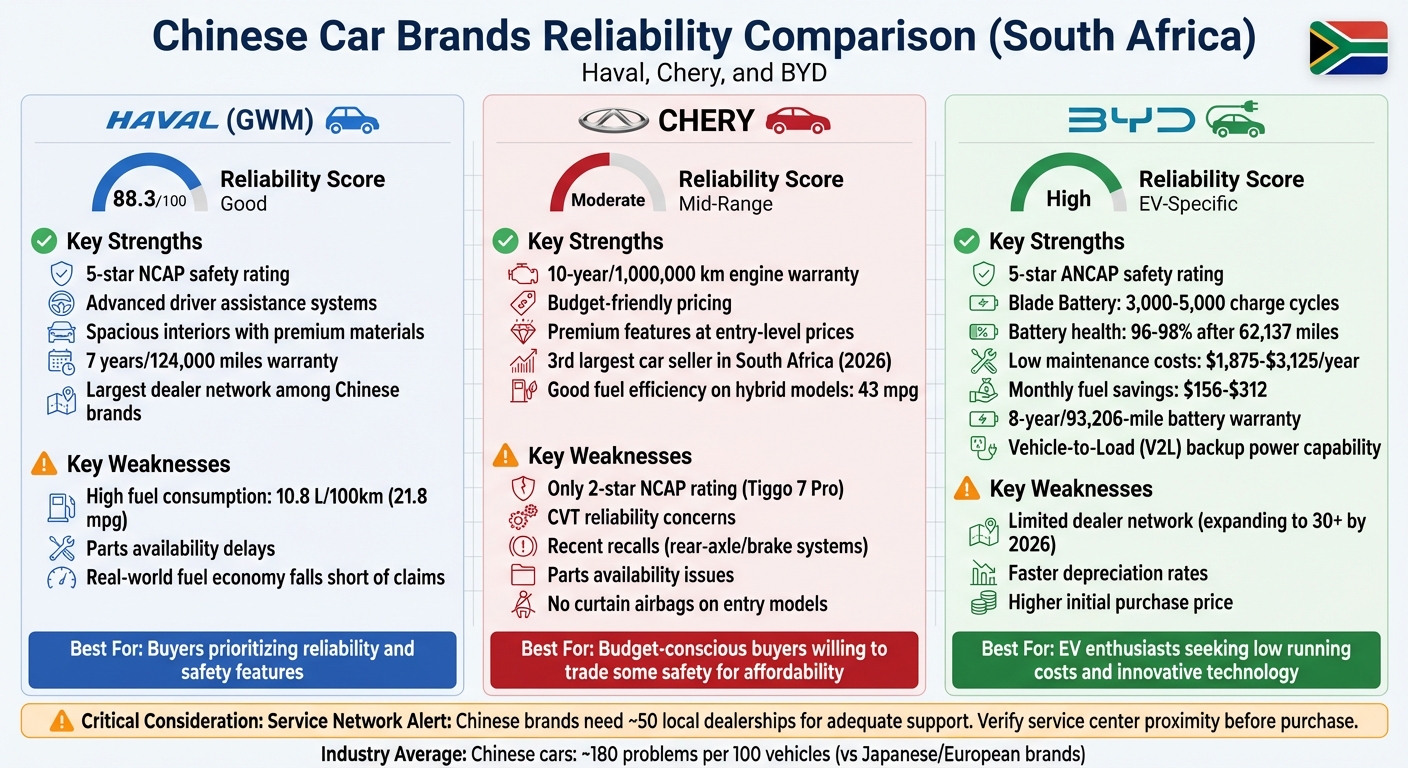
Chinese Car Brands Reliability Comparison: Haval vs Chery vs BYD in South Africa
1. Haval (GWM)
Performance
Haval’s performance lineup shows a lot of variety depending on the model. The H6 GT PHEV stands out with impressive acceleration, going from 0 to 62 mph in just 4.9 seconds – quicker than the Volkswagen Golf GTI. This hybrid powerhouse combines 321 kW (430 hp) and 762 Nm (562 lb-ft) of torque, showcasing its strength.
On the other hand, the H6 2.0T petrol model delivers 170 kW (228 hp) and 380 Nm (280 lb-ft). However, it struggles with throttle lag during stop-and-go traffic, as noted by The Citizen‘s Head of Motoring.
Fuel efficiency is another point of comparison. While the petrol models consume between 10–12L/100km (19–23 mpg), falling short of the claimed 8.3L/100km (28 mpg), the hybrid H6 GT PHEV achieves better figures at 4.8–5.5L/100km (43–49 mpg) and offers an all-electric range of 112 miles.
In addition to performance and efficiency, Haval has worked on improving the overall build quality to meet the challenges of local roads.
Build Quality
Haval has made noticeable improvements in the quality of its vehicles. Reviewers have observed a "day-and-night contrast" between older models and the latest versions. The modern H6 lineup now features leather upholstery, soft-touch materials, and brushed aluminum accents – a big leap from the basic plastics of earlier models. Deon van der Walt from TopGear South Africa noted:
"The ‘Made in China’ stamp no longer carries the ‘slapped together with tape and wishes’ stain".
The suspension system has been tailored for rougher road conditions, using a McPherson strut front and multi-link independent rear setup that handles potholes and uneven surfaces with ease. For off-road enthusiasts, models like the H7 offer a 210 mm (8.3 inches) ride height and specialized "Sand" and "Off-Road" modes for gravel and rugged terrain.
These upgrades in structure and comfort also support the inclusion of advanced safety features.
Safety Features
Haval prioritizes safety in its designs. The H6 has earned a five-star NCAP rating and is packed with modern driver assistance systems. Key features include adaptive cruise control with cyclist and pedestrian detection, lane-keep assist, and forward collision warning. Higher-end trims even offer a 540-degree camera system, which combines a 360-degree view with an under-car perspective – perfect for tight spaces or uneven terrain.
Motoring journalist Ray Leathern praised the system, saying:
"Each works with a human-like smoothness most of the time and provides gentle adjustments to control interfaces without much intrusion".
However, some reviewers have pointed out that the adaptive cruise control can occasionally "overreact" to gradual curves, leading to sudden braking.
Cost of Ownership
Haval’s pricing strategy is designed to compete aggressively. For instance, the H6 2.0 T-GDI Ultra Luxury 4WD is priced at $38,400 (R614,500), while the high-performance H6 GT PHEV costs around $50,000 (R799,900). These prices are lower than smaller SUVs like the Kia Seltos GT-Line or Toyota RAV4 GX, even though the H6 offers more space in terms of length and wheelbase.
The warranty and service plans are equally attractive. Haval provides 7 years or 124,000 miles (200,000 km) of warranty coverage along with a 7-year or 46,600-mile (75,000 km) service plan. However, some challenges remain, such as long wait times for replacement parts, especially for newer models. While the pricing is competitive, these service delays highlight the need for a stronger dealer network.
Dealer Network
Haval has been present in South Africa since 2007 and boasts the most extensive dealer network among Chinese brands. Partnerships with established dealerships have further boosted consumer trust. Despite this, experts suggest that Chinese automakers need at least 50 local dealerships to adequately support their customers – a target the industry is still working to meet.
sbb-itb-09752ea
2. Chery
Performance
Chery’s Tiggo Cross HEV offers a solid fuel efficiency of 43 mpg, slightly below its claimed 46 mpg, and reaches 0–62 mph in just 7.57 seconds. This makes it one of the faster options in its class. Compared to the Tiggo 4 Pro, which averages 26–27 mpg (8.7–9.2 L/100 km), this marks a noticeable leap forward. The Tiggo 4 Pro itself saw improvements when switching from a continuously variable transmission (CVT) to a dual-clutch transmission (DCT), cutting fuel consumption by about 0.5 L/100 km and shaving nearly a second off its acceleration time.
Chery has also put its vehicles through rigorous testing to ensure reliability. For example, a 48-hour endurance test conducted at the Gerotek track near Brits in September 2014 saw five QQ3 models cover an impressive 3,914 miles (6,300 km) at an average speed of 94 mph (151.2 km/h). These advancements demonstrate Chery’s commitment to refining performance and durability.
Build Quality
Chery’s newer models show a clear departure from their earlier budget-focused designs. Interiors now feature soft-touch dashboards, leather-trimmed steering wheels, and digital displays. Road tests also highlight improved cabin insulation, effectively minimizing wind and road noise – even with larger 17- or 18-inch alloy wheels. The Tiggo 4 Pro, for instance, offers 7.1 inches (180 mm) of ground clearance, making it a practical choice for South Africa’s diverse road conditions and light off-road use.
Backing up their confidence in quality, Chery provides a standout 10-year/1,000,000 km engine warranty. As Andre De Kock from The Citizen pointed out:
"The engine comes with a 10‑year, 1,000,000 km warranty… all of which speaks of massive product trust on the part of Chery".
However, some owners have expressed frustration over delays in parts availability and lengthy repair times.
Safety Features
Safety remains an area where Chery struggles to meet expectations. In February 2026, the Global NCAP awarded the Tiggo 7 Pro just two stars for adult occupant protection. This low rating stemmed primarily from the absence of curtain airbags in entry-level models and an unstable footwell structure unable to handle additional stress. On the other hand, higher-spec models like the Tiggo 4 Pro Elite come equipped with six airbags, stability control, and tire pressure monitoring systems.
Richard Woods from Global NCAP remarked:
"A two‑star rating for the Tiggo 7 Pro is very disappointing, but this poor result is seriously compounded by the publication of misleading information on crash test results from other markets".
Echoing these concerns, Bobby Ramagwede of the AA stated:
"The AA believes no vehicle should be sold here without side head protection for front and rear rows. Safety should never be an optional extra, and certainly not reserved for markets outside Africa".
Cost of Ownership
For South African buyers, affordability is a key factor, and Chery positions itself as a budget-conscious brand. The Tiggo 4 Pro 1.5T Elite DCT is priced at $26,000 (R415,900), while the Tiggo Cross Elite comes in at $28,100 (R449,900). These prices are competitive, especially when paired with Chery’s extensive warranty coverage, including a 10-year/621,371-mile (1-million km) engine warranty – one of the longest in the industry.
That said, ownership isn’t without its challenges. Many buyers have reported issues with parts availability and extended wait times for repairs, which can be frustrating. Despite these drawbacks, Chery’s pricing and warranties make it an attractive option for budget-conscious consumers.
3. BYD
Performance
BYD’s lineup is designed to handle South Africa’s demanding road conditions with ease. The Atto 3 Extended Range, for example, delivers 150 kW of smooth, steady power, accelerating from 0 to 62 mph in just 7.3 seconds. On the other hand, the Shark 6 double-cab boasts an impressive 321 kW, reaching 62 mph in a speedy 5.66 seconds. In local driving conditions, the Atto 3 Extended Range has shown it can cover between 205 and 217 miles on a single charge.
Ground clearance varies across models to suit different terrains. The Dolphin offers about 5.9 inches (150 mm) for city driving, while the Shark 6 provides a generous 9.1 inches (230 mm) for gravel roads. BYD’s locally tuned suspension ensures a softer, more comfortable ride compared to stiffer European competitors like the Volvo EX30. At the heart of its performance is the Blade Battery, built on Lithium Iron Phosphate (LFP) technology. This battery is not only resistant to nail penetration but is also rated for 3,000 to 5,000 full charge cycles. That translates to an impressive lifespan of roughly 745,645 to 1,242,742 miles.
Build Quality
BYD vehicles have earned praise for their durability and overall build quality. Pieter V., an Atto 3 owner, shared his experience:
"I’m now at 92,000 km in my Atto 3, and it still feels as tight as the day I bought it. The interior actually feels more solid than my wife’s Audi Q3."
BYD’s attention to detail extends to the paintwork, with durable 120–130 micron paint offering better protection against stone chips compared to the standard 90–100 microns. Early data also indicates strong battery health, with levels remaining at 96–98% after about 62,137 miles. The Atto 3 provides practical interior space, featuring a 440-liter trunk and ample rear legroom for passengers.
Safety Features
Safety is a top priority for BYD, and it shows in their vehicles’ design and features. The Atto 3 has achieved a 5-star ANCAP safety rating, scoring 91% for adult occupant protection and 84% for child occupant safety. It comes equipped with seven airbags, including a center airbag for side-impact protection. Other standard features include adaptive cruise control with stop-and-go functionality, lane-keep assistance, autonomous emergency braking, blind-spot monitoring, and rear cross-traffic alert with automatic braking. Additionally, the Blade Battery’s fire-resistant design ensures it remains safe even under extreme conditions, such as punctures.
Cost of Ownership
BYD offers competitive pricing across its range. The Dolphin starts at approximately $24,994, while the Shark 6 Premium is priced around $60,006. The Atto 3 comes in two trims – Standard Range for about $48,000 and Extended Range at roughly $52,188. Each vehicle is backed by a 6-year/93,206-mile service plan and an 8-year/93,206-mile battery warranty, exceeding typical industry standards.
Maintenance costs are notably lower than those for traditional petrol vehicles. After the service plan period, annual upkeep averages between $1,875 and $3,125, thanks to reduced maintenance requirements. Regenerative braking extends brake pad life to 49,710–62,137 miles, compared to 24,855–37,282 miles for conventional cars. Charging at home costs around $0.32 per kWh, meaning a full charge for the 60 kWh Dolphin is roughly $19.31 – far more affordable than refueling an 80-liter petrol tank, which costs about $125. Owners report monthly fuel savings of $156–$312, translating to over $8,750 in three years.
A standout feature is BYD’s Vehicle-to-Load (V2L) technology, allowing the car to power a home during outages. Thabo M., a Sealion 6 owner, highlighted this benefit:
"My BYD isn’t just a car anymore; it’s a R700,000 backup power system on wheels."
Dealer Network
BYD’s growing dealer network enhances the ownership experience by ensuring reliable service and support. By 2026, the brand plans to operate over 30 dealerships across South Africa, supported by a central parts hub in Gauteng. This hub ensures same-day availability for common wear items and a 3–7 day turnaround for body panels. To further support its customers, BYD is rolling out 200–300 "Flash Charging" stations nationwide by 2026.
Kelly explains Chinese Car Brands in South Africa
Pros and Cons
Road tests in South Africa have highlighted the strengths and weaknesses of various Chinese car brands. Here’s a closer look at how Haval (GWM), Chery, and BYD perform in key areas.
Haval (GWM) has earned a solid reputation for reliability, scoring an impressive 88.3. It also boasts advanced safety features, spacious interiors, and a sturdy build. However, its fuel efficiency leaves much to be desired, with real-world tests showing an average of 10.8 L/100 km (about 21.8 mpg).
Chery has made waves with aggressive pricing and a standout 1-million-kilometer powertrain warranty for first owners. The Tiggo lineup offers premium features – like leather seats and 360-degree cameras – at prices that rival entry-level hatchbacks. George Mienie, CEO of AutoTrader, summed it up well:
"Chinese OEMs have learned how to deliver around 80% of the consumer experience at roughly 60% of the price of traditional players".
Despite these perks, concerns linger about the reliability of its CVT gearboxes and the high fuel consumption of its 1.5L turbocharged engines.
BYD, on the other hand, emphasizes electric vehicle (EV) innovation, using its proprietary Blade Battery technology. This system requires less maintenance due to fewer moving parts. Its vertically integrated approach helps reduce long-term ownership costs. However, BYD faces hurdles, including a smaller service network compared to its more established competitors.
Key Findings at a Glance
| Brand | Key Strengths | Key Weaknesses |
|---|---|---|
| Haval (GWM) | Reliability score of 88.3; advanced safety features; spacious interiors; 5-year/62,137-mile warranty | High fuel consumption (10.8 L/100 km); delays in parts availability |
| Chery | 1-million-km engine warranty; luxury features at budget-friendly prices; strong market presence | CVT reliability concerns; high fuel usage on 1.5T engines; recent recalls on rear-axle/brake systems |
| BYD | Cutting-edge battery technology; reduced maintenance; strong EV performance | Limited service network; faster depreciation rates |
One critical factor to consider is dealership accessibility. Sean Nurse from AutoTrader emphasized:
"Chinese brands need around 50 local dealerships to support customers effectively – and that threshold hasn’t been met".
Before purchasing, ensure that authorized service centers and parts suppliers are located nearby. This can make a significant difference in the overall ownership experience.
Conclusion
Based on extensive South African road test data and performance metrics, clear differences in reliability emerge among top Chinese car brands.
Haval (GWM) stands out as the most reliable option, earning a score of 88.3 in recent assessments. Known for its solid build quality and advanced safety features, Haval has proven itself on local roads. For drivers seeking dependable performance backed by real-world data, Haval remains the strongest contender among Chinese manufacturers.
BYD has carved out a strong reputation in the electric vehicle market. Early owners of the Atto 3 report battery health levels of 96–98% after surpassing 62,137 miles (100,000 km). Its Blade Battery technology is engineered for longevity, supporting 3,000 to 5,000 charge cycles, which translates to a theoretical range of 745,645 to 1,242,742 miles (1.2 million to 2 million kilometers). However, BYD’s smaller service network can pose challenges for buyers outside major cities.
Chery has made notable progress, becoming South Africa’s third-largest car seller by 2026. The brand’s extensive 621,371-mile (1-million-kilometer) engine warranty reflects its confidence in mechanical durability. However, recent recalls related to rear-axle and brake systems highlight areas that require attention.
These insights reveal that while Chinese vehicles now offer competitive performance and safety, ownership satisfaction depends heavily on factors like local service availability and maintenance costs. Reliability has improved significantly, but Chinese cars still average around 180 problems per 100 vehicles, trailing Japanese and European brands. Strong dealership networks are essential to ensuring a smooth ownership experience. Additionally, lower maintenance costs and fuel savings can help offset faster depreciation, making Chinese vehicles an appealing financial option for South African drivers.
FAQs
Which Chinese brand is best for long-term reliability in South Africa?
Recent road tests and reliability studies point to BYD and Changan as two of the most dependable Chinese car brands for long-term use in South Africa. Both have demonstrated impressive performance and durability under the country’s unique driving conditions, proving to be reliable choices for South African drivers.
How big of a risk are parts delays and limited service centers after you buy?
When you buy a Chinese vehicle, parts delays and limited service centers can create some major headaches. Supply chain hiccups and a lack of proper servicing infrastructure in certain areas can mean long wait times for repairs and, often, higher costs.
Even though Chinese car manufacturers have stepped up their game in terms of quality, these issues still linger – especially in regions where support networks are lacking. This can lead to longer downtimes and make maintenance more challenging than expected.
Are BYD EV batteries built to handle heat, rough roads, and frequent fast charging?
BYD EV batteries, including the Blade Battery, are built to perform well under challenging conditions like intense heat and bumpy roads. They are engineered for frequent fast charging and come with safety measures, such as exceptional durability and fire resistance – even when punctured. These features have been proven effective in practical, everyday scenarios.
Related Blog Posts
- Top 5 Cars for South African Roads
- Chinese EV brands gain momentum in South African market
- Leapmotor vs BYD: Can the Newcomer Win South Africa’s EV Battle?
- Chinese Car Brands to Watch in South Africa in 2025