Load shedding in South Africa creates major challenges for electric vehicle (EV) owners. Frequent power outages disrupt home and public charging, increase costs, and cause range anxiety. Battery health also suffers due to irregular charging patterns, with long-term impacts on performance.
Key takeaways:
- Home charging interruptions: Power cuts, often during peak hours, limit overnight charging.
- Public charging issues: Many stations lack backup power, leaving drivers stranded.
- Battery health risks: Voltage fluctuations and incomplete charges accelerate wear.
- Range anxiety: Unpredictable outages make it harder to maintain sufficient charge.
Solutions include:
- Home energy storage systems (cost: $1,389–$3,056) for backup power during outages.
- Solar-powered setups (cost: $6,667–$13,333) for reliable off-grid charging.
- Smart charging strategies to align with outage schedules and protect battery health.
Load shedding makes grid reliance impractical for EVs, but with the right tools, you can charge consistently and reduce risks.
How Load Shedding Disrupts EV Charging
Interrupted Home Charging
Many EV owners depend on overnight charging to save on electricity costs during off-peak hours and ensure their vehicles are ready for the day ahead. But load shedding throws a wrench into this routine. With power outages lasting 2 to 4 hours – and occurring up to 12 times over four days during Stage 4 – those evening charging sessions often get cut short. What’s worse, these outages frequently happen during peak hours (6:00 PM to 8:00 PM), when most people plug in after work. This leaves EV owners scrambling to charge during pricier peak periods once the power is back, pushing up their electricity bills.
There’s also the risk of voltage surges when power is restored, which can damage home charging equipment. To safeguard against this, surge protection devices are essential, but they’re not cheap – costing anywhere from $104 to $260 (R2,000 to R5,000).
"Load shedding schedules vary, sometimes lasting several hours, making it difficult for EV owners to plan charging sessions. Public charging stations may be offline, and home chargers are rendered useless without backup power sources." – Thabo Mbeki, Ecology Writer
The challenges don’t stop at home charging; public charging stations face similar disruptions.
Limited Access to Public Charging Stations
Public charging stations aren’t immune to grid instability. Unless equipped with their own backup power systems – which most aren’t – these stations go offline during load shedding. This creates headaches for EV drivers, particularly on longer trips, as they’re forced to plan around outages. Imagine arriving at a charging station only to find it’s out of service – that’s the reality many face.
When the power does return, the situation doesn’t always improve. Drivers who couldn’t charge at home often flood public stations, leading to long waits and delays. This is especially tough for those in rural areas, where charging stations are already few and far between. If the only nearby station is offline, drivers risk being stranded mid-journey.
This unpredictability fuels range anxiety, as drivers constantly worry whether their next charging stop will be operational. These challenges highlight the pressing need for dependable charging solutions in South Africa.
sbb-itb-09752ea
Volvo EX30 Load Shedding and Charging EX30
Effects on EV Battery Performance and Driving Range
Load shedding doesn’t just disrupt charging schedules – it also impacts EV battery health and driving range.
Battery Wear from Incomplete Charges
Frequent incomplete charges caused by load shedding put extra strain on EV batteries. Repeated shallow charge cycles and voltage fluctuations when power is restored can accelerate wear and tear.
"Frequent power cuts and irregular charging patterns can degrade an EV battery’s lifespan. Partial charging, fluctuating voltage, and repeated deep discharges contribute to battery wear over time." – Thabo Mbeki, Author, Imoto News
On average, EV batteries lose about 2.3% of their capacity per year. However, keeping the battery at extreme levels – fully drained or fully charged – during prolonged outages adds stress, speeding up degradation. For example, a Renault Zoe, which typically offers a 245-mile range, could see that drop to around 189 miles after 10 years of normal use. With South Africa experiencing over 250 days of load shedding annually, irregular charging can accelerate this decline even further. Experts suggest maintaining the charge between 20% and 80%, but this becomes increasingly difficult during Stage 6 load shedding, where outages can total up to 6 hours daily.
These irregular charging patterns not only wear out the battery but also amplify range anxiety, making day-to-day driving less reliable.
Range Anxiety During Extended Outages
Erratic power schedules make it challenging to ensure enough charge for daily commutes. In South Africa, the average commute is about 27 miles (43 km), requiring roughly 8.17 kWh of energy. When overnight charging is disrupted and public charging stations are offline, every percentage of battery charge becomes critical.
"Imagine a world where you rely only on a battery-electric vehicle and you’re being told you’re not able to move." – Mikel Mabasa, CEO, National Association of Automobile Manufacturers of South Africa (Naamsa)
During Stage 4 load shedding, which can cause up to 12 outages over four days, reaching an 80% charge becomes a real challenge. This range anxiety isn’t just a mental hurdle – it’s a practical concern that makes EV ownership riskier, especially in a country where the grid’s Energy Availability Factor dropped below 50% in 2023.
Solutions to Overcome Load Shedding Challenges
EV owners in South Africa have a variety of options to ensure reliable charging even during power outages. These include home energy storage systems, solar-powered charging setups, and smart charging strategies.
Home Energy Storage Systems
Battery backup systems can store energy from the grid or solar panels to charge EVs during outages. For the average South African commute of roughly 27 miles (43 km), you’ll need about 8.17 kWh of energy. To meet this demand without compromising your home’s essential power needs, experts suggest a home battery system of at least 10.24 kWh. As of May 2025, such a system costs between $1,389 and $1,944 (R25,000–R35,000).
These systems help eliminate charging anxiety by ensuring your EV can charge even when Eskom‘s grid is unavailable. Many systems also feature smart charging, allowing you to store energy during off-peak hours and use it during outages or peak demand periods. For example, between January and May 2024, Takealot and Aeversa partnered to implement smart EV charging for 11 JAC electric trucks in Johannesburg and Cape Town. The initiative resulted in a 12.75% reduction in total cost of ownership and a 39% decrease in energy use per kilometer.
Solar-powered charging stations are another effective way to bypass grid reliance altogether.
Solar-Powered Charging Stations
Solar panels offer an independent way to charge your EV, sidestepping the national grid entirely. A home solar system can reduce electricity bills by up to 90% and typically pays for itself within 5–7 years. A medium-sized setup, which includes 8 kW of solar panels and a 15 kWh battery, costs between $6,667 and $8,889 (R120,000–R160,000). Pairing solar panels with battery storage allows you to charge your EV during the day and maintain backup power for nighttime use.
In November 2024, Zero Carbon Charge (CHARGE) launched South Africa’s first fully off-grid, solar-powered EV charging station in Wolmaransstad along the N12 highway. Equipped with 480 solar panels generating 280 kWp and a 550 kWh battery system, the station can charge vehicles from 10% to 80% in as little as 25 minutes. CHARGE plans to expand its network with 120 additional stations spaced 93 miles (150 km) apart along major routes by 2026.
"We believe that if you build it they will come. We are extremely proud of this landmark we have built." – Tim Sandham, Information Manager, CHARGE
Smart Charging Strategies
Beyond physical installations, smart charging strategies can help you make the most of your available power.
Align your charging with load shedding schedules. Use programmable chargers that can avoid outage periods and automatically resume charging when power is restored. To maintain battery health, keep your EV charged between 20% and 80%, which also ensures you’re prepared for unexpected changes in load shedding stages.
Combine home charging with occasional use of ultra-fast public chargers for added flexibility during extended outages. Additionally, maximize your vehicle’s regenerative braking to recover energy while driving, which can help extend your range when charging options are limited. In August 2024, Eskom installed 10 charging stations across five sites, featuring 60 kW DC fast chargers designed to support overnight fleet and workplace charging.
Comparing EV Charging Solutions During Load Shedding
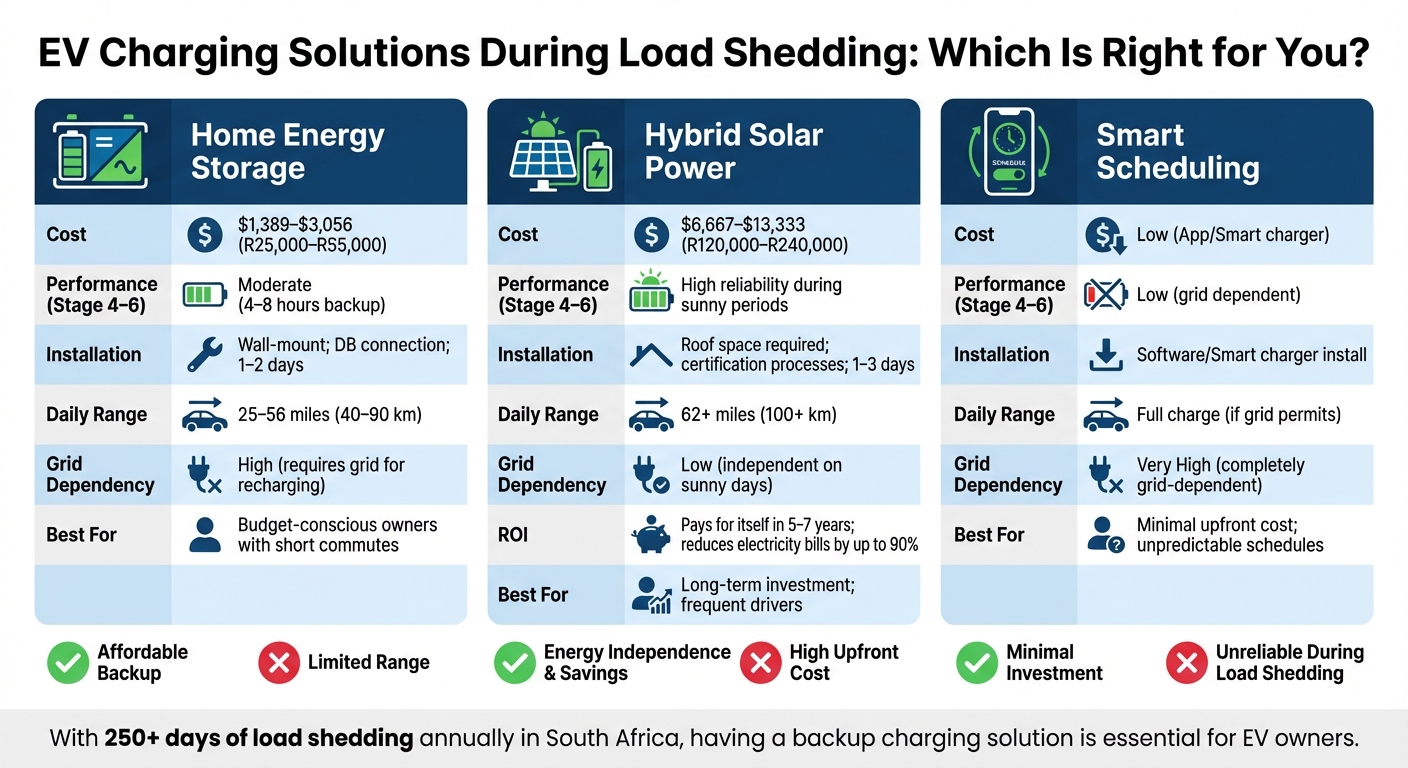
Comparison of EV Charging Solutions for Load Shedding in South Africa
Choosing the right backup solution for EV charging during load shedding depends on factors like cost, driving range, and how much you want to rely on the grid. Each option strikes a different balance between affordability, reliability, and daily driving needs.
Home energy storage systems (a battery paired with an inverter) are the most budget-friendly way to start. However, they depend entirely on grid power for recharging. If you’re dealing with Stage 4–6 load shedding, the limited grid availability might mean your system won’t fully recharge in time. On the other hand, hybrid solar systems are pricier but offer consistent power on sunny days, supporting over 62 miles (100+ km) of driving daily, even during grid outages. Meanwhile, smart charging strategies are inexpensive to set up but can become unreliable when outages last several hours.
Unlike standalone home chargers, these solutions might require some adjustments to your home setup. For example, a home energy storage system can be installed on a wall and connected to your electrical panel in just 1–2 days. A full solar setup, however, needs 538–1,292 square feet (50–120 m²) of unshaded roof space and takes 1–3 days to install. Smart charging is the simplest option, often requiring nothing more than downloading an app or upgrading to a programmable charger.
Here’s a breakdown of how these solutions compare in terms of cost, performance, installation, and the driving range they support:
Comparison Table: Home Energy Storage vs. Solar Power vs. Smart Scheduling
| Solution | Estimated Cost | Performance (Stage 4–6) | Installation Requirements | Approx. Daily Range |
|---|---|---|---|---|
| Home Energy Storage | $1,389 – $3,056 (R25k – R55k) | Moderate (4–8 hours backup) | Wall-mount; DB connection; 1–2 days | 25–56 miles (40–90 km) |
| Hybrid Solar Power | $6,667 – $13,333 (R120k – R240k) | High reliability during sunny periods | Roof space; certification processes; 1–3 days | 62+ miles (100+ km) |
| Smart Scheduling | Low (App/Charger) | Low (Grid dependent) | Software/Smart charger install | Full charge (if grid permits) |
Each solution has its pros and cons, and the right choice depends on your priorities. For instance, hybrid solar power stands out by reducing electricity bills by up to 90% and paying for itself within 5–7 years. In contrast, home energy storage systems and generators are more like one-time expenses with no financial return. These details make it easier to decide which setup best meets your needs for reliable EV charging during load shedding.
Conclusion
Load shedding presents significant hurdles for EV owners in South Africa. From disrupted home charging and offline public stations to range anxiety and higher electricity costs during peak hours, these challenges can feel overwhelming. With power cuts now occurring on more than 250 days a year, relying solely on the grid is becoming increasingly impractical.
Thankfully, there are practical ways to tackle these issues. Home energy storage systems, hybrid solar setups, and smart charging methods can ensure reliable EV charging, even during outages. On top of that, bidirectional charging technology is emerging as a game-changer, enabling your EV to double as a power source for your home during peak load shedding hours.
As the Energy Bee Team puts it:
"Hybrid solar is the only solution that solves load shedding AND saves money long-term." – Energy Bee Team
Planning ahead is key. Keeping your EV battery between 20% and 80% not only helps prevent degradation but also aligns with the smart charging practices discussed earlier. Whether you start with a simple inverter system or go all-in with a solar setup that could pay for itself within 5–7 years, having a backup plan ensures you won’t be left stranded.
Choose a solution that fits your budget and driving habits. With the right preparation, you can keep your EV dependable, even when the grid isn’t.
FAQs
How big a home battery do I need to keep my EV charged during outages?
The size of a home battery you need largely depends on two factors: how much energy your EV requires daily and how long you want backup power to last. For instance, if your EV consumes 30 kWh each day, you’ll want a battery with at least 30 kWh of capacity to cover a full day’s charging during a power outage. Think about your typical energy usage and the potential duration of outages when deciding on the right battery size.
Can load shedding permanently damage my EV battery or home charger?
Load shedding isn’t likely to cause lasting harm to your EV battery or home charger, provided you take the right precautions. That said, frequent power outages can put extra strain on your charging equipment, potentially affecting its reliability over time. To help protect your setup, consider using surge protectors and adjusting your charging schedule to avoid times when load shedding is expected.
What’s the cheapest way to plan charging around load shedding?
The cheapest way to manage EV charging during load shedding is to plug in during off-peak hours when electricity is less expensive. For added reliability, think about backup solutions like inverters with batteries or hybrid solar systems. You can also save money and ensure power availability by charging during milder load shedding intervals or opting for solar-powered charging stations.
Related Blog Posts
- South Africa’s EV Policies: Renewable Charging Impact
- EV Charging in South Africa: Grid Mix Impact
- Load Shedding’s Impact on EV Adoption in SA
- Electric Vehicle Adoption in South Africa: Progress Update