South Africa’s online used car sales are booming, and here’s why:
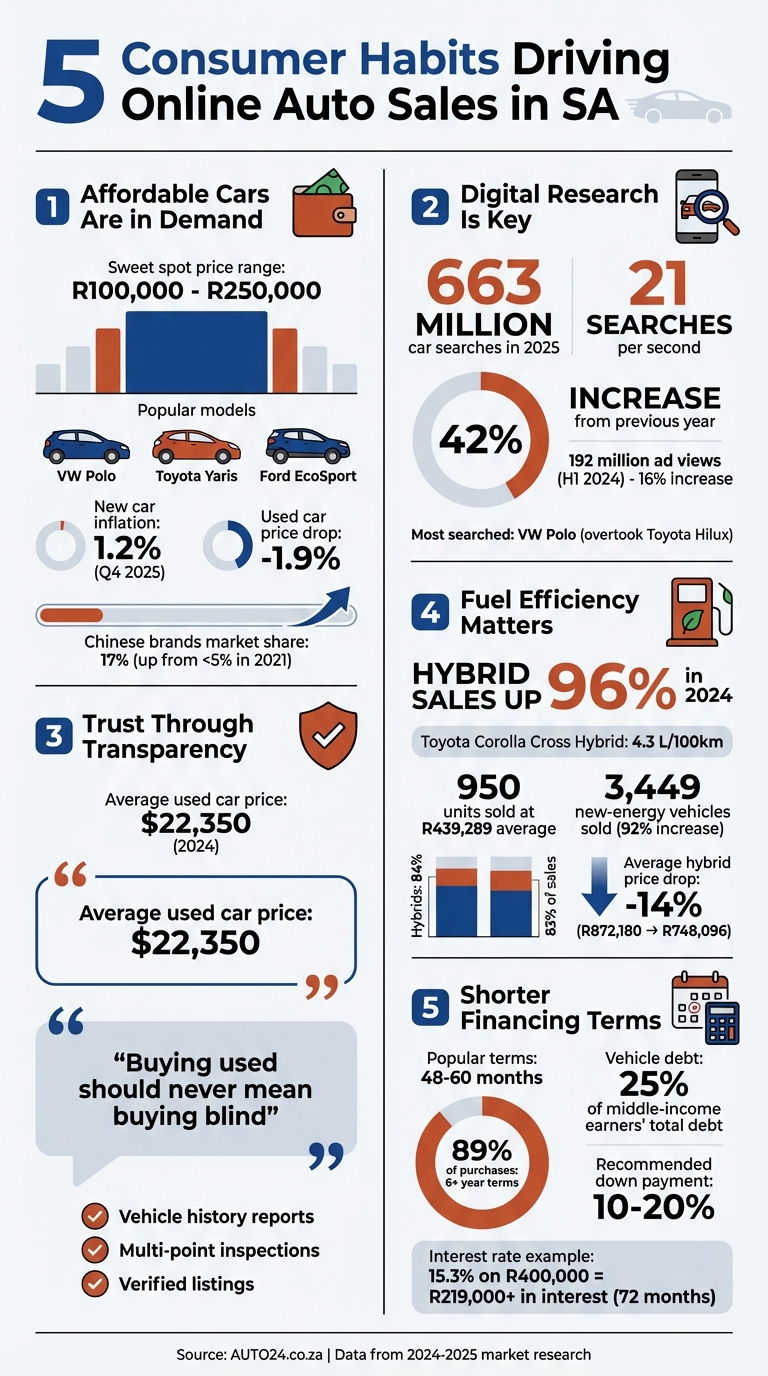
- Affordable Cars Are in Demand: Buyers are prioritizing low monthly payments, focusing on vehicles priced between R100,000 and R250,000. Popular models include the VW Polo and Toyota Yaris.
- Digital Research Is Key: Over 663 million car searches were conducted in 2025 alone, with platforms like AUTO24.co.za offering tools to compare prices, financing, and vehicle histories.
- Trust Through Transparency: Buyers expect detailed vehicle histories and accurate pricing. Verified listings and inspection reports are now standard.
- Fuel Efficiency Matters: Rising fuel costs have increased interest in hybrids like the Toyota Corolla Cross Hybrid, which sold nearly 1,000 units in 2024.
- Shorter Financing Terms: Consumers are opting for shorter loan terms (48–60 months) to reduce total interest costs, using online tools to calculate affordability.
These habits reflect a shift toward cost-conscious and informed decision-making, driven by the convenience and transparency of online platforms like AUTO24.co.za.
5 Consumer Habits Driving Online Auto Sales in South Africa – Key Statistics
Cox Automotive’s 15th Annual Car Buyer Journey Study reveals key trends shaping the industry
sbb-itb-09752ea
1. Focusing on Affordable Vehicle Models
In South Africa, car buyers are increasingly prioritizing affordable monthly payments over hefty upfront costs. With rising interest rates and tighter household budgets, vehicle financing has become a key factor in online car shopping decisions. Unsurprisingly, the demand for reasonably priced cars continues to grow, reflecting this shift in consumer priorities.
"Affordability remains the single most powerful lever in sustaining demand." – Ayesha Hatea, Senior Director of Research and Consulting at TransUnion Africa
For 2025, vehicles priced between R100,000 and R250,000 have hit the sweet spot, offering a practical mix of value, safety, and moderate mileage. Models like the VW Polo, Toyota Yaris, and Ford EcoSport are particularly popular, thanks to their modern safety features and reliable performance.
Platforms such as AUTO24.co.za make finding affordable vehicles easier than ever. They provide tools for pre-approval, interest rate comparisons, and even insurance quotes – all in one place. This streamlined, digital-first approach also allows buyers to explore options nationwide, unlocking access to competitive deals in areas with high vehicle turnover, like Gauteng.
The focus on affordability isn’t limited to used cars. While new vehicle inflation dropped to a record low of 1.2% in Q4 2025, used car prices fell even further – by 1.9% – making new cars a more attractive option. Chinese value brands, in particular, have gained traction, now making up over 17% of new passenger car sales, compared to under 5% in 2021. These brands attract buyers with extended warranties and feature-packed models at lower price points, aligning perfectly with the growing emphasis on value and manageable financing.
2. Using Digital Search Tools to Find Popular Models
South African buyers are now conducting 21 used-car searches every second – that’s over 663 million searches annually, marking a 42% jump from the previous year. This dramatic rise highlights how digital research has become a vital part of the car-buying journey.
Platforms such as AUTO24.co.za and AutoTrader have transformed the process by allowing users to browse certified vehicles, compare models, secure financing pre-approvals, and even sign contracts – all from their smartphones. In 2024, AUTO24 took it a step further by introducing a fully digital document management system powered by AI-driven pricing models, enabling buyers to complete their purchases entirely online.
Industry experts are taking note of this shift. George Mienie, CEO of AutoTrader, remarked:
"Traditional car-selling methods are becoming outdated. Successful dealers have embraced the #RethinkAutoSales strategy… by utilizing market intelligence, which is available thanks to AutoTrader technology and data analytics."
This move toward digital tools is reshaping how consumers make decisions. Recent data shows clear trends in buyer behavior: the Volkswagen Polo surpassed the Toyota Hilux as the most searched-for model in 2024, while budget-conscious brands like Suzuki cracked the top 10 most-searched brands for the first time, replacing Porsche.
During the first half of 2024, ad views soared to 192 million, a 16% increase, as consumers increasingly relied on tools offering instant vehicle histories and real-time market valuations. These features, including multi-point inspection certifications, eliminate much of the uncertainty around pricing. With the average used passenger car selling for $22,350 in 2024, having access to transparent, data-driven comparisons has become crucial for navigating the competitive market.
3. Requiring Vehicle History and Valuation Information
When it comes to buying a car online, trust is everything. Shoppers want to know exactly what they’re getting, which means detailed vehicle history reports are a must. These reports typically include service records, accident history, and previous ownership details – key pieces of information that help buyers feel confident, especially when they can’t inspect the car in person. As AUTO24 aptly puts it:
"Buying used should never mean buying blind."
Accurate pricing is just as important. With the average used car priced at around $22,500 in 2024, buyers need assurance that they’re paying a fair price. Real-time market data is a game-changer here, enabling platforms to provide instant, data-driven valuations. In April 2025, AUTO24 rolled out a 9-point trust model, combining live market updates with comprehensive vehicle history transparency. Every vehicle undergoes thorough checks for mileage accuracy and roadworthiness, ensuring buyers know exactly what they’re purchasing.
The industry is also moving toward verified listings, which mark a new era in online car shopping. Platforms are taking the initiative to inspect vehicles before they’re listed, offering a level of trust and quality that rivals traditional dealerships. AUTO24 emphasizes this shift with their commitment to clarity:
"Transparency is non-negotiable."
Without detailed history reports and accurate valuations, online car sales risk falling short of consumer expectations. Verification processes are no longer optional – they are vital for building trust and credibility in the digital auto marketplace.
4. Choosing Fuel-Efficient and Hybrid Vehicles
Fuel efficiency has become a major factor for car buyers, especially with rising fuel prices. Shoppers are now making decisions based on fuel consumption data – often measured in liters per 100 km (roughly 55 mpg). This shift is reflected in the numbers: used hybrid sales surged by 96% in 2024, even as overall vehicle sales declined. For example, the Toyota Corolla Cross Hybrid, which boasts an impressive 4.3 L/100 km, sold 950 units at an average price of R439,289.
Hybrids are particularly appealing in South Africa for a few reasons. They deliver excellent fuel economy without the challenges associated with fully electric vehicles, such as charging infrastructure and range concerns. This is especially important in a country where power grid instability remains an issue. Unlike electric cars, hybrids don’t need to be plugged in, making them a practical choice. George Mienie, CEO of AutoTrader, summed it up well:
"South Africa’s growing interest in new-energy vehicles highlights the growing appetite towards more sustainable mobility solutions. As the market evolves, we are witnessing a notable rise in the adoption of hybrids and plug-in hybrids, with consumers increasingly seeking efficient, eco-friendly alternatives."
Beyond their environmental advantages, hybrids offer financial savings that are hard to ignore. The average price of a used hybrid dropped 14% in 2024, decreasing from R872,180 to R748,096. Additionally, the used car market saw 3,449 new-energy vehicles sold in 2024 – a 92% increase from the previous year – with hybrids making up 84% of listings and 83% of sales.
Online platforms make these choices even easier. Buyers can now compare fuel efficiency, filter by fuel type, and access detailed service records from the comfort of their homes. Such tools are essential for evaluating hybrid options. Meanwhile, South Africa’s network of over 350 public charging stations continues to grow, further easing concerns about electrified vehicles.
5. Selecting Shorter Financing Terms to Reduce Total Costs
South African car buyers are becoming increasingly strategic about their financing choices, with many now leaning toward 48- to 60-month terms to cut down on interest payments. While a staggering 89% of financed vehicle purchases in 2025 were tied to terms of six years or longer, more buyers are using digital tools to grasp the true cost of extended loans.
Shorter loan terms come with higher monthly payments but significantly reduce the total interest paid. For example, financing a R400,000 vehicle at 15.3% over 72 months could lead to over R219,000 in interest and fees. Opting for a 48-month term instead can drastically lower the overall cost. Andrew Hibbert, a Lightstone Auto Data Analyst, highlighted this shift:
"In 2015, close to 100% of the financed vehicle space was made up of deals amounting to six years or less… Fast forward to 2025, and the second most popular financing term at 10% of market share is now 96 months."
Modern online financing tools have made it easier than ever for buyers to compare loan terms. These platforms allow users to model scenarios side-by-side – ranging from 12 to 96 months – so they can clearly see how much interest they’ll pay over the life of a loan. While longer terms like 96 months may offer lower monthly payments, they extend the repayment period and significantly increase the total cost of ownership.
The challenge lies in striking the right balance between monthly affordability and overall cost. Savvy buyers are leveraging online pre-approval tools to pinpoint their budgets and choosing the shortest term their income can reasonably accommodate. Additionally, increasing the down payment to 10–20% of the vehicle’s value reduces the loan principal, making shorter terms more feasible. With vehicle debt making up about 25% of middle-income earners’ total debt basket, opting for a shorter financing period not only accelerates full ownership but also frees up financial resources sooner – aligning with the broader trend of smarter, more informed purchasing decisions.
Conclusion
The South African used car market is experiencing a notable transformation, shaped by five key consumer behaviors: seeking affordable models, using digital tools for research, prioritizing transparency in vehicle history, opting for fuel-efficient vehicles, and favoring shorter financing terms. These trends highlight a clear move away from luxury aspirations toward practicality, cost-effectiveness, and efficiency. At the heart of this shift lies the growing importance of digital platforms in the car-buying process, paving the way for marketplaces that cater directly to modern consumer needs.
To meet these demands, platforms must provide a smooth digital experience while addressing the trust issues that have long plagued the used car industry. AUTO24.co.za tackles these challenges by offering a fully digital marketplace backed by thorough multi-point inspections and detailed vehicle history reports. These features, combined with robust buyer protections, address the concerns many South African consumers have about purchasing pre-owned vehicles.
Transparency and convenience are essential in this evolving space. AUTO24.co.za blends the ease of digital transactions with the support of local dealerships in Johannesburg and Cape Town, creating a "phygital" experience that guides buyers from their initial online search to the final handover. George Mienie, CEO of AutoTrader, aptly summarized the broader trend:
"The automotive landscape in South Africa is evolving at an unprecedented pace… we’re now seeing a stronger emphasis on efficiency and sustainability influencing buying decisions".
As discussed, South African buyers are increasingly making informed, value-focused decisions, reshaping the auto market. Platforms that combine technological innovation with trust-building measures will lead the way in online car sales. AUTO24’s strategy – featuring transparent pricing, certified pre-owned options like the VW Polo Vivo and Toyota Hilux, and seamless integration with local banking systems – positions it perfectly for this new era. For those prioritizing value and trust, AUTO24.co.za is setting a new benchmark in the online used car market.
FAQs
How do I confirm a used car’s history online?
You can check a used car’s history online by using VIN (Vehicle Identification Number) lookup tools. Platforms like SAIA VIN-Lookup or FirstCheck provide crucial information, including accident records, ownership history, and salvage status. Another option, carVertical, can reveal issues like damage or mileage rollbacks. Running a VIN check helps ensure you’re aware of any hidden problems, offering more confidence when purchasing a used car.
What loan term saves the most money overall?
When it comes to financing, choosing a loan term of up to 72 months (6 years) can often save you the most money in the long run. Extending the term to something longer, like 96 months, usually results in higher total interest payments and increased depreciation costs over time. By sticking with a shorter loan term, you can reduce these expenses and make your purchase more financially efficient.
Are hybrids worth it with South Africa’s power issues?
Hybrids remain a practical choice in South Africa, even with the ongoing power challenges. By blending gas and electric power, they deliver improved fuel efficiency while keeping upfront costs relatively low. This dual-power setup reduces reliance on charging infrastructure, making hybrids a dependable option during load-shedding periods.
Related Blog Posts
- Factors That Influence Used Car Prices in South Africa
- 2025 Car Market Trends: What South Africans Are Buying Now
- New vs Pre-Owned: South African Car Market Trends for 2025
- South Africa new-vehicle sales hit 55 000+ in October 2025 – best month in a decade