
Over-the-Air (OTA) updates are transforming car ownership by wirelessly delivering software improvements directly to vehicles. Here’s why they matter:
- Skip Dealership Visits: Updates install automatically, saving time and effort.
- Lower Maintenance Costs: Fixes bugs and prevents major issues without service fees.
- Boost Performance: Enhances engine, battery, and system capabilities remotely.
- Improve Safety: Quickly addresses recalls and patches cybersecurity risks.
- Upgrade Driving Experience: Adds new features to infotainment and navigation systems.
These updates ensure your car stays current, safer, and more efficient, all from the comfort of your home.
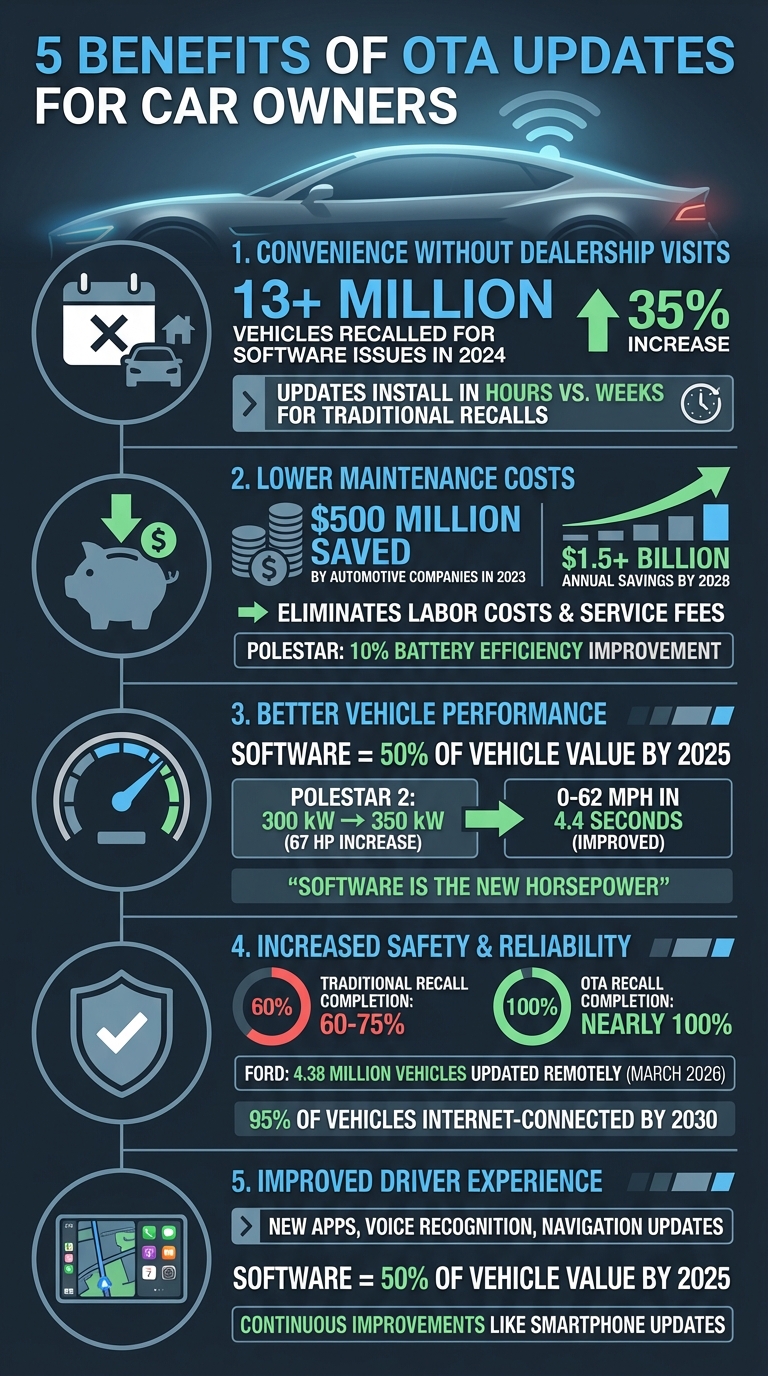
5 Key Benefits of OTA Updates for Car Owners: Statistics and Savings
Car Tech 101: Everything you need to know about OTA updates (On Cars)
sbb-itb-09752ea
1. Convenience Without Dealership Visits
OTA (Over-the-Air) updates let you skip trips to the dealership for software fixes. Instead, your car can download updates via Wi-Fi or cellular networks and install them while parked – often overnight or at a time you choose through a push notification. This means no appointments, no waiting around, and no interruptions to your day.
With software-related recalls on the rise, this capability is becoming increasingly important. In 2024, over 13 million vehicles were recalled due to software issues – a jump of 35% compared to the previous year. Traditional recall processes can take weeks to coordinate and resolve, but OTA updates can address these problems in a matter of days or even hours.
Take Volkswagen’s emissions scandal as an example: 11 million vehicles required physical recalls – a time-consuming process that OTA updates could have handled remotely. Even critical systems like brakes and airbags, which previously required urgent visits to service centers, can now be updated without leaving your driveway.
"OTA updates eliminate the need for in-person visits, reducing costs and disruption." – Editorial Team, Mender
Some car manufacturers are even tying warranty coverage to timely installation of software updates. For instance, General Motors and Tesla require owners to update their vehicles – GM typically gives a 45-day window – or risk voiding warranty coverage for related issues. With a reliable internet connection, these updates are often automatic, ensuring your car stays up-to-date and your warranty intact.
2. Lower Maintenance Costs
OTA updates do more than just save you a trip to the dealership – they can cut down your overall maintenance expenses in a big way.
These updates take care of maintenance tasks automatically while your car is parked, eliminating labor costs and service fees entirely. But the savings don’t stop there. Real-time diagnostics allow manufacturers to spot potential issues across entire fleets and address them before minor software bugs turn into costly mechanical problems. This proactive approach can make a noticeable difference in your repair bills.
Take EV batteries, for example – one of the priciest components in an electric vehicle. Updates to the Battery Management System can help prevent premature wear, saving you a lot of money. Polestar showcased this benefit by using OTA updates to boost EV battery efficiency by 10%. Similarly, Toyota rolled out an update that added 30 extra miles to a vehicle’s driving range. These enhancements not only lower charging costs but also help extend the battery’s lifespan.
"If updates are meaningful, then they can add value. Anything that can improve the range of an EV will increase its worth." – John Ellmore, Editor of Electric Car Guide
However, skipping updates can come back to haunt you. For instance, GM now requires owners of its 2025 and 2026 models to install OTA updates within 45 days to keep their warranty intact. Their warranty policy states, "Damage resulting from failure to install over-the-air software updates is not covered". In short, staying on top of updates isn’t just a matter of convenience – it’s a smart way to avoid costly repairs and keep your warranty in check.
3. Better Vehicle Performance
OTA updates do more than just save on maintenance – they can also elevate how your vehicle performs. Manufacturers can adjust engine control units, fine-tune battery management systems, and even tap into hidden performance potential, all without needing physical upgrades.
Take Polestar, for example. In December 2021, the company rolled out a performance software upgrade for the Long Range Dual Motor version of the Polestar 2. This OTA update increased power from 300 kW (about 402 hp) to 350 kW (approximately 469 hp) and boosted torque from 660 Nm (487 lb-ft) to 680 Nm (501 lb-ft). The result? A faster 0–62 mph time of just 4.4 seconds. The update also focused on enhancing acceleration between 43 and 81 mph, making highway overtaking easier, all without impacting the car’s energy efficiency. It’s not just about better stats – it’s about a more thrilling drive.
This illustrates how software-defined vehicles are reshaping the industry, with the idea that "software is the new horsepower". By 2025, experts predict that software will account for half of a vehicle’s total value.
"I think these updates are more of a sales feature. If you tell me ‘Hey, your car is going to get better every time you download an update’, then I will say, ‘Great. I prefer that than it not happening’." – Rei Vardi, CEO of Eon
What’s even better? These updates improve performance while keeping your vehicle’s warranty intact.
4. Increased Safety and Reliability
Over-the-air (OTA) updates don’t just enhance performance – they also play a crucial role in improving safety and reliability. One of their standout benefits is the ability to accelerate recall fixes and bolster system dependability. Instead of enduring weeks or even months of delays for parts, training, or dealership appointments, manufacturers can now roll out critical fixes in just hours.
This speed has a big impact on recall compliance. Traditionally, recalls see only 60% to 75% completion rates, as many vehicle owners avoid trips to the dealership. OTA updates eliminate this hurdle by delivering fixes remotely – often overnight – while your car is parked in the garage. This convenience has pushed compliance rates for OTA-enabled recalls to nearly 100%.
Take Ford‘s March 2026 OTA update as an example. Ford remotely addressed a safety issue with the Integrated Trailer Module in about 4,380,609 vehicles across the U.S. This defect could have disabled trailer stop lamps, turn signals, and braking. Starting March 17, 2026, Ford deployed the update to affected 2021–2026 models, including the F-150, Super Duty, and Expedition, with full fleet updates expected by May. Millions of vehicles were made safer without requiring owners to visit a dealership.
OTA updates also play a critical role in addressing cybersecurity risks. With 95% of vehicles expected to be internet-connected by 2030, the need to defend against remote attacks has never been more urgent. Manufacturers now monitor vehicle fleets in real time, enabling them to patch vulnerabilities immediately and prevent potential safety hazards. This proactive approach significantly enhances both safety and overall vehicle reliability.
"Chief among the key benefits of OTA updates is the potential to improve recall compliance for key safety features while reducing the time and cost of in-person service visits." – Michelle Kuykendal, Ph.D., P.E., Principal Engineer, Exponent
The best part? Safety-related OTA updates and recall fixes are provided at no cost to vehicle owners. This ensures that keeping your car safe and reliable has never been easier or more accessible.
5. Improved Driver Experience
Over-the-air (OTA) updates are transforming the way we interact with our vehicles daily. These updates can breathe new life into your infotainment system by introducing fresh features and refining existing ones. Think of it like your car getting a software upgrade – just like your smartphone. For example, manufacturers can add new entertainment options such as gaming platforms or in-car karaoke apps, while also improving voice recognition and offering personalized dashboard setups. But the benefits go beyond just entertainment; critical systems like navigation also see major improvements.
Navigation systems, for instance, become far more reliable with real-time map updates. No more fiddling with manual downloads or scheduling trips to the dealership – your routing information stays current automatically. A great example is Geely Auto’s global OTA update for the Geely E5 in February 2026. This update introduced Android Auto, three customizable audio profiles for low-speed alerts (AVAS), and a "New Drive Setup" feature, all aimed at improving system responsiveness and cockpit usability.
These upgrades ensure that your car’s digital features evolve alongside its mechanical performance. In fact, the growing importance of software in vehicles is reshaping how we value them. By 2025, it’s projected that software will account for 50% of a vehicle’s total value. This highlights how digital capabilities are now on par with traditional mechanical features.
"If I’m buying a car, then I would 100% prefer one that has OTA updates that will keep on improving the user experience over time." – Rei Vardi, Founder and CEO, Eon
This shift in focus has been embraced across the industry. Gartner’s 2024 Digital Index even refers to it as the "software is the new horsepower" mindset. With continuous updates, even older car models can stay modern and responsive, ensuring they deliver value and remain relevant throughout your ownership.
Conclusion
Over-the-air (OTA) updates are reshaping what it means to own a vehicle.
The five advantages we discussed – skipping dealership visits, cutting maintenance costs, boosting vehicle performance, enhancing safety and reliability, and upgrading the driving experience – highlight how cars are becoming dynamic platforms that improve over time through regular software updates.
The financial impact of this shift is hard to ignore. In 2023 alone, software-based fixes saved automotive companies approximately $500 million. By 2028, these savings are expected to surpass $1.5 billion annually. Car owners benefit too, as many issues are resolved remotely, avoiding the hassle and expense of traditional recalls.
As vehicles increasingly rely on software, staying informed about OTA updates is more crucial than ever. With software soon accounting for nearly half of a car’s value, understanding this technology is key. Whether you’re considering a new car or looking to optimize your current one, knowing how OTA updates work puts you in the driver’s seat when it comes to making smart decisions.
For the latest in automotive trends and insights, check out ImotoNews South Africa. Keeping up with these advancements ensures you’re prepared to make the most of your vehicle ownership today and in the future.
FAQs
Do OTA updates use Wi-Fi or cellular data?
Over-the-air (OTA) updates can be delivered through either Wi-Fi or cellular data, depending on the connectivity features of your vehicle and your chosen settings. This flexibility allows you to pick the option that works best for you, considering your data plan and network availability.
Can an OTA update drain my battery?
When your vehicle or device undergoes an OTA (Over-the-Air) update, you might notice a temporary increase in battery usage. This happens because the system requires extra power to download and install the new software. It’s a normal part of the process and usually settles down once the update is finished and the system adjusts to the changes.
What happens if I skip an OTA update?
Skipping an over-the-air (OTA) update means your vehicle could miss out on important system upgrades, bug fixes, and security updates. This might affect how well it performs, compromise safety, or even limit access to new features. Keeping up with updates helps ensure your car runs smoothly and stays protected.
Related Blog Posts
- Car maintenance costs in South Africa
- Engine Light On? What It Could Mean in SA Conditions
- Electric Cars in South Africa: 2025 Guide for New Buyers
- OTA Updates in South Africa: Key Trends 2025