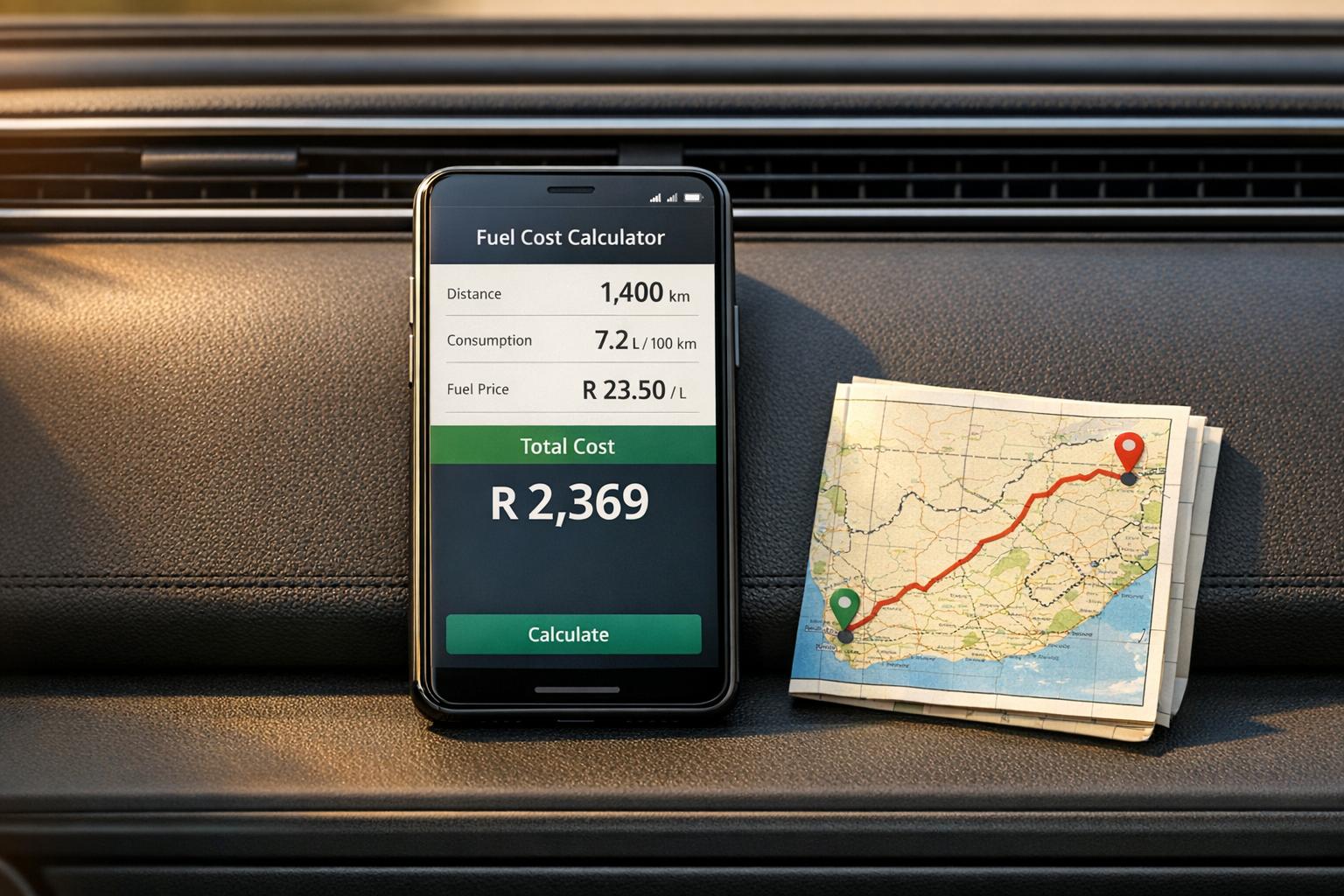
Fuel cost calculators are simple tools that help you estimate how much a trip will cost based on three main factors: distance, fuel efficiency, and current fuel prices. By entering these details, you can quickly calculate your expected fuel expenses, whether for daily commutes or long road trips.
Here’s how it works:
- Input your trip distance (e.g., one-way or round-trip mileage).
- Provide your vehicle’s fuel efficiency (miles per gallon or liters per 100 km).
- Enter the current fuel price in your area.
The calculator uses this formula:
(Distance ÷ Fuel Efficiency) × Fuel Price
For example, driving 500 miles at 25 MPG with gas priced at $4.12 per gallon will cost about $82.40. Some tools even offer advanced features, like adjusting for traffic conditions or calculating cost per mile, making them useful for budgeting and comparing vehicles or routes.
To save on fuel, drive at steady speeds, avoid idling, maintain your vehicle, and plan routes carefully.
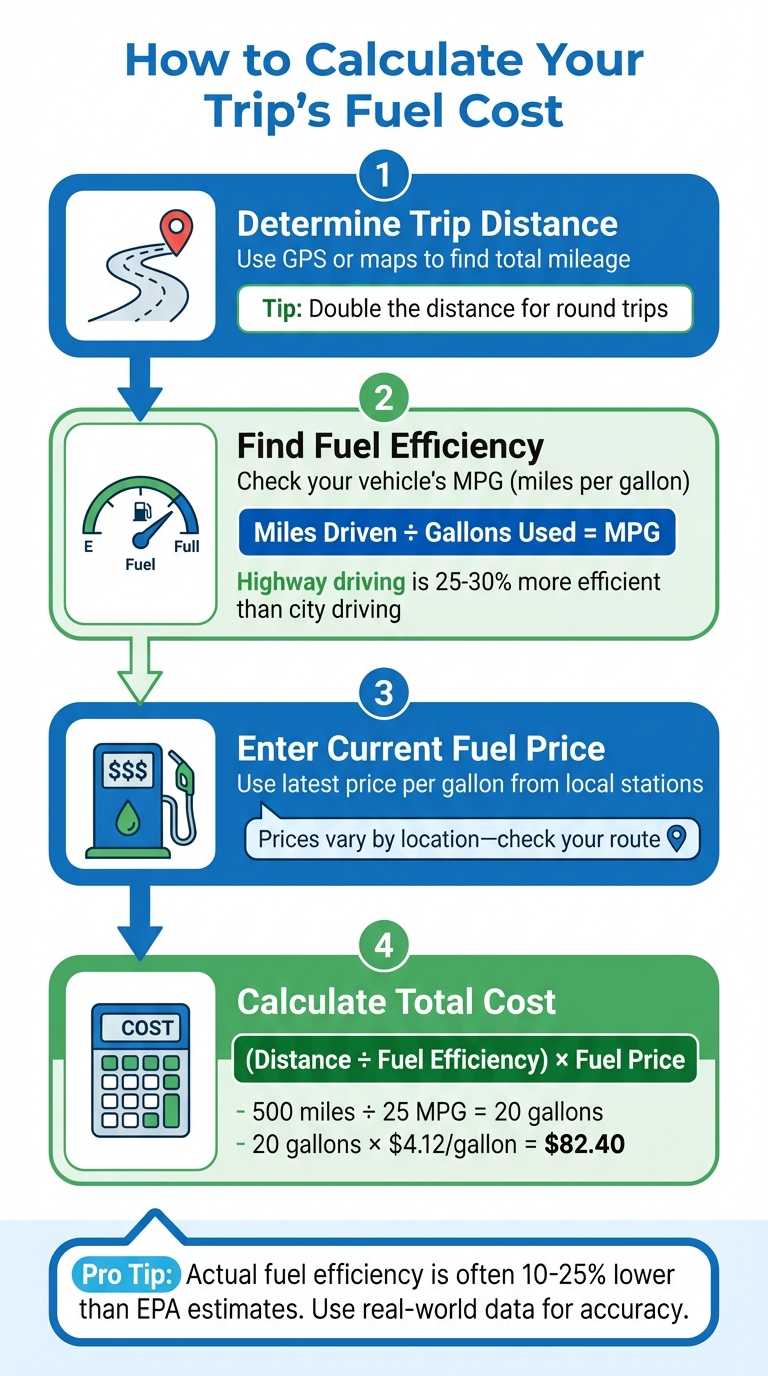
How to Calculate Fuel Costs in 4 Simple Steps
How Fuel Cost Calculators Work
Fuel cost calculators are handy tools that estimate trip expenses based on a few key inputs. Here’s a closer look at how they operate and the factors you need to consider for accurate results.
The precision of these estimates depends on the quality of the data you provide. For instance, actual fuel efficiency is often 10%–25% lower than EPA estimates, so using your vehicle’s real-world performance data is crucial. Additionally, since fuel prices can vary widely by location and fluctuate frequently, it’s important to use the most up-to-date pricing for accurate calculations.
Key Inputs: Distance, Fuel Efficiency, and Fuel Prices
To calculate fuel costs, you’ll need three main pieces of information:
- Trip Distance: This is the total mileage of your journey. Use reliable tools like maps or GPS to determine the distance. If it’s a round trip, don’t forget to double the one-way mileage.
- Fuel Efficiency: Measured in miles per gallon (MPG), this indicates how far your vehicle can travel on one gallon of fuel. You can find this data in your car’s manual, on the trip computer, or by calculating it yourself – just divide the miles driven by the gallons used during a recent fill-up. Keep in mind that highway driving tends to be 25% to 30% more efficient than city driving, thanks to steady speeds and less idling.
- Fuel Price: This is the current cost per gallon at your local gas station. Make sure to use the latest price for an accurate estimate.
Breaking Down the Calculation
Once you’ve got your inputs, the calculation itself is simple. Understanding the math can help you tweak your budget based on driving conditions or other variables.
The formula is: (Distance ÷ Fuel Efficiency) × Fuel Price. First, divide the trip distance by your vehicle’s MPG to find the number of gallons needed. Then, multiply that by the fuel price to get the total cost.
Here’s an example: Say you’re driving 500 miles in a car that gets 25 MPG. You’ll need 20 gallons of fuel (500 ÷ 25 = 20). If fuel costs $4.12 per gallon, your trip will cost $82.40 (20 × $4.12 = $82.40). Using a fuel cost calculator automates this process, sparing you the mental math.
Some calculators go a step further by revealing the cost per mile. This figure is calculated by dividing the total trip cost by the distance. It’s especially useful for comparing vehicles or routes, helping you decide which option is more economical for your journey.
sbb-itb-09752ea
How to Use a Fuel Cost Calculator: Step-by-Step
Using a fuel cost calculator is pretty simple once you know what details you need. Here’s how to get reliable results for planning your trips.
Step 1: Determine Your Trip Distance
First, figure out the total distance of your trip in miles. Tools like Google Maps or your phone’s GPS can give you the exact mileage for the most direct route. If it’s a round trip, just double the one-way distance.
For regular commutes, your car’s odometer can serve as a reliable guide. You can also use it to measure distance for a single trip. If your journey includes stops or detours, be sure to add those extra miles so your fuel estimate covers the entire route.
Once you’ve got the distance, move on to assessing your vehicle’s fuel efficiency.
Step 2: Find Your Vehicle’s Fuel Efficiency
Next, check your car’s miles per gallon (MPG). While the EPA estimates in your owner’s manual or on the window sticker are a good starting point, they might not match your real-world driving. For a more accurate number, try this: fill your tank completely, reset your trip meter, and drive as usual. At your next fill-up, note how many gallons you used and the miles you drove. Divide the miles by the gallons. For example, if you drove 300 miles and used 12 gallons, your MPG is 25.
Keep in mind that highway driving usually gives you better MPG than city driving.
Step 3: Enter Current Fuel Prices
Now, input the current price per gallon from a nearby gas station. Gas prices can change often, so using the most recent price is key. If you’re traveling through areas with varying fuel costs, check prices along your route or use a manual override feature (if the calculator offers one) to input specific prices.
Step 4: Review and Fine-Tune Your Estimate
After entering all the details, the calculator will show your estimated fuel cost. Take a moment to review the result and think about any factors that might influence the actual cost, like extra stops, traffic, or steep terrain that could impact fuel consumption. Some calculators even provide a cost-per-mile breakdown, which can be handy for comparing different routes. If the estimate seems off, double-check your inputs.
Fuel Cost Calculators for U.S. Drivers
When it comes to estimating trip costs, there are plenty of tools that take the guesswork out of the equation. These calculators go beyond basic math by incorporating regional data and unique features. The right tool for you will depend on your specific needs.
AAA Fuel Cost Calculator
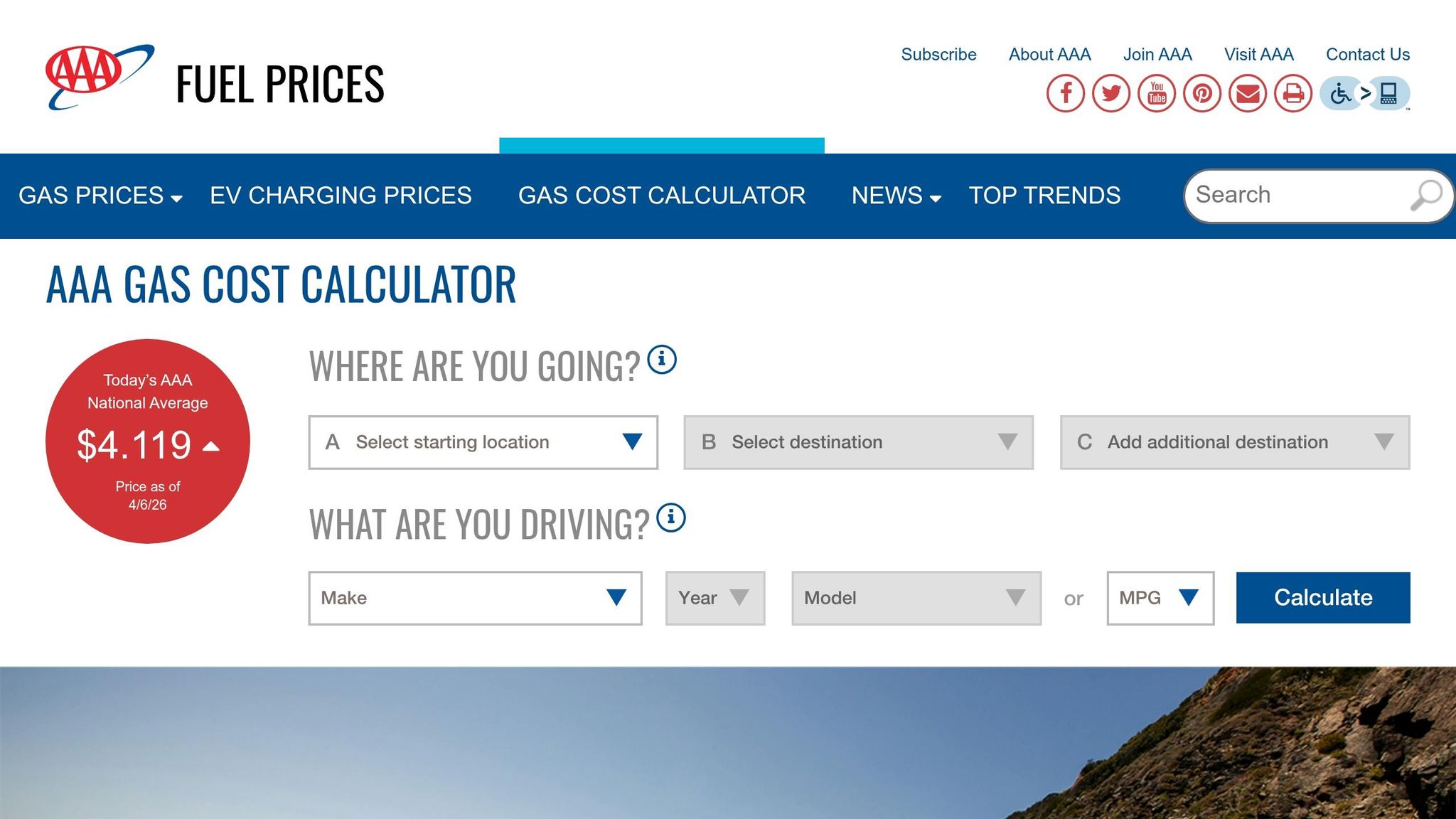
The AAA Fuel Cost Calculator provides tailored estimates by using a database of vehicle makes and models. All you need to do is input your starting and ending cities along with your car’s details – like a 2022 Honda Accord or a 2019 Ford F-150 – and the tool calculates costs based on current average local gas prices. For example, as of April 6, 2026, the AAA National Average is $4.119 per gallon. This tool is perfect for those who want a precise breakdown of regional fuel costs, as it automatically adjusts for price differences between cities.
GasBuddy Trip Cost Calculator

If your main goal is to save money on fuel, GasBuddy is a great option. Enter your destination and vehicle type, and the tool scans a network of over 150,000 gas stations across the U.S. to pinpoint the cheapest gas along your route. It even allows you to schedule stops at specific stations, making it ideal for long trips where savings add up. Plus, using the Pay with GasBuddy+™ Fuel Saver Card can help you save up to 30¢ per gallon. For real-time price updates while you’re on the road, this is a solid choice.
FuelEconomy.gov Trip Calculator
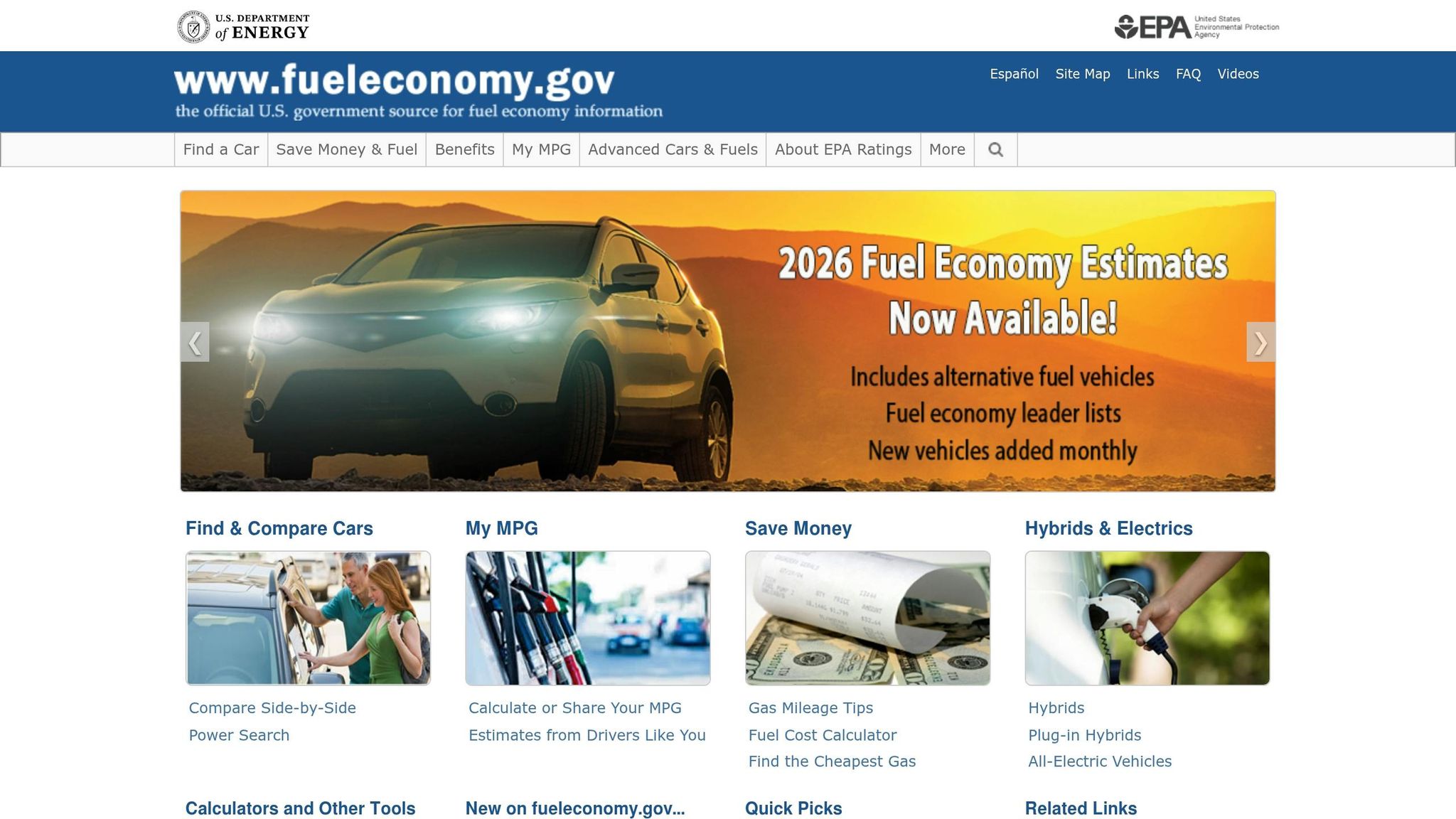
Run by the Oak Ridge National Laboratory for the U.S. Department of Energy and the EPA, FuelEconomy.gov offers a reliable, data-driven tool. You can compare multiple vehicles side-by-side, set your starting point and destination, and even tweak your route using an interactive map. Its ability to customize MPG and fuel prices is especially helpful if you’re considering a new car or comparing costs for different vehicles on the same trip. With official data at its core, this tool is straightforward and dependable.
Here’s a quick comparison of the three calculators:
| Feature | AAA Fuel Cost Calculator | GasBuddy Trip Calculator | FuelEconomy.gov |
|---|---|---|---|
| Primary Data Source | OPIS average prices | 150,000+ station network | EPA & DOE official data |
| Vehicle Selection | Make, Model, and Year | Vehicle type/MPG | Detailed EPA database |
| Best For | Accurate regional budgeting | Finding cheapest gas on-the-go | Comparing multiple vehicles |
With these tools, you can plan smarter and manage fuel costs more effectively, whether you’re budgeting for a road trip or exploring vehicle efficiency. Each offers a unique way to approach fuel savings, making them valuable resources for drivers across the U.S.
Examples: Common U.S. Routes
Let’s take a closer look at how fuel cost calculators come in handy for both everyday commutes and long-distance road trips. These examples break down how simple inputs can translate into clear cost estimates, whether you’re heading to work or embarking on a cross-country adventure.
Daily Commute: Suburb to City Round Trip
Imagine a daily round trip from the suburbs to downtown that totals 40 miles. If your sedan gets an average of 36 MPG (a mix of city and highway driving) and gas is priced at $4.61 per gallon, the math shows a daily fuel cost of about $5.12. Over a month, that adds up to roughly $102.40, and in a year, you’re looking at around $1,228.80 for fuel.
This calculation is also great for comparing alternatives. Let’s say your local public transit offers a monthly pass for $80. Opting for transit could save you over $22 per month, which adds up over time.
Road Trip: Cross-Country Interstate Drive
Now, picture a road trip from San Diego to New York City, covering about 2,760 miles. Driving a vehicle that averages 22 MPG with gas priced at $3.26 per gallon, the fuel cost for this trip would be approximately $407.50. For a shorter journey, like Los Angeles to Seattle (about 1,335 miles), with fuel at $4.42 per gallon, you’d spend around $270 on gas.
Regional gas price differences can make a big impact. For example, filling up in Texas at $2.68 per gallon versus California at $4.84 per gallon can lead to noticeable savings. Using tools like GasBuddy to find cheaper fuel along your route can make a difference. Even saving $0.10 per gallon adds up – especially for trips requiring around 125 gallons of fuel.
Whether you’re calculating costs for a daily commute or a long-haul drive, these examples highlight how fuel calculators simplify planning and help you make informed decisions.
How to Reduce Fuel Costs
Understanding the cost of a trip is helpful, but finding ways to cut those costs can make a real difference. Small changes in how you drive, care for your vehicle, and plan your routes can lead to noticeable savings over time.
After calculating your trip expenses, try these strategies to reduce them.
Drive Efficiently
Your driving style plays a big role in how much fuel you use. For instance, driving at 68 mph instead of 81 mph can cut fuel consumption by 15% to 20%. On highways, aim to maintain speeds between 62 and 68 mph, as fuel consumption increases significantly at speeds over 75 mph.
Avoid rapid acceleration and frequent braking, especially in stop-and-go traffic, as these habits waste fuel. Use cruise control on open roads to keep a steady pace, and if you’re stopped for more than 30 seconds – whether at a train crossing or while waiting for someone – turn off the engine. Restarting your car generally uses less fuel than idling.
In addition to smooth driving, taking care of your vehicle is another key factor.
Maintain Your Vehicle
A well-maintained car runs more efficiently and uses less fuel. Replacing clogged air filters and worn-out spark plugs can increase fuel efficiency by up to 10%. Also, check your tire pressure regularly – under-inflated tires increase rolling resistance, which can boost fuel consumption by 3% to 5%. Inflate them to the levels recommended by the manufacturer.
Don’t forget to lighten your load. Carrying an extra 110 pounds of unnecessary weight can raise fuel use by 1% to 2%. Clearing out heavy items from your trunk before a road trip can help lower your fuel costs.
Plan Your Routes Carefully
Smart route planning can also reduce fuel consumption. Avoid heavy traffic, construction zones, and frequent stops, as these conditions lead to higher fuel use. Navigation apps can help you find the most efficient routes. If you’re traveling in coastal areas, consider refueling there – coastal fuel prices are typically about 60 cents per liter lower due to reduced transportation costs.
For long-distance travel, the type of vehicle you use matters too. Diesel vehicles, for example, consume 15% to 25% less fuel per mile compared to similar gasoline vehicles, especially on highways. This can make a big difference on extended road trips.
Conclusion
Fuel cost calculators take the uncertainty out of planning by giving you precise trip cost estimates. Whether you’re gearing up for an 870-mile drive from Johannesburg to Cape Town or just crunching numbers for your daily commute, these tools let you know exactly what to expect before you hit the road.
To get the most accurate results, use your vehicle’s actual fuel consumption data and stay updated on current fuel prices, which are refreshed monthly. Also, keep in mind that regional price differences can impact your budget – coastal fuel tends to be about 60¢ per liter cheaper than inland prices. Strategically planning your refueling stops can lead to extra savings.
Combine these insights with smarter driving habits. Keeping your speed around 68 mph, ensuring your tires are properly inflated, and reducing unnecessary weight can cut your fuel consumption by 15–20%.
FAQs
How do I find my car’s real-world fuel economy?
To figure out how much fuel your car uses in everyday driving, follow these steps:
- Start with a full tank: Fill your tank completely and either reset your trip odometer or note the current odometer reading.
- Drive a specific distance: Cover a measurable distance, like 100 kilometers (or miles if preferred).
- Refill and record: Fill up your tank again and write down how many liters (or gallons) it took to refill.
- Do the math: Divide the amount of fuel used by the distance you traveled. This gives you your car’s fuel consumption, whether in liters per 100 kilometers (L/100km) or kilometers per liter (km/L).
This method gives you a clear picture of your car’s fuel efficiency based on your driving patterns and conditions.
Should I use liters/100 km or km/L in South Africa?
In South Africa, fuel consumption is usually calculated in liters per 100 kilometers (L/100 km). This approach aligns with the standard way of measuring fuel efficiency and costs in the region, ensuring it matches local practices.
How do I estimate costs if fuel prices change on my route?
To figure out costs when fuel prices shift, try using a fuel cost calculator that allows you to manually adjust the price per gallon. Simply enter your route’s distance and your vehicle’s fuel efficiency, then update the default fuel price to reflect the current rate. This tool will give you a precise estimate of your travel expenses, making it easier to manage changes in fuel prices.
Related Blog Posts
- Fuel-Saving Tips for Long South African Road Trips
- 5 Tips To Save On Fuel Costs In South Africa
- Electric vs Hybrid: Fuel Costs Compared
- Affordable Cars in South Africa: Top Budget Models Under R200k