South Africa’s double-cab bakkie market is one of the most fiercely contested battlegrounds in the local automotive industry. Toyota has held the top spot for decades, Isuzu commands fierce loyalty among commercial operators, and Ford’s Ranger is a perennial favourite among lifestyle and adventure buyers. Into this crowded and deeply opinionated segment steps the Kia Tasman — a vehicle that has generated more conversation about its unconventional looks than about the engineering decisions underneath that actually matter most.
It is time to redirect that conversation. Because when you look past the styling debate and into the Tasman’s powertrain and drivetrain specifications, something interesting emerges: this Korean double cab does things that the Hilux and D-Max simply cannot.
Why Bakkie Buyers Should Focus on the Engine, Not the Design
Design generates opinions. Engineering generates sales. The Toyota Hilux has dominated South Africa’s bakkie charts for decades without being the most handsome vehicle in its segment — because South African bakkie buyers ultimately prioritise reliability, powertrain performance, and capability.
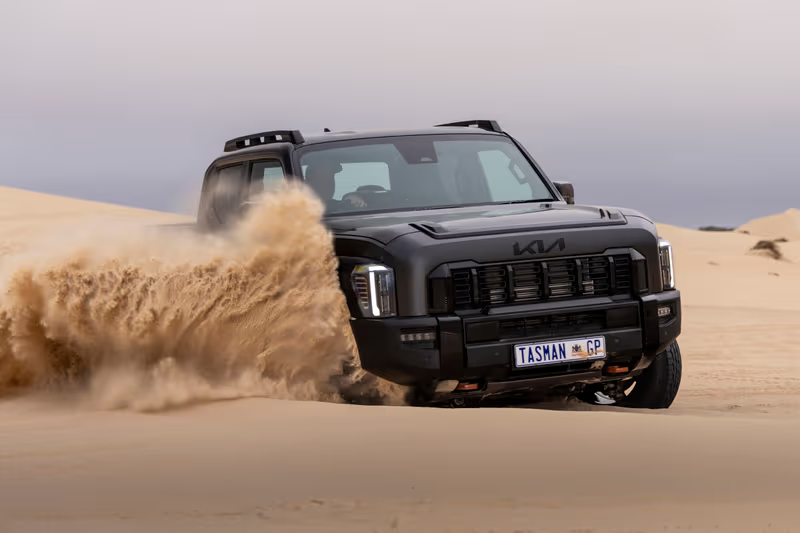
The Tasman has an unusual design. Its headlamps in particular have attracted significant commentary. But there is logic behind the unconventional appearance: the headlamps are deliberately positioned away from the leading edges of the front structure and feature a smaller surface area than conventional bakkie lamps. The engineering reason is practical — reduced exposure to stone chip damage on dirt roads and through roadworks. Anyone who regularly drives on gravel roads in Limpopo, the Northern Cape, or KwaZulu-Natal’s rural areas knows exactly how destructive flying stones can be on exposed headlamp clusters. Kia chose function over convention. For buyers who use their bakkies as intended, that is a sensible decision.
The Tasman’s development was also significantly influenced by Kia’s Australian operation — a market that shares remarkable similarities with South Africa in terms of terrain, heat, driving behaviour, and the dominance of the Toyota Land Cruiser 70 Series as the benchmark for serious capability. That Australian engineering influence means there is deep, considered bakkie thinking behind the Tasman’s specification — particularly in the Pro 4×4 variant.
The Engine: A 4-Cylinder Diesel That Punches Above Its Class
The overwhelming majority of double-cab bakkies sold in South Africa are powered by 4-cylinder turbodiesel engines. V6 and V8 options exist and attract attention, but the workhorse of the segment is the four-pot diesel — and that is where the Tasman makes its most compelling argument.
Kia’s 2.2-litre CRDi turbodiesel is a proven, mature engine architecture. It powers premium-positioned Kia models including the Sorento and Carnival — vehicles where refinement, smoothness, and long-term durability are non-negotiable requirements. The same engine now finds its way into the Tasman, bringing those premium engineering standards into the bakkie segment.
The numbers make for interesting reading when compared against the segment’s established players:
| Bakkie | Engine | Power Output |
| Kia Tasman | 2.2-litre turbodiesel | 154 kW |
| Ford Ranger 2.0 SiT | 2.0-litre turbodiesel | 125 kW |
| Isuzu D-Max | 3.0-litre turbodiesel | 140 kW |
| Toyota Hilux (standard) | 2.8-litre turbodiesel | 150 kW |
| Toyota Hilux (top spec) | 2.8-litre turbodiesel | 165 kW |
The Tasman’s 154 kW output sits ahead of the Ford Ranger’s popular SiT engine and the Isuzu D-Max’s 3.0-litre unit — which is remarkable given that the Isuzu’s engine is considerably larger in displacement. Only the top-specification Hilux 2.8 edges ahead on outright power, and even then, the Tasman’s engine has the smoothness and refinement advantage that comes from being developed for luxury SUV and MPV applications.
For South African bakkie owners who spend meaningful time in Johannesburg, Cape Town, or Durban traffic — where engine smoothness and transmission shift quality matter as much as off-road grunt — the Tasman’s CRDi unit is a significant advantage in everyday driving comfort.
Practical tip: The Kia 2.2 CRDi engine uses a diesel particulate filter (DPF) as part of its emissions system. If you primarily drive the Tasman in urban stop-start traffic, plan a monthly highway run of at least 30 minutes at sustained speeds above 100 km/h. This allows the DPF to complete its regeneration cycle and prevents carbon build-up that can lead to expensive repairs over time.
The AWD System: Where the Tasman Leaves the Hilux and D-Max Behind
This is the Tasman’s most significant technical differentiator — and it is one that deserves careful explanation because its real-world implications are substantial.
The Toyota Hilux and Isuzu D-Max both use traditional part-time 4×4 systems with a transfer case. In 4H (four-wheel high), these systems lock the front and rear axles at a fixed 50/50 torque split. This works well on loose terrain where wheel speed differences between axles are manageable. But it creates a critical limitation on dirt roads at higher speeds: when you enter a corner in 4H with the axles locked, the system cannot vary torque between the front and rear. The result is pronounced understeer — the vehicle pushes wide rather than turning cleanly. It can also cause stress on the drivetrain on hard surfaces.
Critically, neither the Hilux nor the D-Max can operate in 4×4 mode on tar roads. You switch to four-wheel drive for off-road use, then switch back to two-wheel drive for tar driving. That is the traditional bakkie formula.
The Kia Tasman does things differently. It offers a 4A (Automatic AWD) mode that can be engaged on tar roads — something its established Japanese rivals simply cannot do. This is not a gimmick. In real-world South African driving conditions, it has genuine, meaningful benefits:
Towing on mountain passes in wet conditions: If you are hauling a heavy caravan or trailer up a steep pass — the Outeniqua Pass, Huguenot Tunnel approach, or Sani Pass lower slopes — in heavy rain, the Tasman’s AWD system can actively vary torque between front and rear axles through tight, off-camber corners. The Hilux and D-Max in two-wheel drive on wet tar cannot match this traction security.
High-speed dirt road driving: This is where the technical difference is most dramatic. When navigating a fast gravel road — the kind found throughout the Karoo, Limpopo, and the Eastern Cape — the Tasman’s AWD system continuously varies the torque split based on traction requirements. The result is dramatically better steering response and confidence through corners at speed. In the same scenario, the Hilux or D-Max in 4H with a locked 50/50 split will understeer and require more cautious speed management.
For buyers who use their bakkies for adventure travel, farm visits, or high-speed game reserve roads, this drivetrain advantage is not theoretical — it is something you feel every time the surface changes.
Practical tip: When using any bakkie’s 4×4 system on rocky or loose terrain, check tyre pressures before you leave the tar. Lowering tyre pressure to around 1.4–1.6 bar (from the typical 2.2–2.4 bar highway setting) significantly increases the tyre’s contact patch on loose surfaces, improving traction and reducing the risk of punctures on sharp rocks. Carry a portable compressor to reinflate before returning to tar roads.
Towing Capacity: Matching the V6 Competition
The Tasman’s tow rating is competitive with bakkie engines producing significantly more displacement and power. For South African buyers who tow boats, horse floats, caravans, or plant trailers, this is a crucial specification — and the Tasman holds its own without requiring the extra fuel cost and complexity of a V6 powertrain.
The 4-cylinder turbodiesel’s torque delivery is well-suited to towing: maximum pulling force is available from low in the rev range, which is what matters when moving a heavy trailer from a standing start or maintaining momentum on an uphill gradient.
Where the Kia Tasman Fits in the Broader Market
The Kia Tasman is entering a market that has not been kind to newcomers. Mazda retired the BT-50 from South Africa despite a long history in the segment. Kia is under no illusions about the challenge. The Tasman will be a niche product — its unconventional design ensures that — but niche bakkies can succeed when they offer something genuinely different rather than simply repackaging what established players already offer.
The Tasman offers that difference in two meaningful areas: engine refinement and drivetrain sophistication. These are not marketing talking points. They are engineering decisions that affect the daily experience of owning and driving the vehicle.
For South African buyers currently shopping the double-cab segment, auto24.co.za offers a useful comparison resource — listing both new and used models including the Toyota Hilux, Ford Ranger, Isuzu D-Max, and GWM P-Series, allowing buyers to compare specifications and pricing before committing to a decision. Seeing the Tasman’s specs alongside the established competition in one place is a revealing exercise.
For comprehensive bakkie reviews, off-road driving guides, and the latest double-cab news tailored for South African conditions, imotonews.co.za is an essential resource for any serious bakkie buyer doing their research.
A Note on the Electrified Future of Bakkies
The double-cab bakkie segment is beginning its own journey toward electrification — with hybrid and plug-in hybrid bakkies entering global markets and fully electric alternatives on the horizon. For South African bakkie buyers who are curious about what electric mobility options already exist locally — whether as daily vehicles alongside a workhorse bakkie or as a future replacement — EV24.africa offers import options for electric vehicles in South Africa, expanding the choices available to drivers thinking ahead about their next vehicle purchase.
Frequently Asked Questions
How does the Kia Tasman’s engine compare to the Toyota Hilux? The Tasman’s 2.2-litre CRDi turbodiesel produces 154 kW, compared to the standard Hilux 2.8’s 150 kW. The top-spec Hilux 2.8 produces 165 kW. However, the Tasman’s engine is notably smoother and more refined, having been developed for premium Kia SUV and MPV applications.
Can the Kia Tasman use 4-wheel drive on tar roads? Yes — this is a key differentiator. The Tasman’s 4A (Automatic AWD) mode is designed for use on tar roads, including wet or slippery surfaces. The Toyota Hilux and Isuzu D-Max cannot operate in 4-wheel drive on tar roads using their traditional part-time systems.
What is the Kia Tasman’s towing capacity? The Tasman’s braked towing capacity is competitive with class-leading figures in the 4-cylinder segment, matching performance typically associated with larger V6 turbodiesel engines.
Why does the Kia Tasman look so different from other bakkies? The unconventional design — particularly the headlamp placement — reflects deliberate engineering choices. The smaller, recessed headlamps reduce stone chip damage risk, a genuine practical benefit for drivers on gravel roads and through roadworks.
Who influenced the Kia Tasman’s development? Kia’s Australian operation played a significant role in developing the Tasman, given Australia’s similarities to South Africa in terms of terrain, climate, and driving culture. Australia is also the world’s highest-volume market for the Toyota Land Cruiser 70 Series — a vehicle that sets the benchmark for serious off-road capability.
Verdict: More Than Just a Talking Point
The Kia Tasman is going to remain a talking point in South African bakkie circles — but the conversation should shift from its design to its engineering. A 154 kW 4-cylinder diesel that outmuscles larger-displacement rivals, an AWD system that operates on tar and delivers genuine high-speed dirt-road composure, and the refinement standards of a premium Kia SUV — these are meaningful advances on what the Hilux and D-Max currently offer.
It will not replace the Hilux as South Africa’s best-selling bakkie. But for buyers who prioritise technical sophistication, all-surface traction confidence, and engine refinement over brand convention, the Tasman makes a genuinely compelling case.