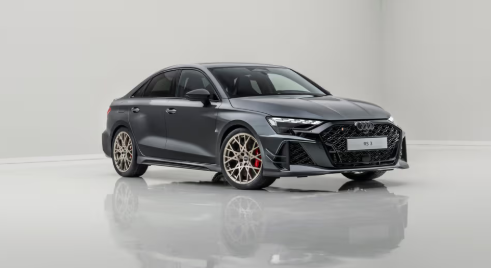
In the world of performance cars, rare mechanical engineering creates lasting value. Ferrari’s flat-plane V8s, Porsche’s air-cooled flat-sixes, BMW M’s high-revving straight-sixes — these are the powertrains that enthusiasts remember, that hold their value, and that eventually become the stuff of museum collections and private auctions. Audi has its own version of this story, and it lives under the bonnet of the RS3 Competition Limited in the form of the world’s last remaining production 5-cylinder petrol engine.
The question is not just whether the RS3 Competition Limited is a great car — it clearly is. The real question is whether this could be the final chapter for Audi’s most iconic and distinctive engineering asset, and what that means for South African buyers considering whether to secure one now.
The 5-Cylinder Engine: Why Nobody Else Makes One Anymore
To understand why the RS3 Competition Limited matters, you need to understand why the 5-cylinder engine is simultaneously one of the most appealing and most challenging configurations in automotive engineering.
Five-cylinder engines occupy a fascinating middle ground. They produce more power than a 4-cylinder but are more compact and easier to package than a 6-cylinder — a meaningful advantage in a compact performance hatchback where space is at a premium. In terms of power delivery, a well-engineered 5-cylinder is smoother than a high-output 4-pot and produces a distinctly characterful sound unlike anything else in production: the uneven 1-2-4-5-3 firing order creates an acoustic signature that is immediately recognisable and deeply addictive.
So why does only Audi still make one?
The answer lies in that same odd cylinder count. Even-cylinder engines — 4s, 6s, 8s — are inherently balanced because their opposing pistons cancel out vibration naturally. A 5-cylinder engine has an inherent mechanical imbalance. Resolving this requires balance shafts — precision-engineered components that add cost, complexity, and weight to the engine architecture. As manufacturers have rationalised their engine portfolios under increasing emissions pressure, the 5-cylinder’s development costs have become difficult to justify commercially.
Ford discontinued its 5-cylinder 3.2-litre turbodiesel (found in older Rangers and Transits) in 2020. Volvo phased out its 5-cylinder petrol units several years before that. Today, Audi stands entirely alone in producing a 5-cylinder petrol engine for a production passenger vehicle — and has done so for 50 years, tracing the lineage back to the legendary Ur-Quattro that transformed Audi’s reputation in the early 1980s.
The RS3 Competition Limited is officially presented as a homage to that 50-year heritage. Whether it is also a farewell is the question that makes it so compelling.
What the Competition Limited Adds to the RS3 Formula
The RS3 Competition Limited is not a power upgrade. It uses the same 2.5-litre, 5-cylinder TFSI turbocharged engine — known internally as the EA855 Evo — that has powered the RS3 since its first generation in 2011. In this application, it produces 294 kW, the same output as the standard RS3 of recent years. Audi has not changed the engine because there is genuinely nothing to fix: it produces all the performance a compact hot hatch needs, and its sound signature cannot be improved upon.
What Audi has changed — significantly — is the suspension setup.
Coilover Suspension: The Meaningful Upgrade
The Competition Limited replaces the standard electronic adaptive dampers with manually adjustable coilover suspension and adds a rear stabiliser bar. For those unfamiliar with the distinction: electronically adjustable dampers typically offer a range of preset modes selected via a button. Coilovers allow the driver — or their suspension specialist — to physically adjust compression and rebound damping using tools, making precise, measurable changes to how the car rides and handles.
This matters enormously in the South African context.
Most high-performance European cars arrive in South Africa calibrated for European road surfaces, which are significantly smoother than what South African drivers encounter daily. The result is often a car that is too stiffly sprung for local conditions — harsh over potholes, punishing on rough urban surfaces, and hard on low-profile tyres and alloy wheels. Johannesburg’s roads, Cape Town’s cobblestones, and the surface variations on virtually any South African road outside a major national highway are simply more demanding than what these cars were engineered for.
The Competition Limited’s adjustable coilovers directly address this. Owners can soften the compression damping for daily driving on imperfect roads — improving ride comfort, protecting tyres, and reducing wheel damage. When the road improves — on a mountain pass, heading to a track day, or on a clean stretch of highway — they can increase damping to eliminate body roll, reduce pitch under braking, and sharpen the handling balance.
This is not a theoretical benefit. It is a practical tool that makes a fast car genuinely usable across the full range of South African conditions, rather than forcing a compromise between track performance and daily comfort.
Practical tip: If you purchase an RS3 Competition Limited (or any coilover-equipped performance car), invest in a baseline alignment and corner-weight setup from a reputable suspension specialist before making your own damper adjustments. A proper baseline ensures that any changes you make from that point produce predictable, measurable results — rather than masking existing alignment issues.
The rear stabiliser bar addition is equally considered. On a quattro all-wheel-drive system with high-grip tyres, managing the transition between mid-corner traction and exit acceleration requires a well-controlled rear axle. The additional stabiliser bar helps maintain composure through corners under full-throttle acceleration, allowing the quattro system to deploy maximum traction without unsettling the chassis.
Why 5-Cylinder Audis Are Genuinely Collectable
Audi’s RS models are not traditionally regarded as investment-grade collector cars in the way that certain BMW M and Mercedes-AMG models are. The exception — and this is well-established among serious collectors — is the 5-cylinder RS models.
The Audi TT RS, RS Q3, and RS3 all use the same fundamental 5-cylinder architecture, and all have demonstrated stronger retained value than their 4-cylinder or 6-cylinder Audi stablemates. The reason is the one discussed above: no other manufacturer makes a 5-cylinder engine, and within Audi’s own lineup, the 5-cylinder is the engineering that makes the RS3 impossible to replicate with different hardware.
When the 5-cylinder engine is gone, no future RS hot hatch — however powerful or technologically sophisticated — will be able to claim the same character. Audi has already signalled its electrification direction with hybrid powertrains being integrated across the RS range. The RS4 has become the RS5 with battery assistance, gaining power while losing some of the pure combustion purity that defined earlier generations.
The RS3 Competition Limited may genuinely be the last Audi RS model powered purely by the 5-cylinder engine without hybrid assistance. That is a significant claim — and one that should resonate with South African buyers who understand why mechanical rarity creates lasting value.
The Production Clock Is Ticking
The commercial and regulatory reality facing the RS3’s 5-cylinder engine is not favourable. The 2.5-litre, 5-cylinder TFSI does not meet Euro 7 emissions standards, which means Audi cannot continue selling it in European Union markets beyond this year. Production of the engine at Audi’s Hungarian plant is scheduled to end in 2027.
This is not a rumour or speculation — it is confirmed manufacturer information. The supply of new 5-cylinder Audis is finite and the endpoint is visible.
For South African buyers, this creates a specific opportunity. The local market has historically been more receptive to combustion-powered performance cars than many European markets, and the ability to source and import vehicles outside EU compliance requirements gives South African enthusiasts access to models that may have shorter windows of availability elsewhere. But the supply of RS3 Competition Limited units is globally limited — and local allocation will not last indefinitely.
For buyers currently comparing the RS3 Competition Limited against other options in the premium performance space, auto24.co.za lists both new and used Audi RS3 models alongside competing vehicles like the BMW M2 and Mercedes-AMG A45 S, providing a useful benchmark for pricing and specification comparison across the hot hatch and compact performance segment.
Practical tip: If you are purchasing a used RS3 Competition Limited as a future collector piece, condition of the exhaust system and turbocharger is critical — both are subjected to extreme heat cycles on a 5-cylinder hot hatch used as intended. Commission a pre-purchase inspection that specifically includes a smoke test of the turbo seals and a check of the exhaust manifold for heat-related cracking. Prevention of turbo failure is far less expensive than remediation.
The Analogue Edge in an Increasingly Digital World
There is a broader cultural shift happening in performance cars that makes the RS3 Competition Limited’s appeal extend beyond its mechanical rarity. Drivers are increasingly seeking more authentic, less electronically mediated driving experiences as cars become more software-dependent and digitally complex.
The Competition Limited, with its manually adjustable coilovers and tools included to make those adjustments, leans deliberately into the analogue. It rewards engagement and mechanical knowledge. It gives the driver direct control over the car’s behaviour in a way that a button-selectable adaptive damper cannot replicate. In a market saturated with vehicle apps and electronic driving modes, this is a meaningful differentiator.
For South African performance car enthusiasts who want to stay current with the broader developments in this space — including where Audi’s RS range is heading post-5-cylinder — imotonews.co.za provides comprehensive coverage of the latest performance car news, first drives, and market analysis tailored for local enthusiasts.
Looking Ahead: What Comes After the 5-Cylinder?
Audi’s direction is clear: electrification and hybridisation across the RS range. The question of what replaces the RS3’s 5-cylinder engine in the longer term remains unanswered. A hybrid 4-cylinder would be faster and more efficient but would lose the character that defines the current car. A fully electric hot hatch would perform differently again.
For South African buyers who are curious about the electric performance landscape already available today — while the 5-cylinder continues its final chapter — EV24.africa offers import options for electric vehicles in South Africa, providing access to electric models that represent the direction performance cars are heading globally. It is a useful resource for those who want to understand both sides of the transition.
Frequently Asked Questions
Is the RS3 Competition Limited the last 5-cylinder Audi? It is very likely the last pure 5-cylinder Audi RS model without hybrid assistance. The 2.5-litre TFSI engine does not meet Euro 7 standards, and production at Audi’s Hungarian plant is scheduled to end in 2027. Future RS models are expected to use hybridised powertrains.
How does the RS3 Competition Limited differ from a standard RS3? The key difference is the suspension: the Competition Limited features manually adjustable coilover suspension and a rear stabiliser bar, replacing the standard electronic adaptive dampers. The engine produces the same 294 kW as other recent RS3 derivatives.
Why is the 5-cylinder engine so rare in production cars today? The odd cylinder count creates inherent mechanical imbalance requiring complex balance shafts, adding cost and engineering complexity. As manufacturers rationalised engine ranges under emissions pressure, the 5-cylinder became commercially difficult to justify. Audi is the only manufacturer that still produces a 5-cylinder petrol engine for a production vehicle.
Are 5-cylinder Audi RS models good collector cars? Yes — unlike many other Audi RS models, the 5-cylinder variants (RS3, TT RS, RS Q3) have demonstrated consistently stronger retained value due to the engine’s unique character and the impossibility of replicating it with conventional 4 or 6-cylinder alternatives.
Is the RS3 Competition Limited available in South Africa? Yes, the RS3 Competition Limited is available in South Africa. Given its global limited production and the 5-cylinder engine’s confirmed end of production in 2027, local allocation is finite and buyers should act promptly.
Verdict: A Future Classic Worth Securing Now
The Audi RS3 Competition Limited occupies a unique position in the current performance car market: technically accomplished, mechanically irreplaceable, and almost certainly the final expression of 50 years of Audi 5-cylinder engineering in its purest form.
The adjustable coilover suspension is the right upgrade for South African conditions, transforming what could have been a Europe-calibrated track tool into a genuinely daily-usable performance car that rewards driver engagement. The engine needs no introduction — its character is the reason the car exists.
Whether you are buying it as a driver’s car, a long-term collector piece, or both, the RS3 Competition Limited makes a compelling case on every dimension. When the 5-cylinder is gone, there will be no going back. That is the most persuasive argument of all.