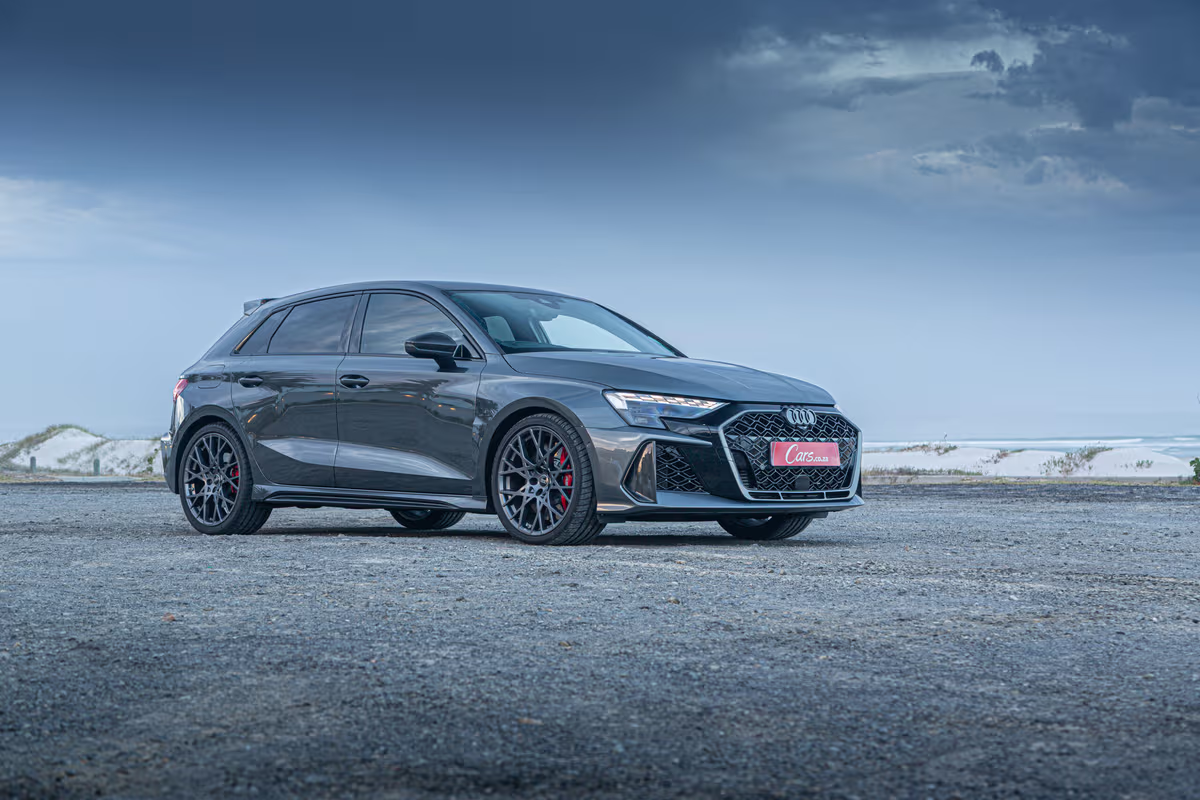
Few cars carry as much emotional weight as the Audi RS3 Sportback. It is the kind of vehicle that petrolheads dream about — a premium, everyday hatchback hiding a genuine supercar engine under its bonnet. With a recent facelift bringing fresh tech and refined handling, we spent several days behind the wheel to ask the obvious question: is the RS3 still the hot hatch king in South Africa?
The short answer? Possibly. But there is plenty to unpack.
Quick Specs at a Glance
| Detail | Specification |
| Model | 2026 Audi RS3 Sportback |
| Price | R1 498 200 |
| Engine | 2.5-litre 5-cylinder turbocharged petrol |
| Transmission | 7-speed automated dual-clutch |
| Power / Torque | 294 kW / 500 Nm |
| 0–100 km/h | 3.8 seconds (claimed) / 3.82 seconds (tested) |
| Claimed fuel consumption | 9.0 L/100 km |
| Luggage capacity | 282–1 104 litres |
Where Does the RS3 Fit in Today’s Market?
The hot hatch segment has changed dramatically over the past few years. Brands that once defined affordable performance — RenaultSport, Ford ST, Opel OPC — have largely disappeared from South African showrooms. What remains is essentially a two-tier market: the accessible end with the Suzuki Swift Sport and the Volkswagen Polo GTI/Golf GTI/R, and the premium tier, where the RS3 lives alongside the BMW M2 and the Mercedes-AMG A45 S.
In that upper tier, there are no bad choices — but there are very different personalities. The RS3 has always been the most liveable of the three, the one you could genuinely use as a daily driver without feeling punished. That remains true after the facelift.
This generation launched locally in September 2022 and received its updates in 2025, keeping the RS3 competitive in a segment where rivals do not stand still.
Interested in exploring what else is available in the performance and premium space? auto24.co.za is a great resource for browsing both new and used vehicles across South Africa — including models like the Volkswagen Golf R, BMW M135i, and other performance hatchbacks that compete in this space.
Performance and Efficiency: The 5-Cylinder Legend Lives On
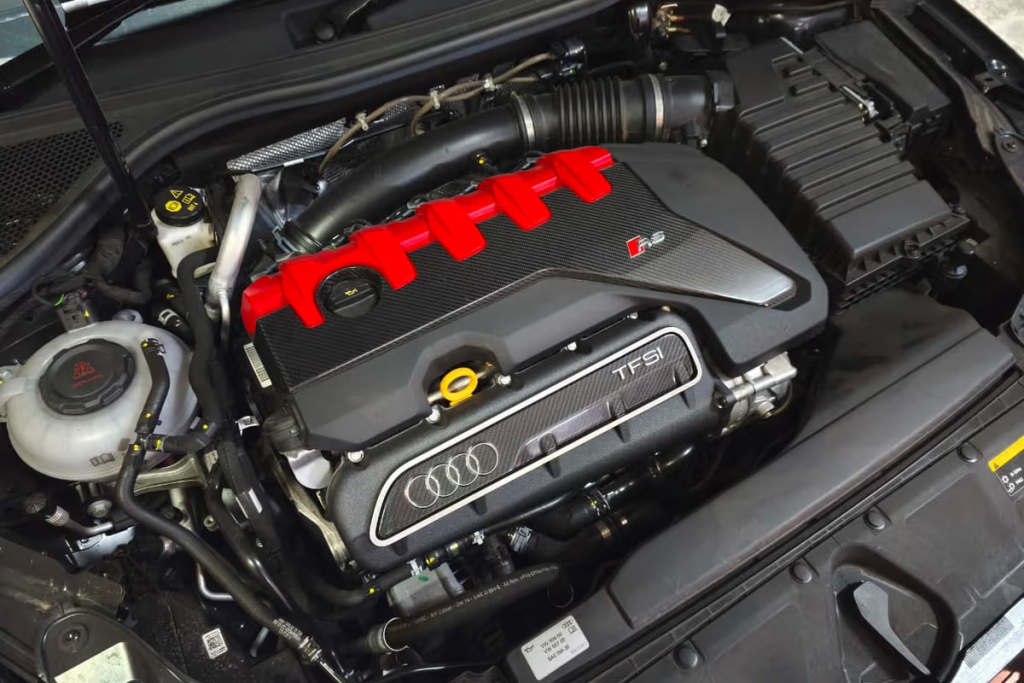
Let us start with the engine, because this is where the RS3’s story begins and ends.
The 2.5-litre, 5-cylinder turbocharged petrol is one of the most celebrated powerplants in modern motoring, and it returns here in unchanged form — 294 kW and 500 Nm. On paper, it trails its rivals from BMW and AMG, which will fuel plenty of passionate debates at braais across the country. In real life, those numbers feel entirely adequate.
What makes this engine special is not the spec sheet — it is the character. The five-cylinder configuration produces a unique, uneven firing order that creates a sound unlike any other engine in production. It burbles, growls, and snarls in a way that is immediately addictive. Euro emissions regulations have toned down the exhaust note compared to earlier generations, supplementing it with some synthesised in-cabin sound — which is a shame, as older RS3s were significantly louder. But even in its muted 2026 form, the engine is deeply emotional and endlessly satisfying.
The performance is equally impressive. Testing under favourable cooler conditions, the RS3 covered the sprint to 100 km/h in 3.82 seconds — matching its 3.8-second claim almost exactly, courtesy of the all-wheel-drive system and launch control. It is extraordinarily quick in a straight line.
Real-world fuel consumption? With enthusiastic driving, expect around 12.5 L/100 km. The official figure of 9.0 L/100 km is achievable in gentle conditions, but you did not buy an RS3 to drive gently.
Practical tip: If you want to extend service intervals and protect that exceptional engine, use the manufacturer-specified fully synthetic oil and avoid cold, hard acceleration until the engine has reached operating temperature — a discipline worth building on any high-performance vehicle.
The RS Torque Splitter: The Secret Weapon
One of the most impressive pieces of engineering in the RS3 is the RS Torque Splitter on the rear axle. Instead of a traditional rear differential, Audi uses two multi-plate clutches — one for each rear wheel — that can distribute torque independently and instantly.
The result is transformative. Turn into a corner, apply throttle early, and the outer rear wheel receives slightly more drive than the inner, rotating the car into the bend rather than pushing wide. An AWD car that behaves like this through corners should not exist — and yet it does.
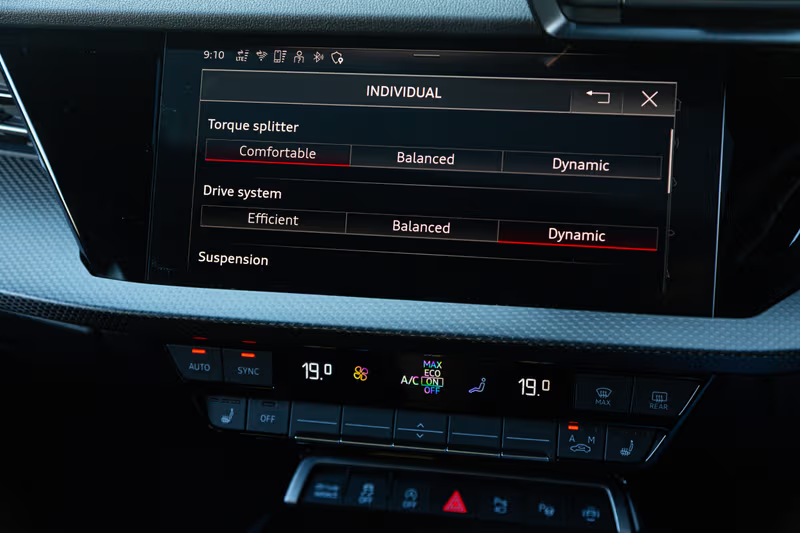
For the brave (and those with a generous tyre budget), drift mode is a genuine option. The torque splitter settings are even adjustable, letting you dial in exactly how aggressively it intervenes.
Ride, Handling and Daily Comfort
The RS3’s ride quality is one of its underrated strengths. The combination of wider 265/30 R19 front tyres and 245/35 R19 rears creates an unusually grippy contact patch, while Audi’s progressive steering adjusts its ratio as you turn the wheel — light and easy at low speeds, progressively quicker as the steering angle increases. It takes a moment to recalibrate, but the benefit in urban manoeuvrability and cornering precision is real.
Perhaps the best thing about the RS3’s dynamics is that you do not have to be aggressive to enjoy them. The car feels engaging at everyday speeds, rewarding without being demanding. You can commute from Fourways to Sandton without stress, then attack a Highveld back road on the weekend — the same car, the same weekend.
For those who want to read more about tyre maintenance and how tyre choice affects handling on South African roads, imotonews.co.za covers everything from performance driving tips to practical car care guides for local enthusiasts.
Practical tip: On high-performance vehicles with staggered tyre setups like the RS3, regular tyre rotation is not possible in the conventional sense — make sure you inspect tyre wear front and rear separately, and factor in the higher replacement cost of performance rubber when budgeting ownership costs.
Design and Interior: Subtle Updates, Strong Execution
The facelift has not reinvented the RS3’s look — it did not need to. The gaping front bumper, flared wheel arches, and oversized oval exhaust outlets (which, on closer inspection, are decorative covers over smaller pipes — a minor disappointment) remain unmistakably RS. The addition of Digital Light Signatures is a neat touch, delivering a personalised DRL sequence each time you unlock the car. It is the kind of detail that never gets old.
Inside, Audi’s MMI infotainment system continues to impress. It is responsive, logically laid out, and has aged gracefully — proof that well-executed design does not need constant reinvention. New additions include two customisable RS1 and RS2 buttons on the steering wheel, which can be mapped to driving modes, drift mode, or performance settings. Our test car had them set to drift mode and the sportiest configuration — entirely appropriate.
One minor frustration: the surrounding buttons use a gloss-black finish that picks up fingerprints immediately. It is a small but persistently irritating detail on a vehicle at this price point.
The Extras Problem: Premium Pricing for Premium Options
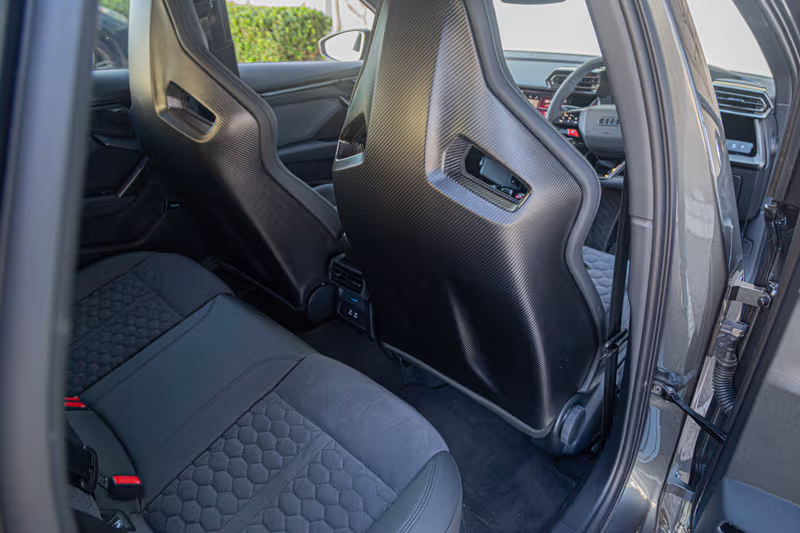
Here is where things get candid. The RS3’s base price of R1 498 200 is significant, but the options list can add considerably to the total. Our test unit arrived with R160 000 worth of additions, including Daytona Grey paint (R14 700), RS bucket seats (R40 500), climate control package (R13 000), additional airbags (R7 000), and Audi navigation and infotainment upgrade (R9 700) — bringing the as-tested total to R1 752 100.
The RS bucket seats deserve a special mention: they are exceptional, offering outstanding lateral support during spirited driving. But R40 500 for seats feels steep when you have already committed to this level of spend. Adaptive chassis control adding another R20 200 feels equally ambitious.
The lesson? If you are shopping for an RS3, seek out a well-specced used example rather than building from new. Platforms like auto24.co.za regularly feature used premium performance vehicles, which can represent outstanding value once the initial depreciation hit has been absorbed by someone else.
A Moment on the Future of Performance Cars
The RS3’s continued existence is genuinely worth appreciating. When this generation launched in 2022, the five-cylinder engine’s future was uncertain — EU emissions deadlines and Audi’s planned shift toward electrification nearly ended it. A slowdown in EV adoption and a postponement of the emissions timeline gave enthusiasts a reprieve, but the writing is on the wall. This is almost certainly the last RS3 to use the iconic five-cylinder.
For drivers who are thinking ahead about where personal mobility is heading, EV24.africa offers import options for electric vehicles for South African buyers — expanding the choices available for those who want to explore sustainable performance alongside, or eventually instead of, the combustion-powered icons we love today.
Frequently Asked Questions
What is the price of the Audi RS3 in South Africa? As of April 2026, the RS3 Sportback starts at R1 498 200 and the RS3 Sedan from R1 528 200. Fully optioned or special edition variants like the Carbon Edition or Competition Limited can reach up to R1 610 700.
How fast is the Audi RS3 from 0 to 100 km/h? The RS3 covers the sprint in 3.8 seconds. Top speed is electronically limited to 250 km/h as standard, with optional RS Dynamic packages raising this to 290 km/h.
What engine does the Audi RS3 use? The RS3 is powered by the multi-award-winning 2.5-litre 5-cylinder TFSI turbocharged engine, producing 294 kW and 500 Nm, driven through the quattro all-wheel-drive system and RS Torque Splitter.
What warranty and service plan does the RS3 include? It comes with a 1-year/unlimited km warranty and the 5-year/100 000 km Audi Freeway Plan, covering all scheduled servicing and maintenance items.
Does the Audi RS3 have a drift mode? Yes. The RS Torque Splitter enables a dedicated RS Torque Rear (drift) mode, which sends maximum torque to the rear wheels for oversteer-enabled cornering. Settings are fully adjustable.
Verdict: Buy One While You Still Can
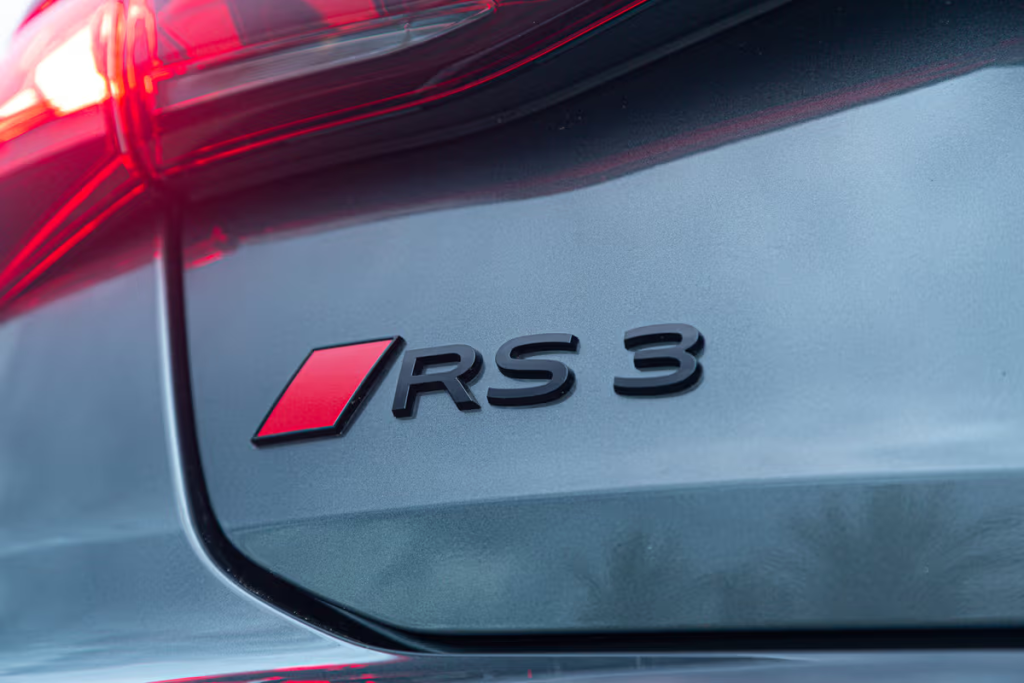
The facelifted Audi RS3 Sportback is not a revolution — it is a refinement. And given that the underlying car was already excellent, refinement was exactly what it needed.
The five-cylinder engine remains one of the greatest in modern motoring: characterful, quick, and deeply satisfying to use. The RS Torque Splitter elevates the handling to a level that rivals struggle to match. And the day-to-day livability keeps the RS3 honest as a practical choice, not just an emotional one.
If this is genuinely the last five-cylinder RS3 — and the evidence suggests it is — then it will undoubtedly become a collector’s item. Buy one now, spec it carefully, maintain it properly, and you will have one of the most rewarding performance cars ever produced in South Africa.